![[NB] Creative Futures CIC](http://images.squarespace-cdn.com/content/v1/68c276df7928f778938222f2/98488c41-8030-41a8-b1b4-ee4c899d7119/NBCF+BRAND+MASTER+copy-16.png?format=1500w)
The State of the Art
There are winters in New Brighton when the sea feels like a neighbour. And there are winters when it feels like a judge.
This has been one of the judging ones.
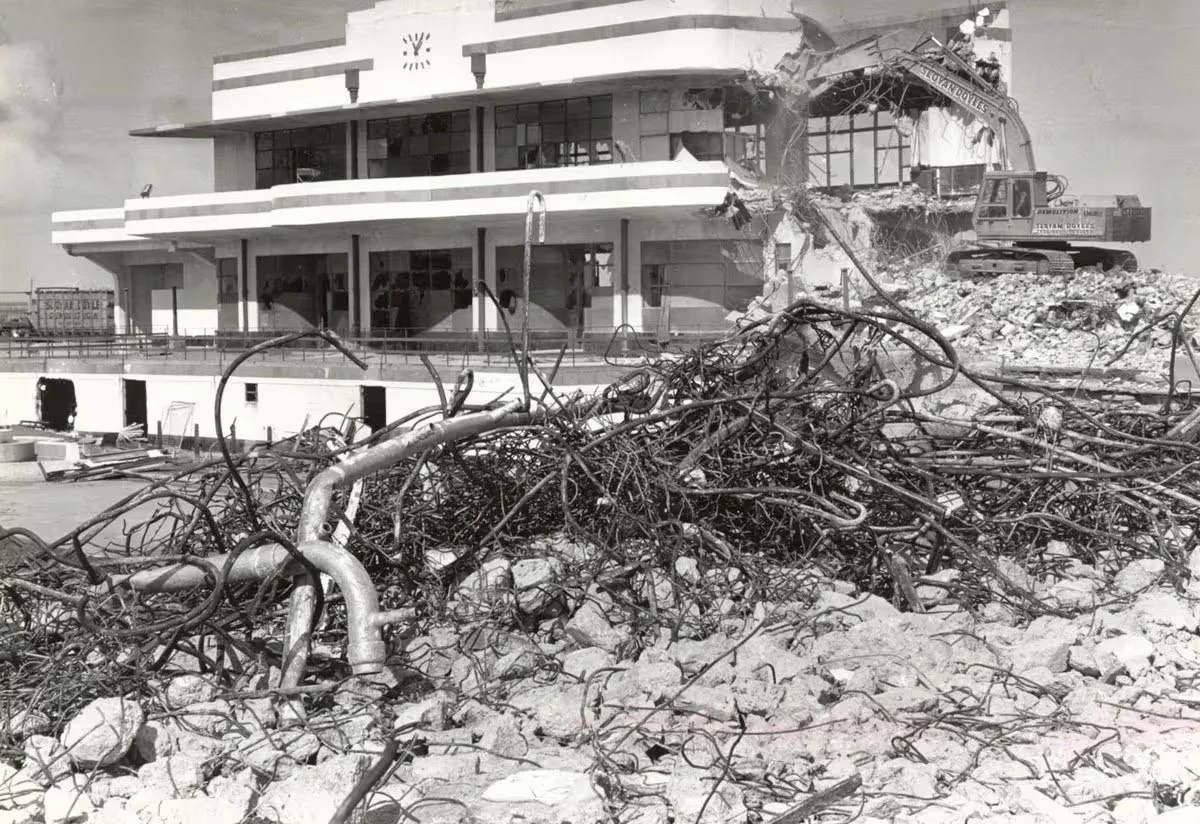
Damage at New Brighton Baths after the great storm of February 1990
If you live on the North-West coast, you grow up with wind in your bones. Liverpool Bay and the Irish Sea have never been polite. But this season has been a procession: named storms arriving one after another, each one with its own personality, each one leaving a little mark behind. By the Met Office’s own storm log for the 2025–26 season, we’ve already had Storm Amy (3–4 October 2025), Storm Benjamin (22–23 October 2025), Storm Claudia (14 November 2025), Storm Bram (8–10 December 2025), Storm Goretti (8–9 January 2026), and Storm Chandra (26–27 January 2026).
Chandra was the latest punch in the ribs — and it landed only days ago.
When winds hit like that, people here start talking in time. Not “last week”, but “the last time it felt like this”. For many of us, the memory it drags up is the famous one — 15 October 1987, when the Great Storm tore across Britain and the clip that still circulates today was born: BBC forecaster Michael Fish telling viewers not to worry about a hurricane… shortly before the worst arrived.
That moment has become folklore, but the real lesson wasn’t about one forecast. It was about how quickly the line between “rough weather” and “damage” can be crossed.
And that line is exactly where our murals now live.
For nearly a decade, New Brighton’s walls have carried the town’s stories in public: faces, names, local legends and global figures, painted big enough to belong to everyone. The trail is not decoration. It’s a civic asset — a reason to visit, a reason to linger, a reason to feel proud of the place you’re standing in.
But the coast is a brutal curator.
This winter’s storms have accelerated what we’ve been watching creep in for years: mortar softening and shedding, hairline cracks widening into water routes, paint lifting where the wall can’t hold it any more. Once moisture gets behind a surface, the wall doesn’t fail politely. It fails fast.
That’s the uncomfortable truth: if we ignore the early warnings, we don’t preserve the murals — we simply postpone the loss, and make it far more expensive when it arrives.
Now, we need to be careful with language here, because weather is complex. The Met Office is clear that detecting long-term trends in windstorm number or intensity is difficult, and the evidence isn’t straightforward.
But what is clear — and what every coastal community is now feeling in their bones — is that the impacts are getting harder to shrug off: wetter winters, faster flooding, repeated disruption, and a sense of cumulative battering rather than occasional drama.
For a mural trail, “cumulative” is the killer
Some of our most important works are already showing critical vulnerabilities. Martin Luther King Jnr. Mike Jones the RNLI skipper.
Captain Mike Lowe, standing out on the front like a proud sentinel — and taking the full force of salt air, driving rain, and wind that hits the promenade with nothing to slow it down.
Mike spent his life reading tide and weather at the helm of the ferry. He understood ebb and flow as something you respect, not something you defeat. There’s an irony there: now his portrait is fixed to a wall, while the elements he mastered keep testing it.
And this is where we need to be honest about public art.
Murals are not meant to be immortal. They are, in a sense, supposed to have a relationship with time — with weather, with changing streets, with the slow turning-over of the town’s stories. There is dignity in that. A town that never changes becomes a museum. A town that changes too fast becomes a building site.
What we are asking for is the sensible middle ground: managed renewal, not sudden collapse.
We are not willing to let everything go at once — not through neglect, not through weather damage, not through the false economy of “we’ll deal with it later”. What we want is a programme that accepts the coastline as reality and responds like grown-ups:
protect what can and should be protected now (especially the anchor works)
repair early, before small failures become structural
add coatings and UV/moisture barriers where appropriate
and over time, rotate and refresh parts of the trail deliberately — so the gallery stays alive without being wiped out by one bad season
New Brighton Creative Futures is already moving. As soon as we get a dry window — walls need to breathe before they can be treated — we will be out doing urgent touch-ups and stabilisation, because doing nothing for another month is not an option.
But here’s the hard limit: we cannot “DIY” climate resilience for a town-scale cultural asset.
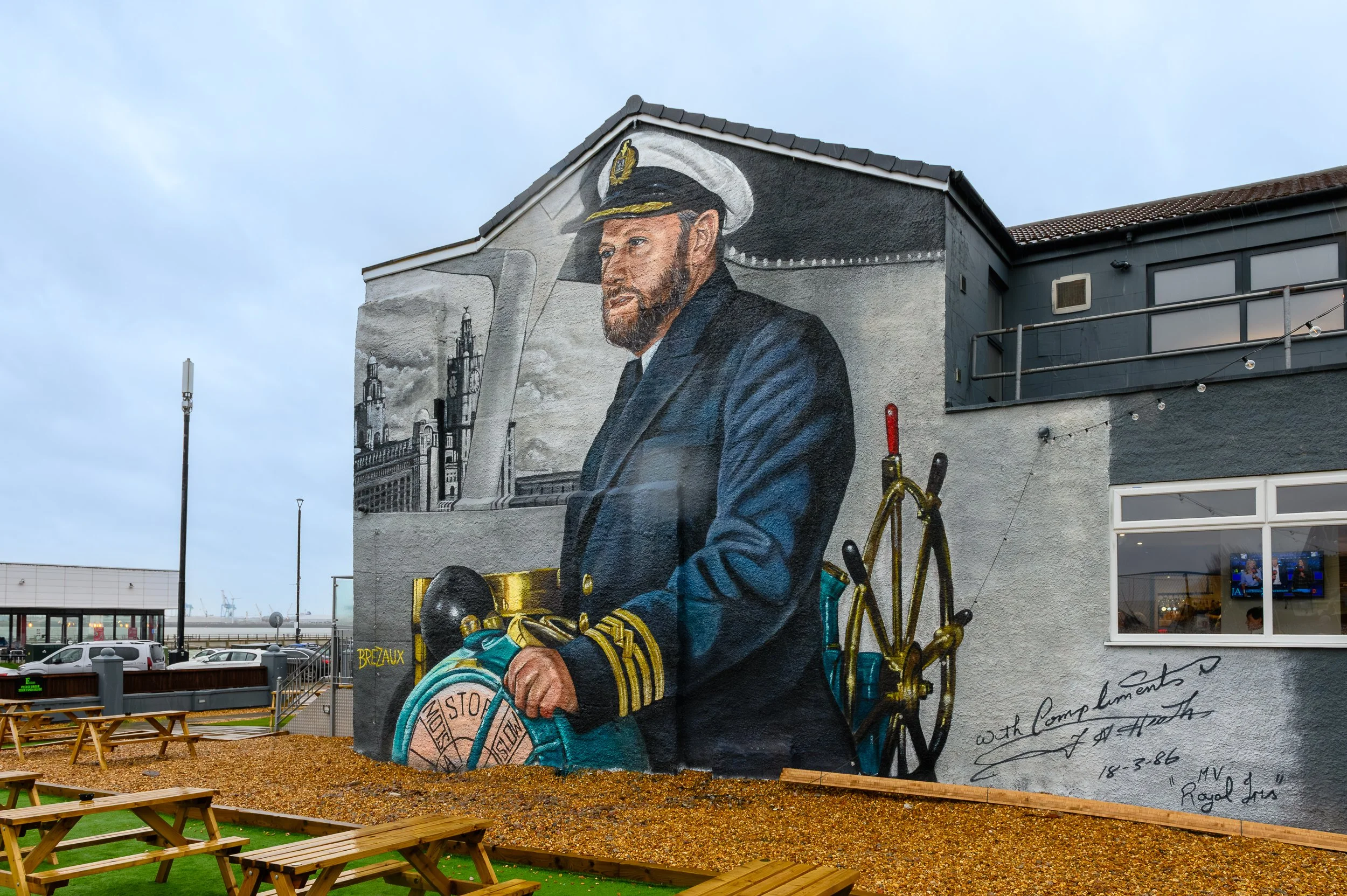
Captain Mike Lowe weathering the storms down on the front
Protective coatings, proper substrate repair, re-rendering, conservation-grade materials — these are not glamorous line items, but they are the difference between a mural that lasts and a mural that fails. And if we’re serious, we can do it in a way that builds skills locally: bringing in Wirral Met students and apprentices, creating real on-the-ground learning in plastering, rendering, surface preparation and paintcraft, under experienced guidance.
Which brings us to the real point of this piece.
We are heading towards the new financial year. Budgets are being shaped now, not in April when the money is already spoken for. This is the moment for soft power to become practical power: council, the Liverpool City Region, local sponsors and partners sitting down with us in February and agreeing an action plan that treats the mural trail like what it is — part of New Brighton’s visitor economy, identity, and regeneration story.
Doing nothing is not a neutral position.
It is a decision to let the walls fail, to let the costs balloon, and to let the town quietly lose one of the most visible symbols of its renaissance — just as we are trying to showcase Victoria Quarter on a wider stage.
We don’t need panic. We need stewardship.
The tide will keep coming in. The wind will keep testing the promenade. The only question is whether we meet that reality with a plan — or with excuses after the damage is done.
Let’s meet in February. Let’s agree the protection and maintenance programme. Let’s phase renewal intelligently. And let’s keep New Brighton’s stories on the walls — not in the “before” photos.
