
There's a paragraph in the government's new high streets strategy that reads best on the platform at New Brighton station.
Hope on the High Street came out on 28 October, alongside the Budget. It's the government's strategy for high streets and town centres across England, built on six pillars, from leadership and culture to safety and housing. The fourth pillar is "Easy access and connectivity", and its strapline is three words we'd happily paint on a wall: reasons to explore.
Under that pillar sits paragraph 116:
"Good street design improves connectivity and helps people explore the whole town centre. Clear maps, lighting signage and wayfinding should be accessible and legible, linking shops, services, transport hubs, cultural venues and public spaces and helping people navigate safely and confidently during the day and after dark. Seating, accessible toilets, heritage interpretation, points of interest and green routes can encourage visitors to stay longer and support more businesses."
Read that list again. Transport hubs. Cultural venues. Shops. Public spaces. Now walk it.
The transport hub is New Brighton station, where 1.19 million journeys started or ended in 2024/25. The cultural venue is the OpenAIR Gallery, with more than 45 works on the walls of the Victoria Quarter. The shops are the independents around it, alongside the cafés and bars. The public space is the promenade, and beyond it, the sea. Station first. Then the Victoria Quarter. Then the sea. That's the pilot route in Finding New Brighton, the wayfinding plan we published in October.
Let's be straight about what the strategy is and isn't. It doesn't mention New Brighton. It doesn't fund signs. It isn't a consultation with a form to fill in. What it does is set down, in the government's own words, the thing we've been asking for. And that makes the gap much easier to see.
Paragraph 114 says routes into a town centre should be "integrated, safe, accessible, attractive and clearly signposted". Step off the train here and the platform hands you an empty, taped-off information case. There's no clear map, no walking times and no reason to turn towards the Victoria Quarter rather than straight to the car park or the beach. By our estimate, the walk from the station through the Victoria Quarter to the sea takes about eight minutes. Nothing says so.
That matters more here than in most towns. Nine in ten of Wirral's visitors come for the day, and a day out is decided on foot. Day visitors don't plan a route in advance. They follow what they can see. If the next good thing isn't signed, most of them won't find it.
The strategy describes places like ours. It sorts England's high streets into types, and one of them is "Tourism destinations": "High streets reliant on visitor footfall, often seasonal", "Common in coastal, historic and visitor locations". Among the policy needs it lists for them is to "Improve visitor experience". It doesn't put New Brighton in that box. But anyone who knows Victoria Road in August, and again in February, will recognise the description.
It also says high streets "need to find new anchors, be they hospitality, cultural spaces, public services, leisure or education settings", and that culture, leisure, hospitality and markets "create reasons to visit, stay longer and return". In the Victoria Quarter, the cultural anchor is already here, painted on the walls. What it doesn't have is a single sign at the station telling you it exists.
And the money follows the feet. The strategy's own research says people who walk to the high street "typically visit twice as frequently and spend up to 40% more compared to those who drive". Make a town easy to walk and people walk further, stay longer and spend more of their day in it.
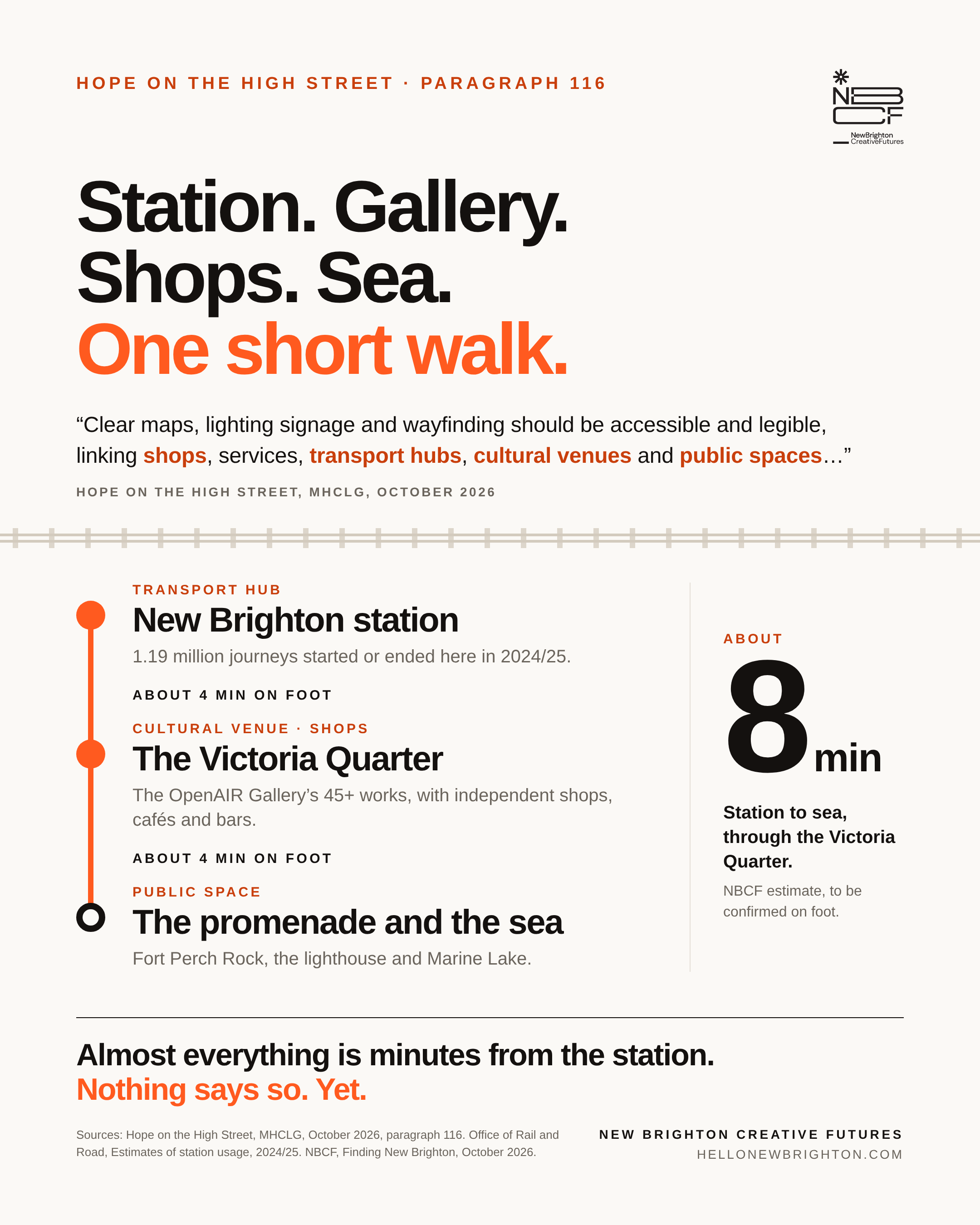
Paragraph 116, walked: from New Brighton station, through the Victoria Quarter, to the sea.
It quotes paragraph 116 of Hope on the High Street and maps its transport hubs, cultural venues, shops and public spaces onto a route from New Brighton station through the Victoria Quarter to the promenade, about eight minutes on foot by NBCF's estimate.
The headline money in the strategy's £210 million Community Assets Programme goes to buildings, £125 million of it to derelict ones. Signs are a smaller, faster job. They won't transform footfall on their own. But they are the quickest, cheapest part of making a town easy to walk, and part of our system is already built. Our five free Hello New Brighton boards, for trains, food and drink, things to do, places to stay and shops, logged 765 visits between 7 and 12 October, 533 of them on the train board. That's a minimum, because some ad blockers stop the counter.
The strategy is honest about why this kind of work stalls. Around 40% of high streets studied by the High Streets Task Force "lacked effective partnership arrangements". We found the same on the walk from the train to the tide. No single body owns the route from the station to the sea. A shared steering group can.
It's also clear whose levers these are. Councils and local transport authorities "can manage streets and parking, improve walking, wheeling and cycling routes, license outdoor trading and invest in accessible public spaces". Three reports already on Wirral Council's work programme are the moment to use them: Pedestrian Friendly Wirral in December, the Core Active Travel Network in February and the Combined Authority's Transport Plan in March. We're asking for New Brighton station, and the walk from it, to be written into all three. Then an officer lead, a steering group with us, Merseyrail and local partners, and a pilot on the ground next summer.
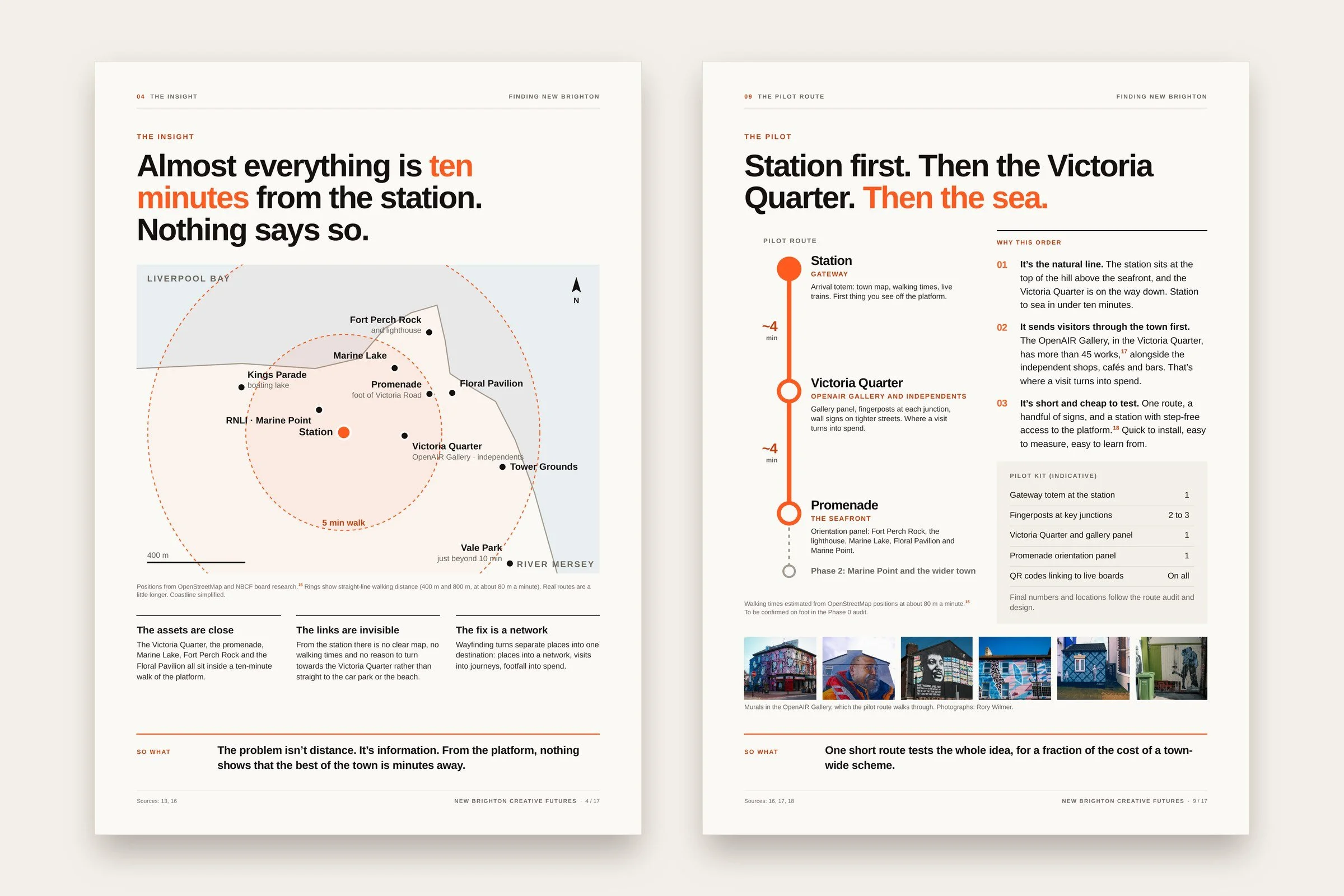
Read → Finding New Brighton (PDF, 17 pages)
One more piece of news for Wirral. The strategy also brings a £125 million Derelict Buildings Fund, and Wirral has been allocated £3 million, the maximum. That money is for buildings, not signs: buying, restoring and reusing empty high street buildings. The guidance asks councils to begin community engagement by the end of 2026. If there's an empty building in New Brighton you'd love to see brought back to life, now is the time to say so.
Hope on the High Street is a good title. Hope is what you feel stepping off a train at the seaside. The job now is to make sure that feeling survives the first minute on the platform. The government has written down what good looks like. We've drawn the route. Let's put the first sign in the ground.
Read → Hope on the High Street
Hope on the High Street, Ministry of Housing, Communities and Local Government, October 2026 (CP 1704); paragraph numbers from the gov.uk HTML version. Station figures from the Office of Rail and Road, Estimates of station usage, 2024/25. Visitor figures from STEAM 2025, via the Liverpool City Region Destination Partnership. Board visits are our own count from Cloudflare Web Analytics, 7 to 12 October 2026, and should be read as a minimum. Walking times are estimates, to be confirmed on foot. Derelict Buildings Fund allocation from MHCLG's interim guidance, Annex A. Photography by Rory Wilmer.
