![[NB] Creative Futures CIC](http://images.squarespace-cdn.com/content/v1/68c276df7928f778938222f2/98488c41-8030-41a8-b1b4-ee4c899d7119/NBCF+BRAND+MASTER+copy-16.png?format=1500w)
Friends of New Brighton Station
The station at the end of the line.
New Brighton railway station has been the front door to this town for a hundred and thirty-seven years. It has never had a Friends group. It should. And in time, so should every station on the Wirral Line.
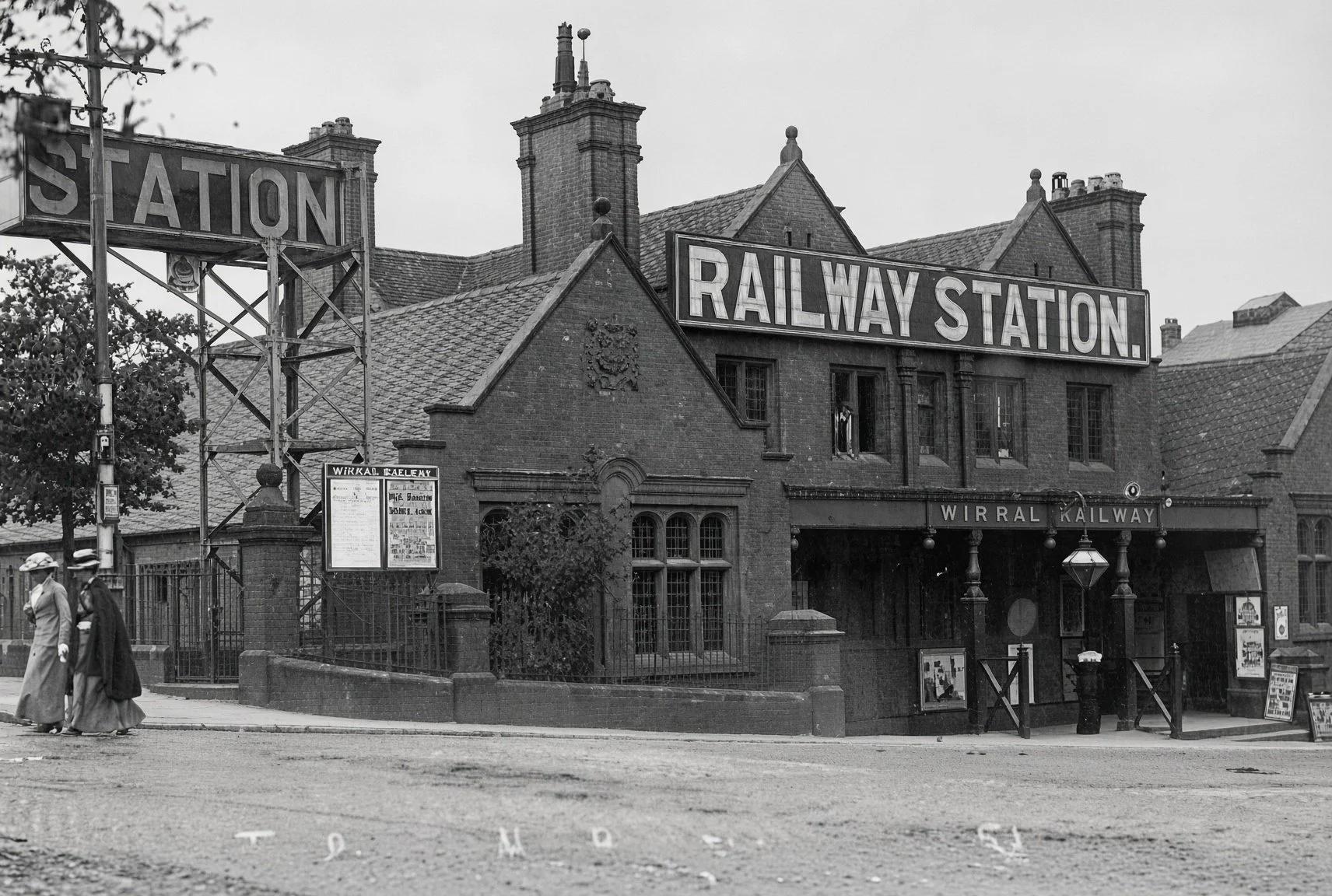
Step off the train at New Brighton on a Tuesday morning and the first thing you notice is the sky. The platform sits low and open to the weather; the wind comes straight off the Mersey and the Irish Sea beyond it. You walk under the canopy, past the signage, out through the little booking hall, and if you turn left down Atherton Street you are in the middle of a Victorian seaside resort within four minutes. If you turn right, you are on the promenade in five. There is not another Merseyrail station where the sea is that close to the ticket barrier.
Then look at the station itself.
It is a working station of the modern Merseyrail kind — Class 777s at the platform, live departure screens, CCTV, a small waiting room, a café, toilets, level access to both platforms. On the Office of Rail and Road’s own figures, 1.192 million passenger journeys began or ended here in 2024–25 — up from 994,000 the year before, and well over three times the pandemic-year floor of 382,000 in 2020–21. This is a busy small station getting busier.
It is also, by any honest look, a station that could be doing more for the town it serves.
The canopy is tired. The planters, where there are planters, are the planters somebody put in a decade ago. Wayfinding out into the town is minimal. The wall behind the drop-off is a blank. Between the ticket barrier and the sea there is a five-minute walk down some of the most photographed streets on the Wirral, and the station itself does not yet say so.
Friends of New Brighton Station is our proposition — from New Brighton Creative Futures CIC and, we hope in time, from every group in this town that already cares about the place — that this station deserves to be looked after by the community it belongs to. Not instead of Merseyrail. Not instead of Network Rail. With them, alongside them, as the community leg of the three-legged stool a good station stands on.
With the rail industry transitioning to Great British Railways, and an increasing focus on devolution and local decision-making, Friends of New Brighton Station — and the future Wirral CRP — is meant to be the community-voice conduit that shapes rail around local needs and ambitions.
And, further out, as the seed of something bigger: a Wirral Line Community Rail Partnership stretching from New Brighton down to Chester, with a Friends group at every station on the line that wants one.
The station’s story
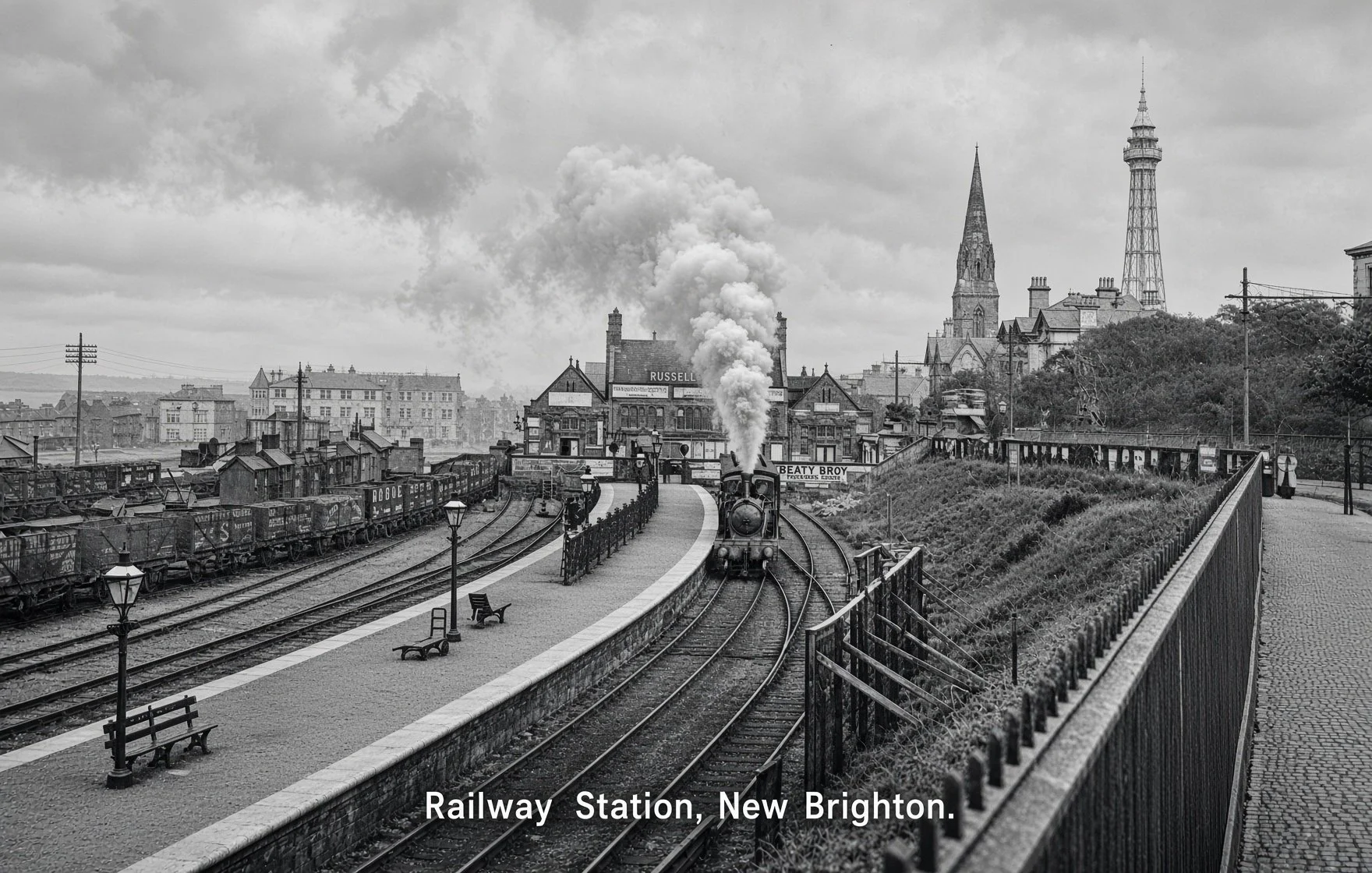
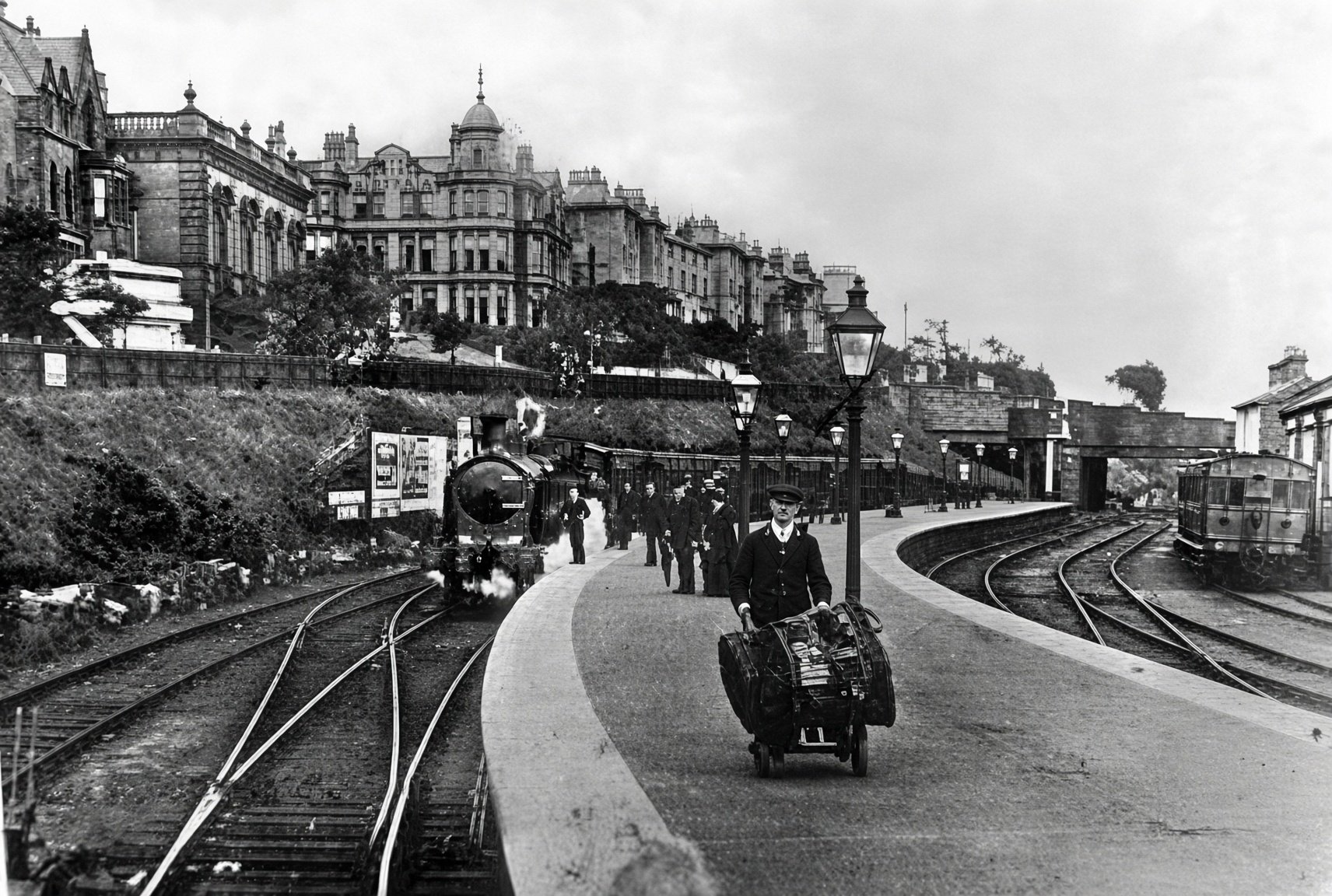
New Brighton railway station opened in 1888 as the terminus of the Wirral Railway’s northern branch — an extension driven up from Birkenhead Park through Wallasey to meet the growing resort at the tip of the peninsula.
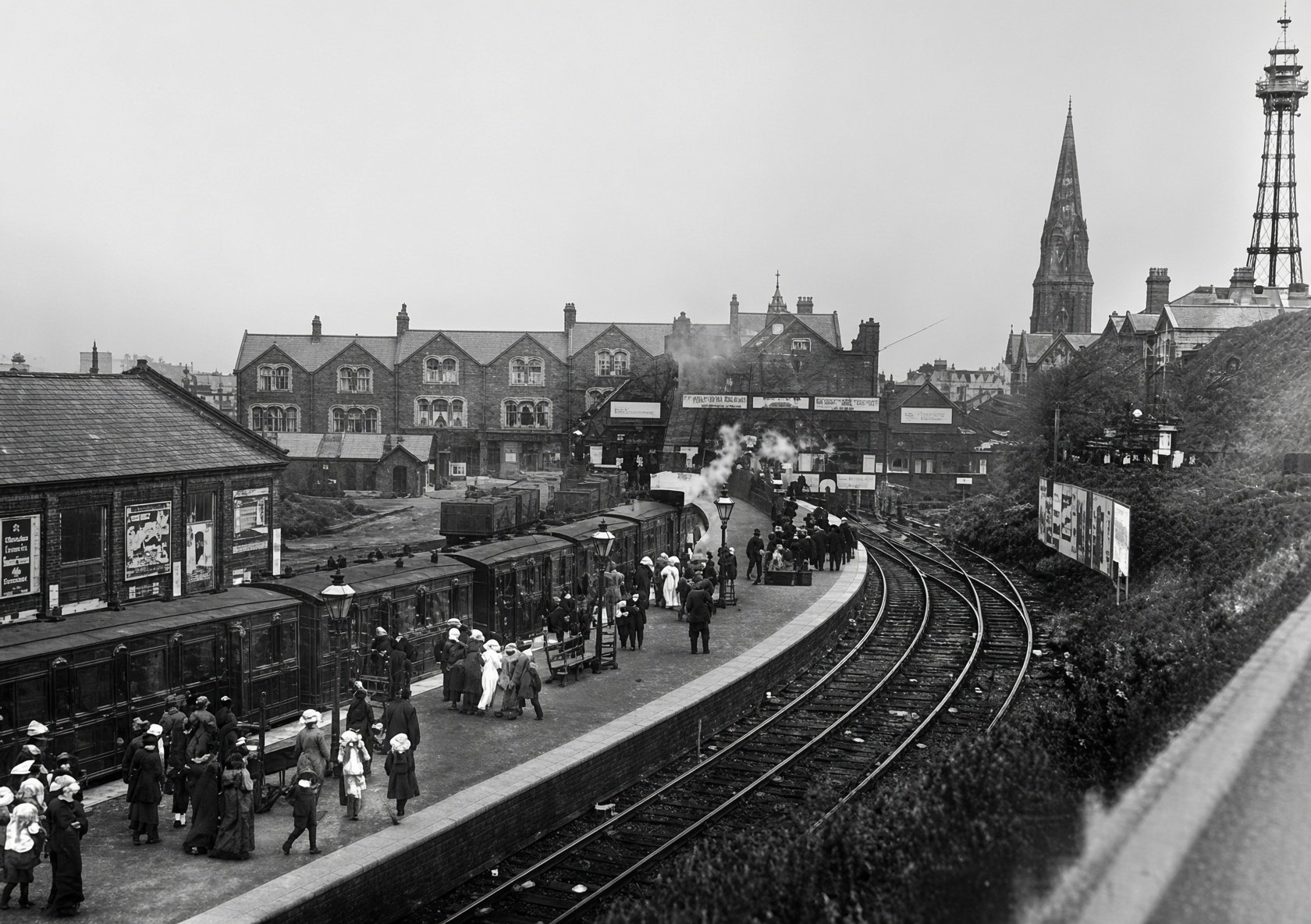
New Brighton Railway station opened in 1888 and is responsible for many families arriving on holiday to the Seaside Resort. Wallasey Days Gone By.
Its arrival slotted New Brighton into the national network at the exact moment the town was hitting its stride: Eugenius Birch’s iron pier was already twenty years old, the Ham and Egg Parade was about to be cleared, the Tower was twelve years away.
For its first fifty years the trains here were pulled by steam, and to reach Liverpool you had to change at Birkenhead Park onto the Mersey Railway. That changed in 1938. Under the London, Midland and Scottish Railway, which had absorbed the Wirral Railway in the 1923 Grouping, the West Kirby and New Brighton branches were electrified — third-rail, 650 volts DC — and on 14 March 1938 the first direct trains from New Brighton to Liverpool Central ran under the river without a change. Everything about how the station works today — the electric trains, the through service — dates from that spring.
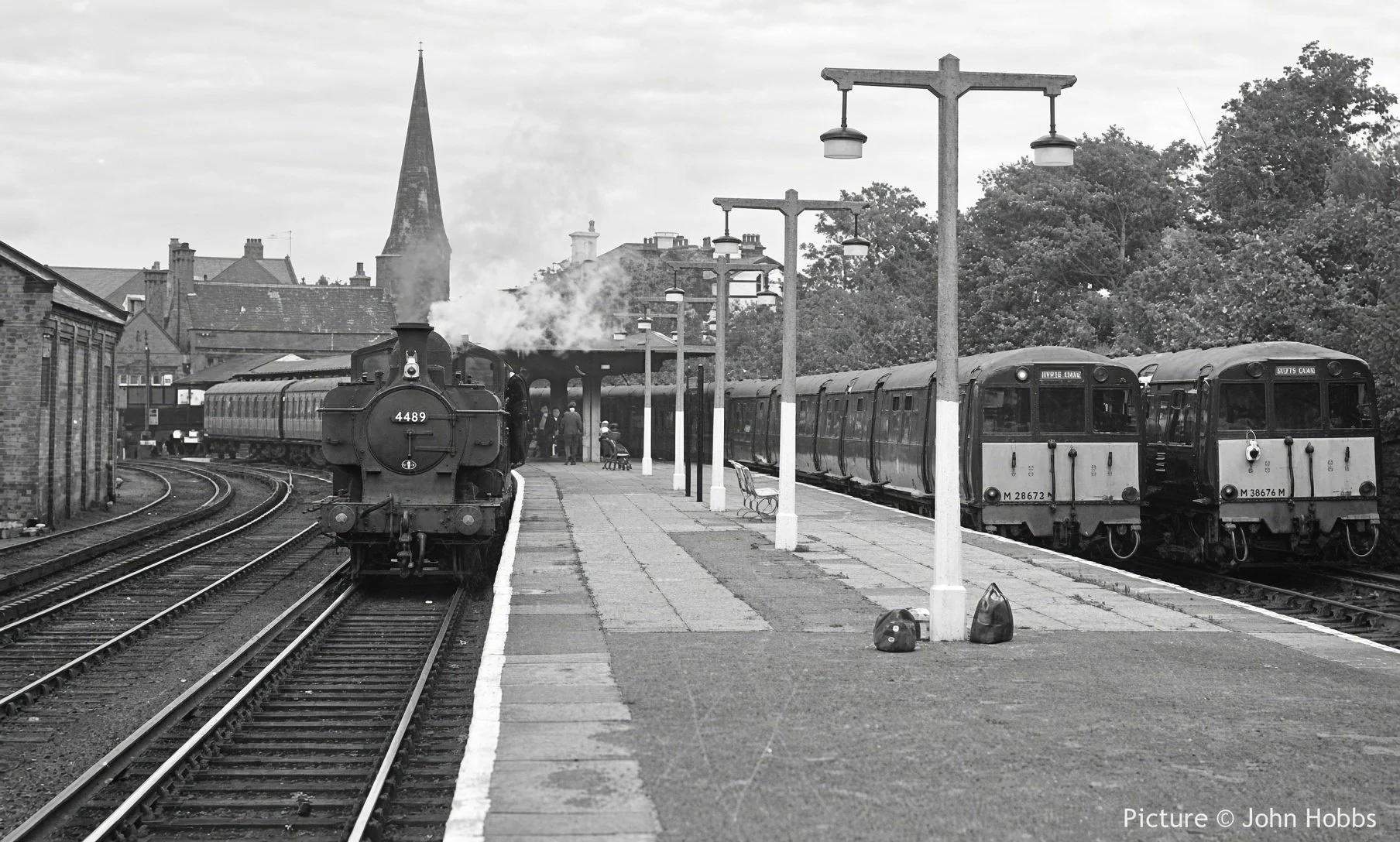
Then the century did to New Brighton station what it did to New Brighton. The goods yard closed on 30 October 1965. The through diesel service from Wrexham via the Borderlands Line, and the direct diesel from Chester Northgate, both faded away between 1968 and 1978. The Victorian station buildings were progressively rationalised. The reason today’s station is a modest island-platform structure with a small booking hall is the run of decisions taken between 1965 and the late 1970s: the building was cut down because the traffic that had justified it had gone; then the traffic came back, but the building didn’t.
There is, though, a piece of the original still here. The station master’s house at New Brighton was converted, in 1983, into a music recording studio; Station House Studios opened for business in 1985, on official record as the earliest post-industrial reuse of the Victorian station fabric on this site. It is the closest thing to a Victorian station building we still have here.
The station is not on the National Heritage List for England. New Brighton has twenty-three listed buildings — the lighthouses, Fort Perch Rock, a church, the sea-front shelters, the war memorial, a former bank — but the station is not among them. The Wirral Council Local Heritage List, a locally-drawn register of non-designated heritage assets, is currently being built, with 139 nominations counted by September 2025 and rising. It is exactly the sort of vehicle in which the surviving station-master’s house, and the site itself, could be recognised.
The line the station sits on has been called the Wirral Line since Queen Elizabeth II formally opened the Merseyrail network on 25 October 1978. Four Wirral termini — Chester, Ellesmere Port, West Kirby and New Brighton — under the river through the single-track Loop tunnel driven under Liverpool in 1972–73 and back out again. Since summer 2020 its trains have been the Swiss-built Class 777 units — battery-capable, ordered under a £460 million contract from Stadler — replacing forty-year-old British Rail stock.
New Brighton has been the last stop on this line since 1888. A hundred and thirty-seven years of continuous service. Never a Friends group.
What a Friends of Station group is
Across the United Kingdom, hundreds of stations have a Friends of Station group — a local volunteer body that works with the train operating company and Network Rail to look after the station, celebrate its heritage, and connect it to the community. The Community Rail Network — the sector’s national membership body — defines station adoption as “the involvement of two or more individuals or organisations from outside the railway industry in the care of a station.” It is a formally recognised part of the UK’s rail landscape. The Department for Transport’s 2018 Community Rail Development Strategy sets out what these groups are for, structured around four pillars: providing a voice for the community, promoting sustainable and healthy travel, bringing communities together, and supporting social and economic development.
What that means in practice depends on the station. In its most modest form a Friends group plants planters, keeps the platforms and forecourt in good order, reports faults early. At the far end of the spectrum sit groups like the Friends of March Railway Station (FACET) in Cambridgeshire — a registered charity that has restored rooms in the historic station buildings and now hosts school and community groups in them — and the extraordinary Coffee Carriage at Maghull on the Merseyrail Northern Line, whose café — commercial tenant plus community hub — turned an ordinary suburban station into the winner of the World Cup of Stations 2024, beating 47 other stations for the title of Britain’s best. Merseyrail’s own Deputy Managing Director described the recipe there as “a dedicated station team, a wonderful local business, and station volunteers, who keep it looking at its best.” Three legs. A working station. A local business. A community group. Miss any one, and the stool wobbles.
Closer to home, on our own line: Love Bebington adopted Bebington station and, a little further south, Spital station, working with Merseyrail to transform them. Bebington was named Best Station on the Wirral at the 2025 Cheshire Best Kept Stations Awards, alongside two other Merseyrail wins. The template exists on this line. We are proposing to run it here, and, in time, everywhere else on the line that wants it.
Our vision
Friends of New Brighton Station, as we see it, is four things.
It is a cared-for station — planted, painted, fault-reported, kept. Small interventions on a schedule. A station that visibly has people looking after it.
It is a cultural station — the point at which our OpenAIR Gallery work meets the platform. Art on the walls where the walls are ours to work with. Interpretation of the town’s history where the station’s physical fabric can carry it. Storytelling that begins the moment the doors open — and working with the local school, which is nearby, on the education and creative-writing side of that.
It is a social station — a place to meet, not only a place to leave from. The Coffee Carriage model, adapted to what New Brighton needs. Events on and around the platforms. A station that people go to, not only through.
It is a partnership station — the piece of common ground on which Friends of Marine Lake, Friends of Victoria Quarter, New Brighton in Bloom, Seaside Coastal Community and NBCF can each add something without any of them having to run it alone. New Brighton has never been short of energy. What it has been short of is a shared table.
The wider ambition — a Wirral Line Community Rail Partnership
None of the above is unusual. What is unusual is the ambition to do it not just here, but along the whole line.
The Wirral Line is the operational descendant of at least four different Victorian and Edwardian railway companies stitched together over a century and a half. Four termini — Chester, Ellesmere Port, West Kirby, New Brighton — and a single-track loop under Liverpool. Thirty-four stations in total, from the north Wirral coast round to the Cheshire border. Some are already loved. Some are not. None of them, at present, sits under a formal Community Rail Partnership in the sense the DfT’s strategy uses the term.
A CRP is a core unit of the community rail world — a partnership of train operators, Network Rail, local authorities and community groups covering a line or a cluster of lines, funded on a multi-year basis by the operator. There are more than seventy-five of them across Great Britain today. Community Rail Lancashire, which historically covers Merseyrail’s area of operation, is one of the best-known. There is not yet one dedicated to the Wirral Line, and we think there ought to be.
Every station on the line is a candidate for a Friends group. Bebington and Spital already have one, in effect, under Love Bebington. New Brighton would be the second on the line. Two along the top of the peninsula, two along the middle, one at Chester (in collaboration with Transport for Wales and the Community Rail Partnerships that already terminate there), one at Ellesmere Port, and the whole thing knitted together under a Wirral Line CRP would be a generational piece of civic infrastructure, not a next-year project.
It is worth naming the ambition even at this early stage, because the town-by-town version of this argument — “let’s fix our station” — is a smaller and less interesting argument than the line-wide version that says “let’s remake the line.”
Both matter. We are starting with the town-by-town version. But we are keeping the line-wide version in view.
Working with partners
We are not the operator of the station. We do not own the track or the building. Nothing that follows will happen without the people who do, and we would rather set the shape of the partnership out honestly now than pretend otherwise.
Merseyrail is the train operating company and the natural first partner. Its own 2025 Social Value Report sets out £1.4 billion of social value delivered over two years, with named programmes for local charity support, LGBTQ+ inclusion, Merseyrail in Bloom station transformations, and community engagement across the network. Community rail is core business for them, publicly and in their own words. Friends of New Brighton Station would be an offer to help deliver at our station what Merseyrail has said, in that report, is a strategic commitment.
Network Rail is the infrastructure owner, and its community rail arm — described in its own How we support community rail guidance — issues the community licences and leases under which volunteer activity on railway land happens. Any physical intervention at the station will pass through them.
Wirral Council is the local authority. Its Local Heritage List is the natural vehicle for local recognition of the station’s surviving fabric, and its Regeneration and Place directorate is the counterpart in the wider New Brighton conversation.
Liverpool City Region Combined Authority and Merseytravel are the transport authority and the funding-and-planning body. Any longer-term investment in stations sits within their remit.
Community Rail Network is the national body under which any future Wirral Line CRP would sit.
NBCF-CIC is the seed, the coordinator, and the creative partner. Friends of New Brighton Station is, in its first phase, a named project of NBCF-CIC, using our existing governance, insurance and CIC infrastructure so that the group can be up and running now, without the two-to-four-month wait a fresh Charitable Incorporated Organisation would require. If, in twelve months, the steering group wants to spin the Friends group out into its own CIO, we will help make that happen.
The aligned New Brighton community groups we hope to build this with are Friends of Marine Lake, Friends of Victoria Quarter, New Brighton in Bloom and Seaside Coastal Community. Others as they emerge.
And, over time, the line as a whole — every station along it that wants a group, and a Wirral Line CRP that binds those groups together.
How to get involved
Follow the Friends of New Brighton Station page on Facebook, which is live from this week.
If you use New Brighton station — as a passenger, a commuter, a day-tripper, or somebody who walks past it every day — get in touch. Tell us what you would change about it, what you would not change, and what you would help with. We are convening the first founding conversation between the aligned New Brighton community groups over the coming weeks, and the range of voices in that room matters.
If you are on another Wirral Line station — Bebington, Spital, Port Sunlight, Leasowe, Wallasey, Hoylake, West Kirby, Chester, Ellesmere Port, or any of the others — and you have been thinking there ought to be a Friends group at your station too, please get in touch. This is meant to grow beyond New Brighton. We would rather build the Wirral Line CRP with a dozen groups than run a good local operation on our own.
If you are part of any of the bodies named above — Merseyrail, Network Rail, Wirral Council, LCRCA, Merseytravel, Community Rail Network — and you would like to have the sort of conversation this article is trying to open, we would welcome that too.
Write to us at info@hellonewbrighton.com
New Brighton railway station has been the last stop on this line since 1888. A hundred and thirty-seven years of continuous service, with never a Friends group. Bebington and Spital have shown, on our own line, what happens when a community adopts a station. The Coffee Carriage at Maghull has shown, on the sister line, what happens when three legs of the stool are all in place.
The Wirral Line has thirty-four stations. It ought to have thirty-four groups.
We would like New Brighton to be the second.
Sources and further reading
The station and the line
New Brighton railway station — Wikipedia (opening 1888, electrification 1938, goods yard closed 30 October 1965, diesel Wrexham service history, Station House Studios 1985, current passenger figures from the Office of Rail and Road). https://en.wikipedia.org/wiki/New_Brighton_railway_station
Merseyrail — New Brighton station page (staffing, facilities, accessibility, cycle storage). https://www.merseyrail.org/plan-your-journey/stations/new-brighton.aspx
Wirral line — Wikipedia (composite history of the constituent Victorian companies; 1938 LMS electrification of the former Wirral Railway; 1978 formal opening of the Merseyrail network by Queen Elizabeth II; Loop tunnel 1972–73; electrification to Chester 1993 and Ellesmere Port 1994; Class 777 Stadler £460 million contract; four termini; thirty-four stations; 750 V DC third rail). https://en.wikipedia.org/wiki/Wirral_line
Wirral Railway — Wikipedia. https://en.wikipedia.org/wiki/Wirral_Railway
Mersey Railway Tunnel — Wikipedia. https://en.wikipedia.org/wiki/Mersey_Railway_Tunnel
London, Midland and Scottish Railway — Wikipedia. https://en.wikipedia.org/wiki/London_Midland_and_Scottish_Railway
British Rail Class 777 — Wikipedia. https://en.wikipedia.org/wiki/British_Rail_Class_777
Station House Studios — Discogs label listing (station master’s house conversion, 1985). https://www.discogs.com/label/664783-Stationhouse-Studios
Listing and heritage
Listed buildings in New Brighton, Merseyside — Wikipedia (twenty-three nationally listed buildings, station not among them). https://en.wikipedia.org/wiki/Listed_buildings_in_New_Brighton,_Merseyside
Local Heritage List for Wirral — Historic England / Wirral partnership. https://local-heritage-list.org.uk/wirral
Wirral View, Wirral’s Local List grows to 139 landmarks, with deadline now extended (September 2025 nominations count). https://wirralview.com/regeneration/wirrals-local-list-grows-139-landmarks-deadline-now-extended
Community rail — the framework
Department for Transport, Connecting communities with the railways: the community rail development strategy (four pillars framework, station adoption definition). https://www.gov.uk/government/publications/community-rail-development-strategy/connecting-communities-with-the-railways-the-community-rail-development-strategy
Community Rail Network — national membership body. https://communityrail.org.uk/
Network Rail, How we support community rail (permissions regime — community licences, community leases, landlord’s consent; twenty regional community rail leads). https://www.networkrail.co.uk/who-we-are/community-rail/how-we-support-community-rail/
Merseyrail Social Value Report 2025 — landing page and full PDF (£1.4 billion social value over two years; Merseyrail in Bloom; local charity support). https://www.merseyrail.org/about-us/merseyrail-in-the-community/social-value-report-2025/ · https://www.merseyrail.org/media/knypfzge/merseyrail_social-value-report_oct-2025_digi_singles-1.pdf
Case studies
Friends of March Railway Station (FACET) — Charity Commission register (registered charity no. 5096732). https://register-of-charities.charitycommission.gov.uk/en/charity-search/-/charity-details/5096732
Greater Anglia, National recognition for March station and community volunteers’ projects. https://www.greateranglia.co.uk/about-us/news-desk/news-articles/national-recognition-march-station-and-community-volunteers
ITV News Granada, Maghull Station named Britain’s Best in the World Cup of Stations 2024 (25 October 2024 — Coffee Carriage; Suzanne Grant quote on the three-legged stool of station team + local business + volunteers). https://www.itv.com/news/granada/2024-10-25/station-wins-britains-best-in-world-cup
Merseyrail, Maghull Station competes to win the World Cup of Stations 2024. https://www.merseyrail.org/news/station-and-service-updates/maghull-station-competes-to-win-the-world-cup-of-stations-2024/
Merseyrail, Bebington community group teams up with Merseyrail to make a difference (Love Bebington; adoption of Bebington and Spital). https://www.merseyrail.org/news/community/bebington-community-group-teams-up-with-merseyrail-to-make-a-difference/
Growth Platform, A trio of Merseyrail stations triumph at Cheshire Best Kept Stations Awards (Bebington named ‘Best Station on the Wirral’ 2025). https://growthplatform.org/news/2025/02/a-trio-of-merseyrail-stations-triumph-at-cheshire-best-kept-stations-awards/
New Brighton community groups referenced
Friends of Marine Lake. https://www.marinelake.uk/
Friends of Victoria Quarter
OpenAIR Gallery — Hello New Brighton. https://hellonewbrighton.com/
New Brighton in Bloom. https://www.newbrightoninbloom.co.uk/
Seaside Coastal Community. https://www.newbrightoncoastalcommunity.co.uk/
If a claim in the piece above is not covered by one of these sources, that is a bug — please tell us and we will correct it.