![[NB] Creative Futures CIC](http://images.squarespace-cdn.com/content/v1/68c276df7928f778938222f2/98488c41-8030-41a8-b1b4-ee4c899d7119/NBCF+BRAND+MASTER+copy-16.png?format=1500w)
D*Face after dark, a beetle with no name and a graffiti museum on Réunion
A new weekly column on the walls going up around the world and the artists painting them. This week: Madrid, Oakland, Saint-Denis, València and Southend.
This is the first NBCF Street Art Weekly, and it starts with a simple idea. We look after more than 45 murals in the OpenAIR Gallery in New Brighton, and we don't want to make the next ones in a vacuum.
Street art is a conversation that runs from Madrid to Oakland to Saint-Denis, and the best of it happens between artists who are watching each other. So every Tuesday we'll look beyond our own walls at what went up around the world the week before. Who painted it, where, and how. The festivals doing it well, the commissions worth knowing about, and the arguments the scene is having with itself.
We'll name every artist. We'll show their work where they posted it, rather than lifting it onto our own site. And we'll tell you what we think.
We're doing this to learn. How other towns open their walls to their own artists, how festivals leave something standing when they end, how a neighbourhood comes to care for what's been painted. That's where we take our inspiration from. The walls themselves stay with the artists who made them.
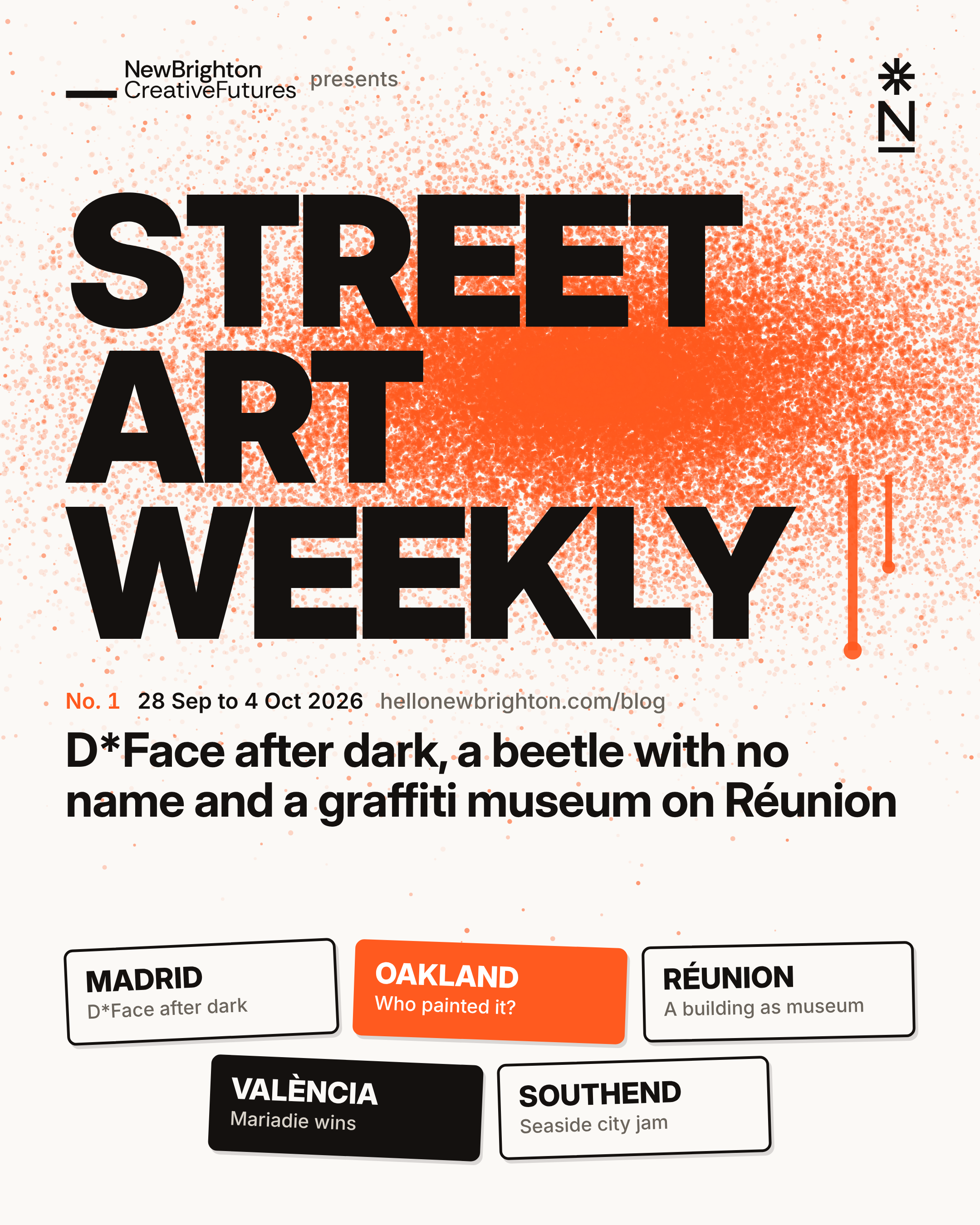
NBCF WEEKLY · 28 SEPTEMBER TO 4 OCTOBER 2026
The week didn't belong to one wall. It belonged to a terrace in Madrid, a plaza in València, a building on the far side of the world and the high street of another seaside town. And the loudest conversation of all was about a name.
Madrid
In Carabanchel, in the south of Madrid, Karen K photographed D*Face's latest wall at night. A pale, winged woman bites a red bandana. A small suited figure floats beside her. The signature reads DFACE-26. Traffic streaks through the foreground and the tables underneath are full. A press shot proves a wall exists. A photograph like this proves it has a public.
Oakland
The post that travelled furthest wasn't a new wall at all. Jacob Lyons set a photograph of a beetle mural in Oakland beside an AI-assisted remix of it, and asked to be pointed to the artist. It passed a million views. The replies did the rarer thing and argued about credit, naming the painter as Ursy before most would talk about the remix.
We think the replies had it right, and we want to say where we stand. AI is part of the street art conversation now, and pretending otherwise helps no one. To his credit, Lyons asked who painted the wall. But the remix went out first and the name came after. A remix only exists because an artist stood on a ladder and painted the original, and that name belongs at the top.
Our own line is simple. We never use AI to make artwork. Every wall we commission is painted by hand, by an artist we name, because we believe in the craft. We do use AI behind the scenes, for the paperwork, policies and admin a small CIC drowns in, and as a tool when we build our websites. The difference matters to us. A tool that clears the desk gives artists more of our time. A tool that remixes their work without their name takes something from them.
Saint-Denis, Réunion
On Réunion, the festival has taken over a whole building. Réunion Graffiti's eighth edition opened on 1 October in Bâtiment B, a former complex of nearly 5,000 square metres in Saint-Denis. Twenty-nine artists have worked through it, inside and out, and most of the line-up is from the island itself, which festival director EKO LSA describes as a tribute to the Réunion scene. Down on the Barachois, six city buses are being painted on both sides, more than 100 metres of live work. The festival closes on 10 October, but the building stays open until 31 December, with guided visits at weekends and schools and youth groups during the week.
This is the model we keep coming back to. Ten days of paint is an event. Three months of open doors, with schools coming through every week, is a place. And a line-up drawn mostly from the island means the festival leaves behind a scene as well as walls. Fly every artist in and a town gets pictures. Build it around the people who live there and it gets painters.
València
In València, the Liga Nacional de Graffiti spent 2 to 4 October in Monteolivete, its second visit to the city and one of eight stops on this year's national circuit. Ten artists painted live in front of the neighbours, sketches at the foot of the wall and every correction made in public. Mariadie took first prize with a woman turning into fire. Rudi came second with a piece led by its letters, and Konestilo and Danklabra shared third.
We're in two minds about painting as a contest. It puts the process in front of people, the sketches and the second attempts, and that is the best thing a street can watch. But a wall outlasts its scoreboard. The neighbours in Monteolivete will live with all ten pieces, not just the winner, and the measure of the weekend is whether they still like walking past them next year.
Southend-on-Sea
Closer to home, and closer in kind. Southend City Jam painted its walls at the end of August, along the High Street, Clarence Street, Alexandra Street, Market Place and the Travel Centre, and the city is still walking them. Barbara Battaglia's walk-through this week reads like an open studio. Stocke, Scaf, SoK, Naisogee, Ellespaint, HCUAR and Andy Downes are among the names, and Ster.upc's piece on the seafront, opposite Adventure Island, is the one local photographers keep framing.
We have a soft spot for this one. A seaside town painting itself in public, with the high street as the gallery, is something New Brighton knows from the inside.
Next week
Five walls, and the thread through them isn't style or scale. It's whether a wall has a public, and whether that public knows who painted it. Every wall in this column will carry its painter's name, and where we can't find one, we'll say so. If you're near any of these, go while the festivals are still on. If you're not, follow the artists themselves.
