![[NB] Creative Futures CIC](http://images.squarespace-cdn.com/content/v1/68c276df7928f778938222f2/98488c41-8030-41a8-b1b4-ee4c899d7119/NBCF+BRAND+MASTER+copy-16.png?format=1500w)
Two Stars, and the Long Habit of Letting Go
We came near the bottom of a national seaside survey. We could argue with it. Instead we read it — honestly, and all the way through.
The Which? verdict arrived the way these things always do now — as a number, screenshotted and passed around before most of us had read past the headline. New Brighton, 52%. One hundred and eighth out of a hundred and eighteen seaside towns. Two stars for the beach. Two for the seafront. One — just one — for things to do. And then, barely a week later, a second knock: the shortlist for the country’s first Town of Culture was published without our name on it. Birkenhead’s was there. Ours wasn’t. Two verdicts in a fortnight, both landing in the same tender spot.
You can feel the town bristle at moments like this, and we know that bristle well. It’s protective. It comes from love. Plenty of people have already written the rebuttal, and they weren’t wrong to — forty-seven visitors on a national panel were never going to catch a February sunset over Liverpool Bay, or the particular quality of light that once made this the most painted, most photographed stretch of the northern coast. But bristling is easy, and it changes nothing. We’d rather do the harder thing: take it on the chin, and then look properly — all the way through — because somewhere inside that ugly little number is the most honest description of New Brighton we’ve had in years. And we have never been the kind of place that looks away from itself.
A VERDICT FROM FORTY-SEVEN PEOPLE
Start with the forty-seven. That is how many people, across an entire national panel, had been to New Brighton recently enough to score it at all. You could read that as a reason to dismiss the whole exercise — small sample, wide margins, statistically shaky. We’d rather read it as the actual result, and the single most useful sentence in the report. Forty-seven is not a measure of how good we are. It is a measure of how few people are thinking about us in the first place. We are, geographically and in the national imagination, the end of the line — the last stop on the peninsula, the place you drive past on the way to somewhere with a bigger name. The survey didn’t fail to measure New Brighton. New Brighton has quietly gone missing from the map, and that is a far harder thing to admit than “the survey was unfair.”
And being unseen is its own kind of problem, because it compounds. Fewer visitors means fewer people to sing about the place, which means fewer visitors still, which means a panel of thousands can only muster forty-seven who’ve set foot here lately. A town can be full of life and starved of attention at the very same time — and that, more than any single missing amenity, is the trap we are in. Hold that thought, because it turns out to be the most fixable part of this whole story.
WHERE THE SCORECARD IS FAIR
First, though, let’s be fair to the survey, because some of it is fair to us. The biggest draws this seafront ever had are long gone, and nothing of that scale has replaced them. What came instead was Marine Point — and it’s a mixed thing, so let’s be honest about both halves of it. Some of it is genuinely good, and we should say so: Nando’s, the Turkish grill, the Italian, Marino Lougne, Greggs, the ice-cream parlour are busy and thriving, and we’re glad they’re here. The rest is amenity — an Iceland, a Morrisons, a Home Bargains, a Costa, a Starbucks — and amenity has its place. A town needs a shop and a coffee, and we are not against a single one of them. But it is cookie-cutter retail, the same parade bolted onto bypasses up and down the country, and there is little in it that makes a stranger catch a train. There’s a cinema in there too, though, like cinemas everywhere, it is up against streaming and the way our habits have changed.
The real frustration is smaller and more particular than that. It’s that a handful of units still sit empty, year after year, when they could be doing something of genuine community benefit — the immersive, experiential kind of space we keep talking through with Focal Studios. And it’s a question of vision. When a development turns its back on one of the finest views in the north — when what faces the sea is a car park and the rear of a retail block, with a budget travel-lodge hotel dropped in behind — you have to ask whether that really does justice to the vista, or to what New Brighton could be. This is the seafront. It deserves the front of the building, not the back.
So on a grey Tuesday with half the shutters down, two stars is a fair account of what a stranger finds when they step off at the water’s edge. We’re not going to pretend otherwise. If that’s all you saw of New Brighton, you’d mark it exactly where the panel did.
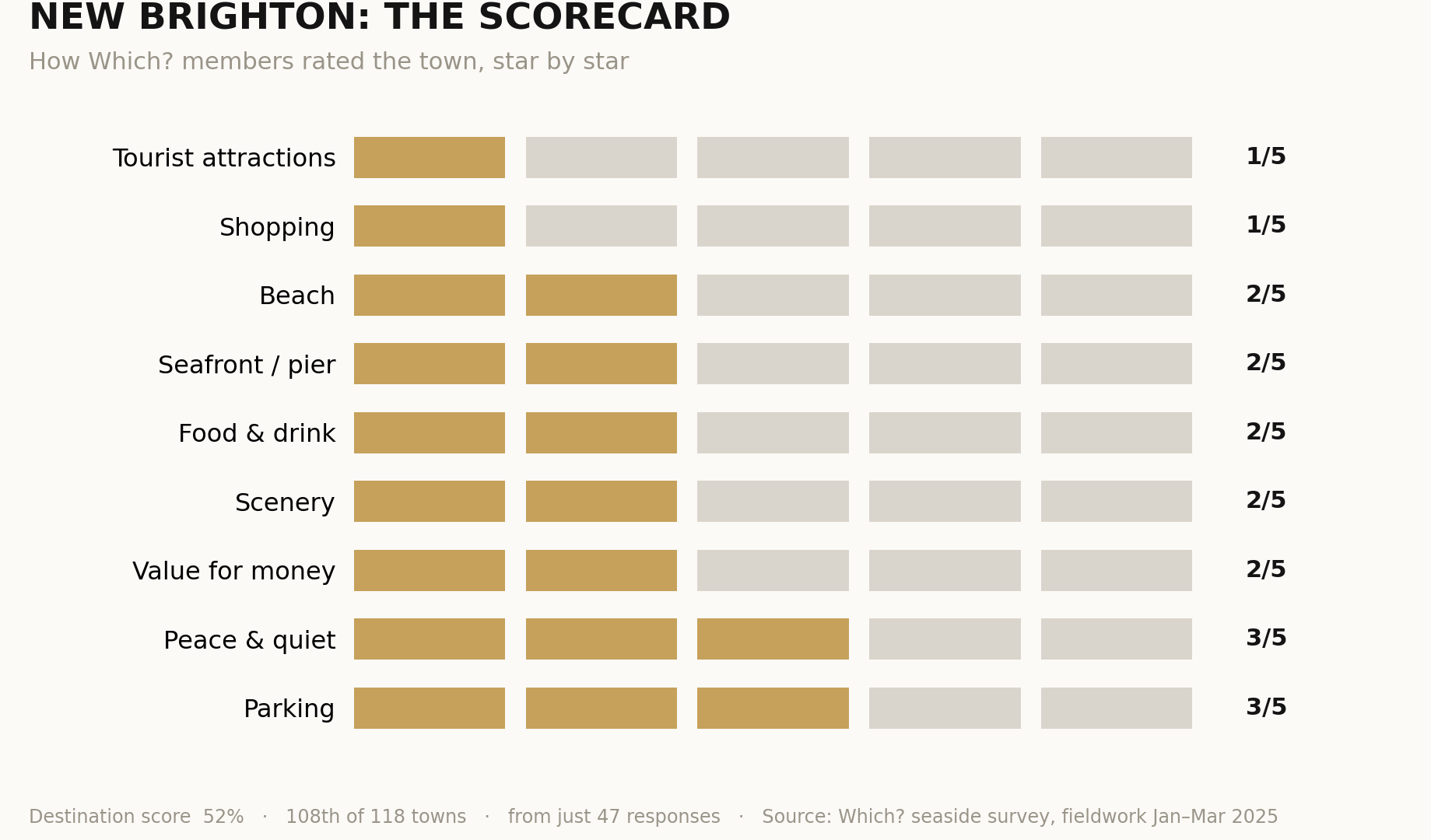
How Which? members scored us: ones and twos across nearly everything a visitor is asked about.
WHAT THE SCORECARD NEVER SAW
But here is the thing those forty-seven visitors almost certainly never saw — because the stranger rating a wet Tuesday is standing in the wrong place. The real New Brighton isn’t only the seafront. Step a few backstreets up, into the Victoria Quarter, and the whole picture changes.
Follow the OpenAIR Gallery mural trail off the front and you walk straight into it: independent cafés, bars, restaurants and pubs — not hanging on, but thriving, growing, genuinely full. There are monthly farmers’ markets and vinyl record fairs. Live music, busking, street performance spilling out at the weekend. It is a quarter that has, almost entirely under its own steam and without waiting for permission, become somewhere worth coming for in its own right.
And it refuses to be just one thing, which is the whole charm of it. The lowbrow and the highbrow sit happily a wall apart here — dive-bar grit, grunge and spray-paint on one corner, and around it the Hatch Gallery showing fine art and holding proper exhibition space for artists and makers. That mix isn’t a compromise or an accident; it is the character of the place. It’s the reason street artists of real international standing have chosen to paint here, and the reason the trail keeps growing wall by wall.
Nor is it only the art. There’s the entertainment strip — the bowling, Wilkie’s Palace amusements, the Floral Pavilion carrying a full programme of its own — and, running past all of it, the promenade: the beginning of one of the longest continuous seafront walks in the country, now part of the King Charles III England Coast Path, the longest coastal trail in the world. There’s the District House. The salons along the road. The sporting crowd. The One Stop on the corner that half the town seems to move through in a day. None of that fits inside a star rating for “tourist attractions.” All of it is real, all of it is ours — and a survey taken at the shoreline will miss very nearly every bit of it.
SO WHY THE TWO STARS?
Which brings us to the honest question. If there is this much life here, why the two stars? Part of the answer is almost embarrassingly simple, and it is the most fixable thing in this entire piece: people can’t find it.
Our own work on the town keeps landing on the same two words — wayfinding, and branding. The best of New Brighton is up the side streets, and a visitor arriving at the seafront is given almost nothing to lead them there. There is no clear thread from the water’s edge to the mural trail, from the beach to the bars, from the front to the thriving quarter three minutes’ walk uphill. We are, in effect, a town that hides its best rooms from its own guests, and then wonders why they leave underwhelmed. Picture the visitor who parks by the sea, walks the prom, buys a coffee, sees the empty units, and drives home — never once told that a whole other New Brighton was waiting just behind them. That visitor gives us two stars, and they’re not wrong to. They reviewed the only town we showed them.
This is where the fifty-two per cent starts to look less like a wound and more like an instruction. Connect the dots — with signage, with a coherent identity, with a story a stranger can actually follow from the moment they arrive — and that same visitor gets the true sample of what New Brighton has to offer. Fix the wayfinding and the branding and the stars follow almost mechanically, because for the first time the person scoring us will have actually seen the place. It is, bluntly, the cheapest transformation available to us, and very nearly the only one we can begin on our own, tomorrow, without waiting for anybody’s budget.
THE HARDER TRUTH: WE CAN’T PROGRESS
The deeper answer is less comfortable, and it is not the one people usually reach for. It isn’t really about personalities, and it isn’t about infighting. It’s that we can’t get on. Business rates here are punishing and rents are high, and between them they keep good units dark and good ideas stillborn before they’ve traded a single day. Ask why so much of Marine Point sits empty and the answer is rarely a lack of people with ideas; it’s the sums not adding up for anyone brave enough to try.
And the regeneration that would tie all of this energy together — the Marine Promenade masterplan, the plan the town itself was consulted on and broadly backed — has stalled for want of momentum. Not for want of a document. For want of movement. We already have the amenities. We already have the space. The empty units at Marine Point could be an immersive exhibition space by next summer if someone simply handed Focal Studios the keys. The reason we score the way we do is not that New Brighton lacks life. It’s that New Brighton can’t progress — and a place that cannot move forward eventually gets marked down for standing still. That, not the beach and not the shops, is the true finding buried in the number.
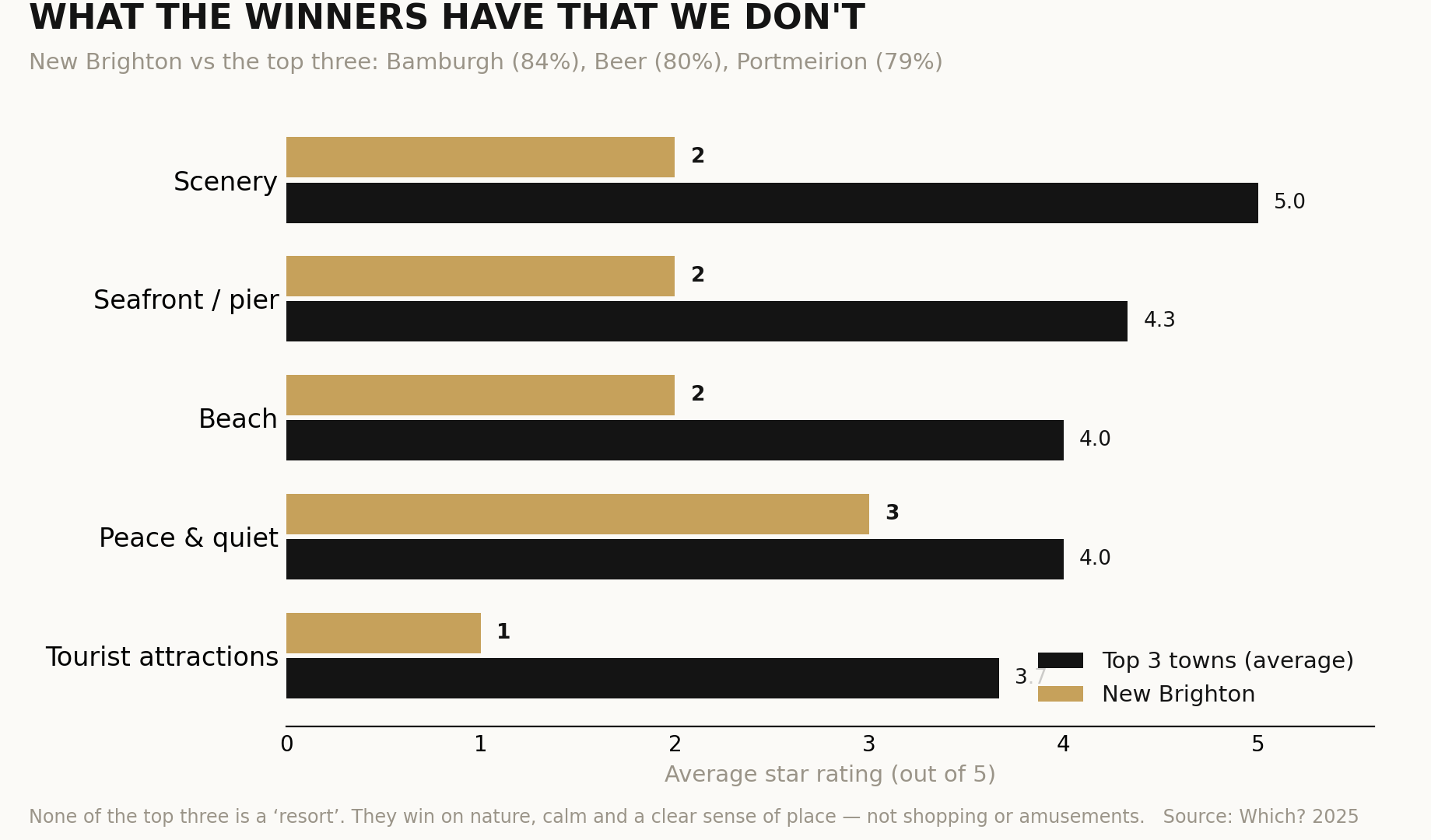
The towns that beat us win on coherence, not charm — they know what they are, and everything joins up.
Look at the towns that beat us and it’s clarifying rather than crushing. Bamburgh, first in the land: a village of four hundred people, a castle, a beach. Beer, a fishing cove in Devon. Portmeirion, which is really one man’s dream of a beautiful place, built to be walked through. Not one of them is a resort. Not one has more shops than we do — Bamburgh scores the same single star for shopping that we do. What they have is coherence. They know exactly what they are, and everything about them joins up and points the same way. We don’t lack charm, and we certainly don’t lack culture. What we lack are the connections — the wayfinding, the identity, and above all the delivery — that would turn all this scattered life into a single, legible place.
AN OLD PROBLEM IN NEW CLOTHES
It helps, too, to know that this is an old problem wearing new clothes. New Brighton was invented. In the 1830s a Liverpool merchant named James Atherton bought a hundred and seventy acres of sandhills and set out, quite deliberately, to build the north’s answer to Brighton — he borrowed the fashionable name and every ounce of ambition that came with it. (There is a quiet joke in the fact that Brighton itself only manages mid-table in the very same survey, but let it pass.) For a while, what stood here was staggering. By 1900 we had a tower that rose five hundred and sixty-seven feet — taller than Blackpool’s, the tallest building in all of England — and gathered around its foot a ballroom, a pier, a fairground, ferries, and later the largest open-air bathing pool in the country. Steamers ran day-trippers across from Liverpool in their thousands. For a moment, this small town at the tip of the Wirral out-dazzled every resort in the north.
And then, one by one, we let them go.
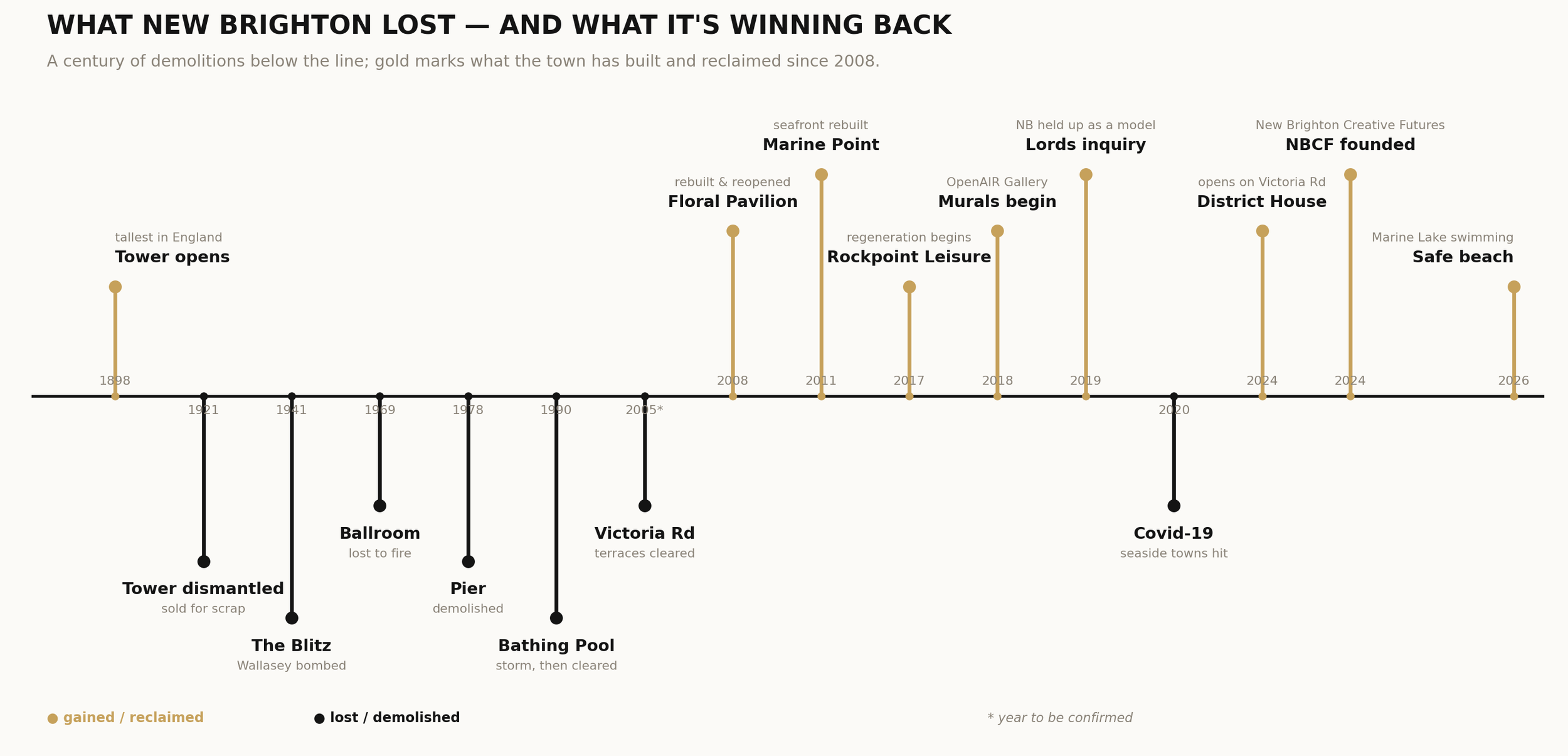
A century of losses below the line — the tower, the ballroom, the pier, the pool — and, since 2008, what New Brighton has finally built and reclaimed.
The Tower was neglected through the First World War, sold for scrap, and gone by 1921 — for a century afterwards it held the strange record as the tallest structure ever demolished in Britain. The Ballroom burned in 1969. The Pier closed in 1972 and came down in 1978. The baths were wrecked by a storm and cleared away in 1990. The war took its share too — the Blitz of 1941 fell hard on Wallasey — and some of the losses have been self-inflicted and recent: half of Victoria Road’s Victorian terraces were cleared for housing, changing the character of the street for good. Read the last hundred years like that and two stars stops being an insult and becomes something sadder and far more useful: the latest line in a long habit of building something magnificent and then failing to keep it. That is the real history of this place. Not a town that was never great — a town that keeps mislaying its own greatness. Ambition has never been our weakness. Holding on, and lately getting anything built at all, is where we come undone. The lowest-scoring town in the whole survey, Bognor Regis, earned a single line from Which? that ought to frighten every one of us:
“A seaside town that’s forgotten it’s next to the sea.”
We are closer to that sentence than we would like to be. But — and this is the difference — we are also the only town on that bottom rung actively adding something back. The Floral Pavilion was rebuilt in 2008 and Marine Point followed in 2011; the murals arrived; the House of Lords held New Brighton up as a model of privately-led seaside regeneration; and the Marine Lake, cleaned up over years by the Friends of Marine Lake, is once again a certified safe place to swim; and in 2024 we founded New Brighton Creative Futures itself, to protect and grow the mural trail that began it all. The tide, slowly, is turning.
WHAT WE BUILD NEXT
Because the honest read of this survey doesn’t end in gloom. It ends in a to-do list, and for once a genuinely exciting one, because the raw material is already here. The space is built. The energy is real. What’s missing is momentum, and a handful of transformative moves that would, between them, end our long life as the end of the line.
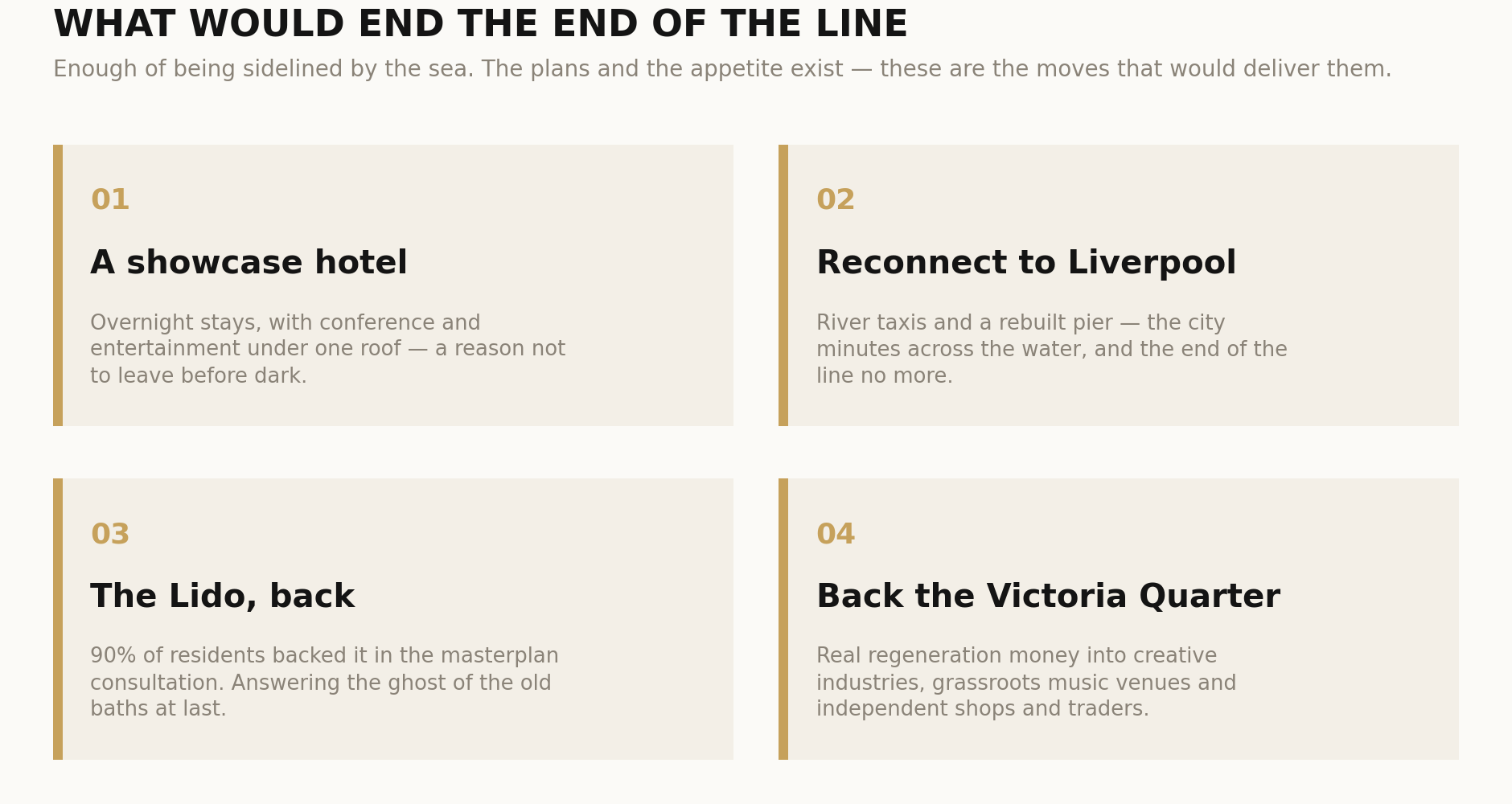
The amenities and the space are largely built already. These are the moves that would connect them.
We need reasons to stay the night. A proper showcase hotel — not a budget box, but somewhere with real amenities, with conference space and entertainment under one roof — would change the fundamental economics of the town, because it would stop New Brighton being a place you leave before dark. Overnight visitors eat two dinners, not none. They fill the bars in the evening and the breakfast tables in the morning. They turn a day-trip economy, which is always the thinnest kind, into something that can actually sustain the independents we already have.
We need to be connected again. There is no good reason — none — that we shouldn’t have a river link: taxis across the water to Liverpool in a matter of minutes. Do that and the whole curse reverses. “The end of the peninsula” becomes “a direct hop from the city.” Liverpool’s millions of visitors get a beach they can reach by boat for an afternoon, and Liverpool itself gets back the seaside it quietly lost. The very thing that has held us back — being stuck out here on the edge, looking outward across the water — becomes, overnight, the thing that makes us worth the crossing.
And we need to answer our own history. Bring back the Lido — which ninety per cent of residents backed in the masterplan consultation, an almost unheard-of level of agreement about anything — and you don’t just add a pool; you lay the ghost of the old baths to rest and hand the town its landmark back. Reconnect the pier, which people want with nearly the same force, and you restore the physical link to Liverpool that made this place in the first place. None of these is a fantasy. Every one of them already sits in plans, in consultations, in the plainly stated wishes of the people who live here. What they have lacked, every single time, is delivery.
And none of it needs to wait for the grand gestures, either. The immediate, unglamorous version of all this is sitting empty right now: hand the dark units of Marine Point to the people already doing the work — the makers and galleries who’ve proved the appetite up the hill — and you could have an immersive, come-back-tomorrow attraction on the seafront within a year. The gap between “two stars” and “worth the trip” is not as wide as the number makes it feel. It is mostly a set of keys, and the will to hand them over.
AND, HONESTLY, OURSELVES
Because we promised to look all the way through: yes, some of this is on us. We can be our own worst obstacle. We’re quick to fall out and slow to get behind a shared idea; we’re fond of the word “renaissance” without always doing the unglamorous work it asks for. That’s true, and it’s worth saying out loud. But let’s keep the order of things straight, because it matters enormously. The town has already agreed the plan. The problem is not that New Brighton can’t decide what it wants — we did that, together, in the consultation. The problem is that, having decided, we can’t seem to move. What is needed now is not another round of soul-searching. It’s will, investment and momentum — the three things that turn a masterplan on a shelf into a place people would cross the water to visit. And it’s worth saying plainly that when the funding and the fanfare keep drifting to the bigger town up the river, momentum is exactly what gets starved.
◆
So — two stars. Good. Let it sting; sit with it for a minute. A scorecard is only an insult if you throw it away. Read properly, and read all the way through, it is the clearest brief we have been handed in a generation: get seen, connect the dots, and finally deliver the things we have been promising ourselves for a hundred years. Forty-seven people is not a verdict on our worth. It is a dare to be noticed — and we are exactly the kind of town that should take that personally.
We know what we are. We know, even more clearly, what we could be. New Brighton has spent a century losing towers and piers and ballrooms and pools. The next one is about building — and this time keeping — what comes after. We’ve read the scorecard. Now we get to work.
NOTES & SOURCES
Scores and star ratings: Which? seaside towns survey, fieldwork Jan–Mar 2025 (8,952 experiences from 3,872 panel members; New Brighton n=47). Town of Culture: DCMS shortlist announced 9 July 2026 — Birkenhead shortlisted (large-town category), New Brighton not (small-town). Lido support: New Brighton Marine Promenade Masterplan consultation — 90% of respondents agreed a lido was a good idea; 59% supported the masterplan overall (haveyoursay.wirral.gov.uk). Masterplan adopted by Wirral Council, 16 July 2024. Promenade: part of the King Charles III England Coast Path, opened 2026, the world’s longest coastal trail. History: New Brighton founded by James Atherton, 1830s; Tower (567ft, opened 1898, dismantled from 1919, cleared by 1921); Tower Ballroom fire 1969; Pier (closed 1972, demolished 1978); open-air Bathing Pool (opened 1934, storm-damaged and demolished 1990) — Wikipedia, History of Wallasey, National Piers Society. Fightback milestones: Floral Pavilion rebuilt and reopened December 2008; Marine Point 2011; House of Lords ‘The future of seaside towns’ report 2019 (New Brighton’s Victoria Quarter cited as a model of privately-led regeneration; evidence from Daniel Davies, Rockpoint Leisure); Wallasey Blitz, 1941; New Brighton Creative Futures CIC founded 2024. Timeline dates marked * — the Victoria Road clearance, District House opening and Marine Lake safe-swimming certification — are to be confirmed. Wayfinding: NB Creative Futures, hellonewbrighton.com/wayfinding.
