![[NB] Creative Futures CIC](http://images.squarespace-cdn.com/content/v1/68c276df7928f778938222f2/98488c41-8030-41a8-b1b4-ee4c899d7119/NBCF+BRAND+MASTER+copy-16.png?format=1500w)
The bins, the boxes, the bollards
What if we painted them? A civic case, drawn from Dublin, Belfast, Newcastle, Cardiff, Limerick and Groningen, for treating dilapidated street furniture as something to commission rather than something to replace — and a modest proposition for Wirral.
Walk down Grange Road in Birkenhead, or the promenade at New Brighton, or Liscard Village, or the length of Borough Road, and count. Count the bins with the paint blistered off. Count the ones with the base rusted through. Count the ones — and there are a lot of these — whose side-door catch has failed, so that the door that ought to be latched shut while the operative empties the liner from the side now hangs open in the wind, gulls in and out of it, the contents on view to the street. That is the default fault of a Wirral street bin: not a broken lid, but a broken catch on the side. Once you know to look for it, you see it everywhere. We have written about the men who empty these bins, and about what it takes to look after the promenade one bin at a time, in our piece on Kenny Dunn — the man the starlings wait for. Then count the utility cabinets on the corners — the traffic-signal boxes, the BT junction boxes, the telecoms cabinets — and count the ones tagged, or scarred by fly-posting glue, or bleached grey by twenty summers of neglect. Count the bollards. Count the lamp columns.
You will lose count.
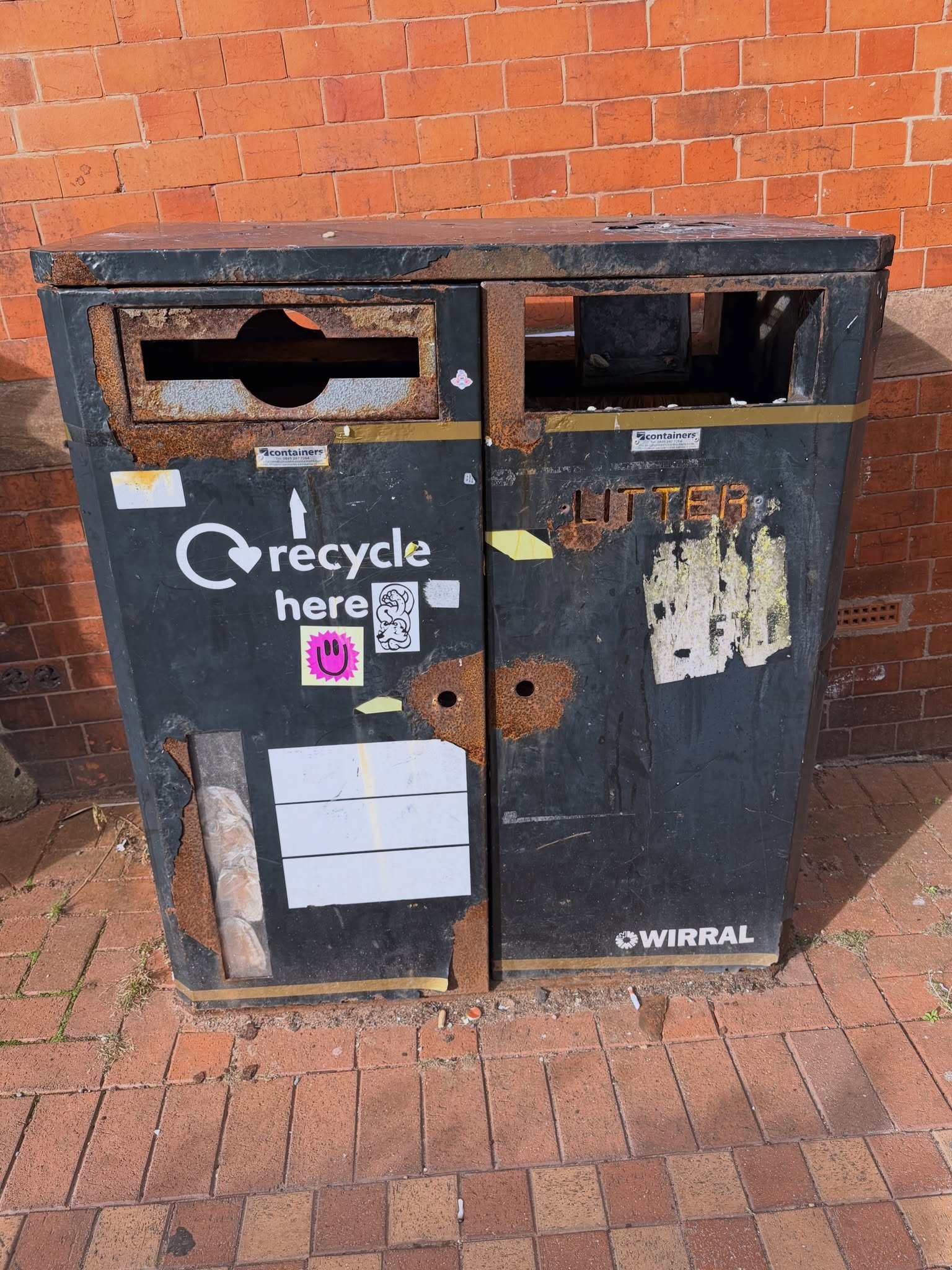
None of this is contested. Wirral Council itself, in the Birkenhead Town Centre Masterplan adopted by its Economy, Regeneration and Housing Committee on 12 March 2025, acknowledged in the driest possible language that the borough's public realm "can lack quality, due to inconsistent surfacing materials." That is the sound a council makes when it agrees that the streets are worn out.
Stop and look at any one of these small objects on any Wirral street. A litter bin, say. The bin is not a small thing. There are, on Wirral's own figures, roughly 330 on-street litter bins in the current three-year rolling replacement programme, for which the Council has publicly tendered a contract worth £115,400 excluding VAT — £138,480 including VAT — running from October 2025 to October 2028. The contract objective, in the Council's own words on the Find-a-Tender notice, is a "combination of aesthetic features, durability and value for money." That works out to about £420 a bin, before you install it, before you remove the old one, before you dispose of it. Multiply that up. Add the utility boxes we do not own but live with. Add the columns. Add the bollards. Add every hard object between the housing and the sea.
The state of these objects is not neutral. It is a mood. It is what a resident's eye rests on while they wait for a bus, and what a visitor's eye rests on while they wonder whether to come back. And the question we would like to put on the record here is a simple one:
What if, instead of leaving them to decay quietly on a maintenance schedule, we painted them?
A different route — Dublin & Belfast
In the summer of 2013, a team inside Dublin City Council called Beta Projects — an internal innovation unit set up to prototype cheap, small interventions in the public realm — painted eleven traffic-signal control boxes on the city's Northside. They wanted to test a hunch. A few years earlier, in 2006, a Dubliner called David Murtagh had been backpacking in Brisbane and seen the Australian city's painted junction boxes. He tried a vinyl-wrap pilot in Temple Bar when he got home; insurance concerns blocked painting at the time. In 2014 he was made redundant from Diageo and approached the Council. In the summer of 2015, Dublin Canvas aunched properly with fifteen painted boxes in Rathmines, Camden Street and Baggot Street, and another thirty-one that autumn.
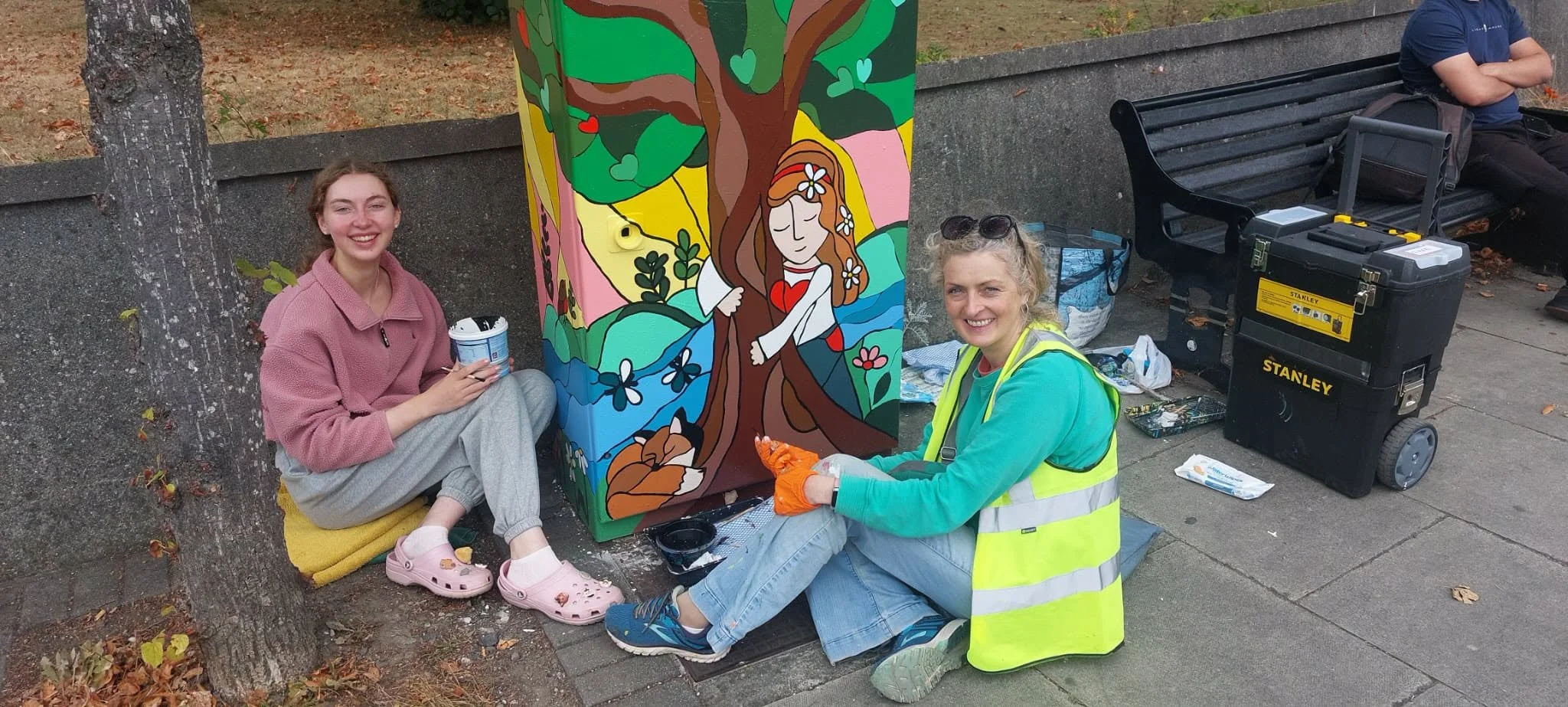
"Nature's Embrace" by local artist Clare Tunnicliffe Rosy Days on the corner of the Howth Road and Station Road. Great addition to Raheny Village.
By November 2023 the project had painted 853 boxes. It passed 900 during the 2025 season, and on the programme's own current trajectory should reach a thousand during 2026. It is funded jointly by Dublin's four local authorities — Dublin City, Dún Laoghaire-Rathdown, Fingal, and South Dublin — with Dublin City Council covering roughly two-thirds. Artists receive a €300 expenses honorarium (with materials supplied) or €375 (bring your own materials). The selection panel is made up of Council arts officers, planning officers and public-domain officers — not curators. Anyone over eighteen can apply. Roughly two-thirds of the selected artists are women. About one in four boxes has been painted by an artist who is not Irish. The average painted piece survives around four and a half years — five in the suburbs, three in the city centre where the tagging is heaviest.
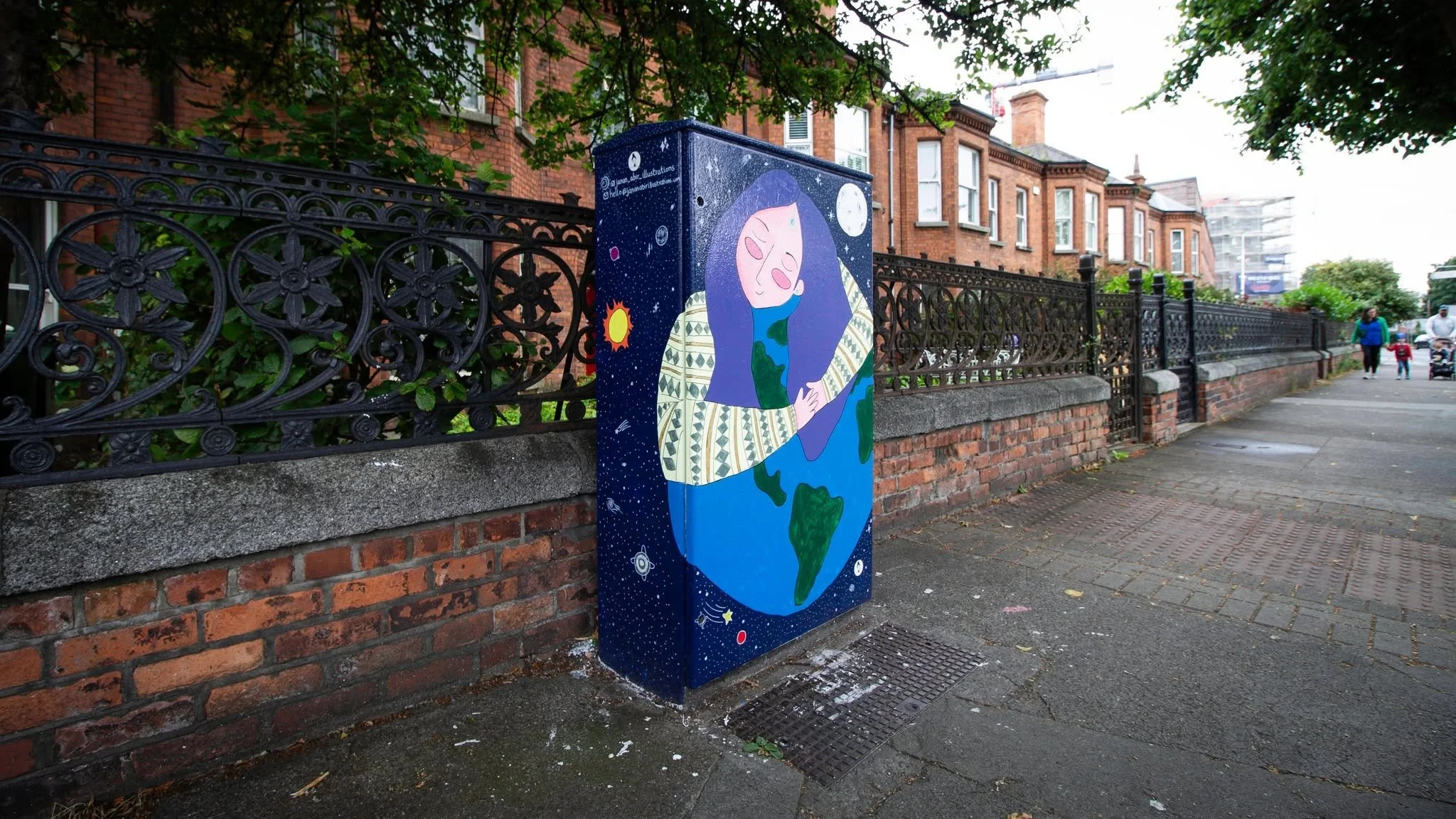
‘A Reassuring Hug’ by teacher & children's book illustrator Jan Abir. Artwork located at Donnybrook Road, Donnybrook, Dublin 4. Created Summer 2024.
That is what a proven programme looks like. Small unit cost. Council-run. Volumes. A tagline — "Less grey, more play" — that means what it says. And this detail, given to The Irish Times by Siobhán Maher of Dublin City Council: the cost of repainting a tagged box was about €90 a time, and before the project began some boxes had to be touched up weekly. A painted box, once it's a painted box, gets tagged less. A tagged painted box, when repainted, becomes another painted box. A grey box, when tagged, becomes a tagged grey box, and then it stays that way.
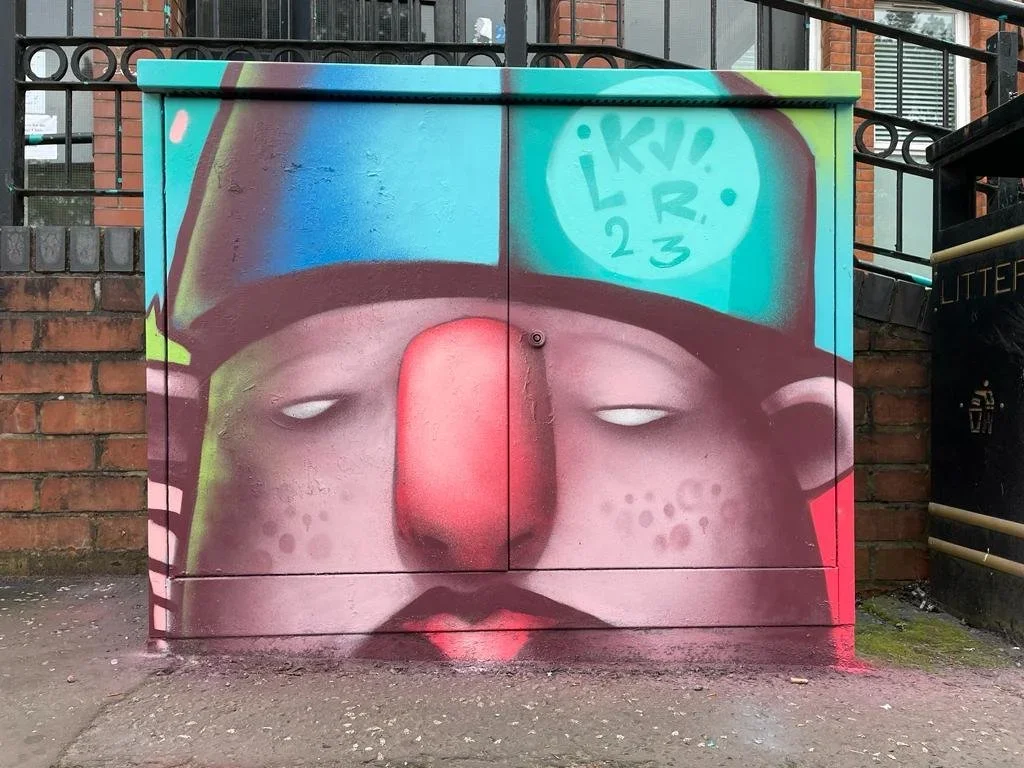
Belfast Canvas junction box. https://www.daisychaininc.co/projects/belfast-canvas
Belfast City Council studied Dublin Canvas explicitly. In September 2018 its City Growth and Regeneration Committee directed officers to design a scheme "similar to the Dublin Canvas project"; the pilot proposal came back to Committee in March 2019. Belfast Canvas launched that year with a Phase 1 budget of £13,905 — £8,000 from an existing Council departmental line, the balance from the Cathedral Quarter and Belfast One Business Improvement Districts. By its fifth phase in 2024–25, twenty-five national and international artists painted twenty-seven boxes in one season; more than 130 junction boxes have been transformed cumulatively. The Council reports on the programme in its own arts pages. Residents nominate boxes for the next round.
The wider tour
This is not a Dublin oddity. Once you know what to look for, you find versions of it in almost every reasonably ambitious town in these islands.
Newcastle upon Tyne is midway through a Creative Central NCL programme of utility-box commissions co-funded by Newcastle City Council and the North East Mayoral Strategic Authority; three artists on the current cohort — Newcastle-based illustrator Aysha Tengiz, the artist and animator GRAEME, and Middlesbrough-based Emma Bennett— with pieces sited across the city centre on Clayton Street, Newgate Street, Pink Lane and around Central Station, running 2024 through 2026.
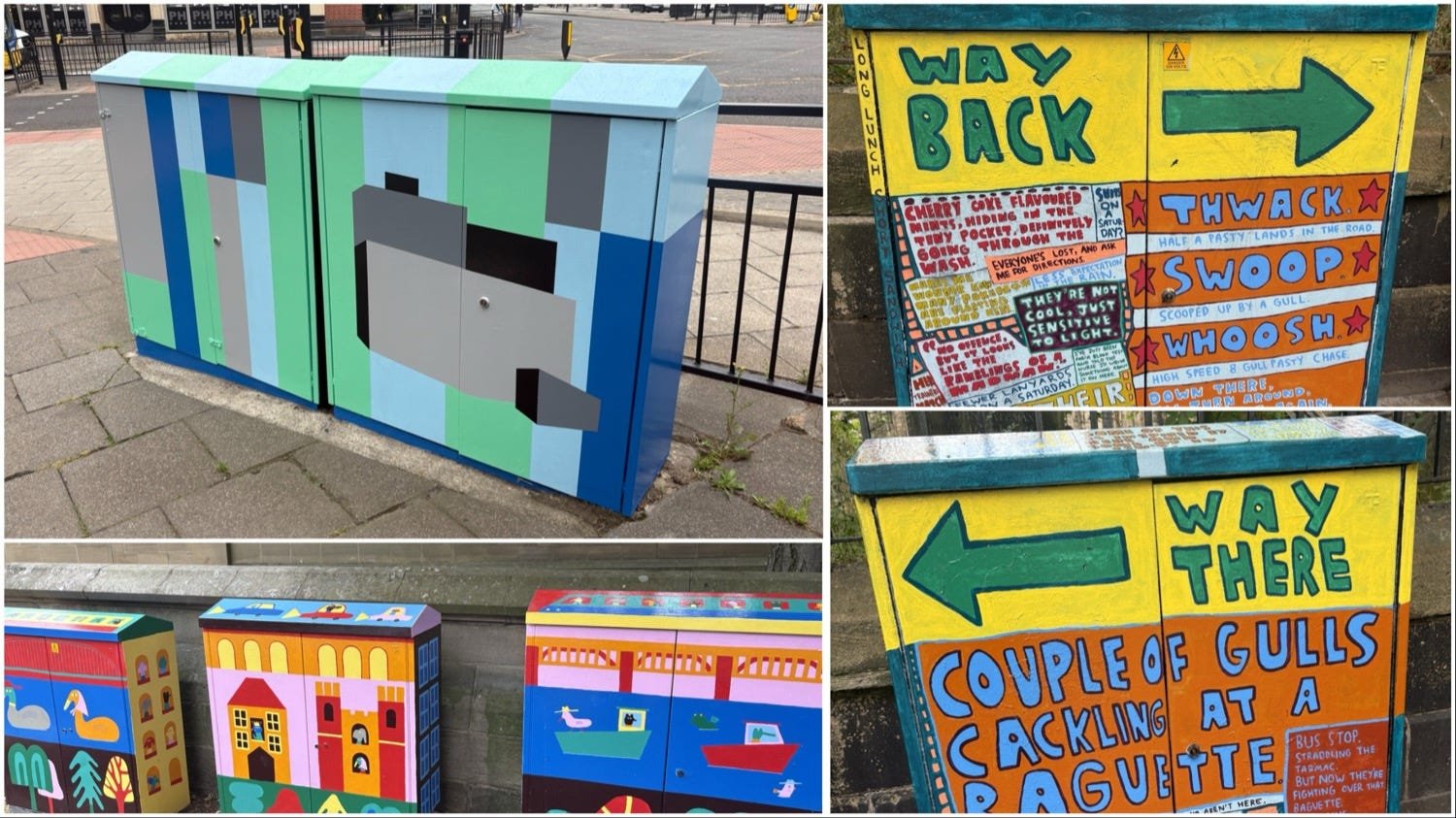
Clockwise from top left, utility boxes in Newcastle city centre from artists Emma Bennett, GRAEME and Aysha Tengiz
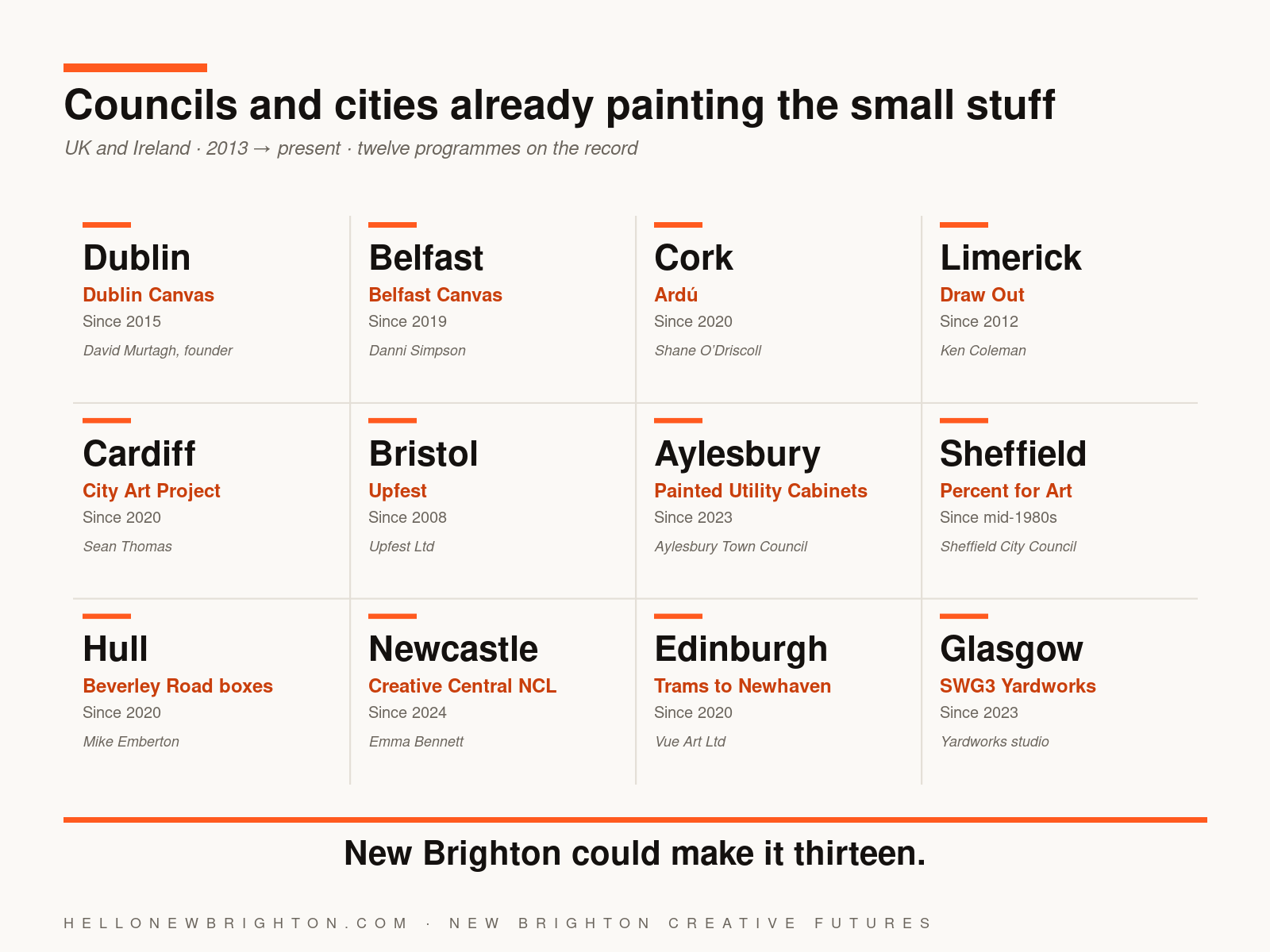
Hull City Council ran a signal-control-box trial on Beverley Road in 2020, three named artists (Mike Emberton, Lydia Caprani, Sean Azzopardi), with an explicit anti-vandalism rationale in the council press release. Cardiff has both a Council x University of South Wales illustration-student partnership and a remarkable one-man effort by a Cardiff Council caretaking officer called Sean Thomas, whose City Art Project has transformed more than a hundred walls, shutters and utility cabinets across Grangetown, Ely, Caerau and beyond over five years — with pieces including Lisa Derrick's abstract designs on the Grangetown embankment and, on Atlas Road in Canton, cabinets featuring her late dachshund William. Edinburgh commissioned eighteen box murals along Leith Walk and Constitution Street in 2020 as part of the Trams to Newhaven works, delivered by Vue Art with Tactical Media. Glasgow funds a small-street-furniture strand called "Outside The Box" through the SWG3 / Yardworks studio, paid for by the Council's Community In Place Fund and Creative Scotland. Aylesbury Town Council— a small English town council — has run its own utility-box scheme since 2023. Limerick has an eight-box strand within Draw Out, with named artists — Ken Coleman on Bedford Row, Darren Ryan on O'Connell Street, Margarita Bernal at Arthur's Quay, Kathy Tiernan on Rutland Street, Craya O'Donnell on Wickham Street, Leah O'Sullivan at Foxes Bow.
None of these places has invented anything that Wirral could not do. Some of them — Newcastle, Hull, Aylesbury — did it with programme budgets that would sit inside a single line of a Wirral committee paper without being noticed.
Why it works — the psychology, kept honest
There is a temptation, when arguing the civic case for painted street furniture, to reach immediately for "broken windows." The phrase is famous. James Q. Wilson and George L. Kelling published Broken Windows: The Police and Neighborhood Safety in The Atlantic in March 1982, and its central image — an unrepaired window signalling that no one cares, inviting more disorder — has been in the water ever since.
The theory as a policing doctrine has had a rough time in the peer-reviewed literature. Robert Sampson and Stephen Raudenbush, publishing in the American Journal of Sociology in 1999, videotaped 23,000 street segments across 196 Chicago neighbourhoods and found that, once you controlled for concentrated disadvantage and collective efficacy, the direct disorder-to-crime relationship largely disappeared (with the exception of robbery). Bernard Harcourt's 2001 Illusion of Order extended the critique. A 2015 meta-analysis by Braga, Welsh and Schnell in the Journal of Research in Crime and Delinquency found that whatever crime-reduction effect the wider "policing disorder" literature could support came from community and problem-solving strategies, not from aggressive misdemeanour arrests.
That, honestly stated, is the part of the story that does not hold up.
The part that does hold up is smaller, older and more useful. In December 2008, Kees Keizer, Siegwart Lindenberg and Linda Steg at the University of Groningen published a paper called The Spreading of Disorder in Science. Six field experiments in a Dutch city. The design was elegant: manipulate a single visible cue of neglect — graffiti on a wall, dropped fireworks, an abandoned shopping trolley — and measure whether people break a different, unrelated norm in the immediate vicinity. In their headline experiment, when an alley was clean, 33% of participants littered a flyer left on their bicycle. When the same alley was covered in graffiti, 69% littered. Roughly double. In a related experiment, when a mailbox area was tidy, 13% of passers-by pocketed a five-euro note visible through an addressed window envelope; against a graffiti backdrop, 27% did.
Visible neglect roughly doubles minor norm-breaking nearby. Visible care suppresses it. That is a claim the evidence properly supports.
There is a randomised controlled trial from Philadelphia (Branas et al., PNAS, 2018) which took 541 vacant lots, cleared, graded and grassed a randomised subset of them, and installed a low wooden fence — a signal, the authors were explicit, that someone was looking after the parcel. Eighteen months later, gun violence and residents' reported fear both fell in the neighbourhoods around the fully-greened lots. There is a small British field study from Newcastle (Nettle et al., PeerJ, 2014 showing that spending a short time in a visibly neglected neighbourhood measurably shifts a person's social attitudes toward the norms of that neighbourhood.
None of this is a promise that painting a bin will lower Merseyside Police's crime figures. It is a narrower claim: the physical state of the small objects on a street is a signal, and the signal changes how the street is used. In the language the Dublin Canvas team have been using since 2015, within the norms of street art itself, you have to be better than what's there to paint over it. A painted box is not a magnet for tagging. A grey one is.
The economics — a painted bin costs less than a replaced bin
The received wisdom is that leaving public assets to decay is a cost-saving strategy. It is not. It is a deferral.
A cast-iron heritage-style litter bin — the kind that would suit a Wirral promenade, and the kind Broxap in Staffordshire makes at scale — is priced by manufacturer quotation rather than public list, but the retail band across comparable British cast-iron heritage bins runs from roughly £700 to £1,500 or more per unit, before installation. A standard steel or plastic council bin, priced across Wybone and Glasdon ranges, sits at £75 to £500. A standard replacement street lamp column, on Wiltshire and Surrey County Councils' published highway schedules, is £2,600 to £3,700 installed. A Grade II listed heritage column, as Brighton and Hove City Council is finding in its £4 million programme to restore more than eighty seafront lanterns, can run to £50,000 per column on full conservation-grade restoration.
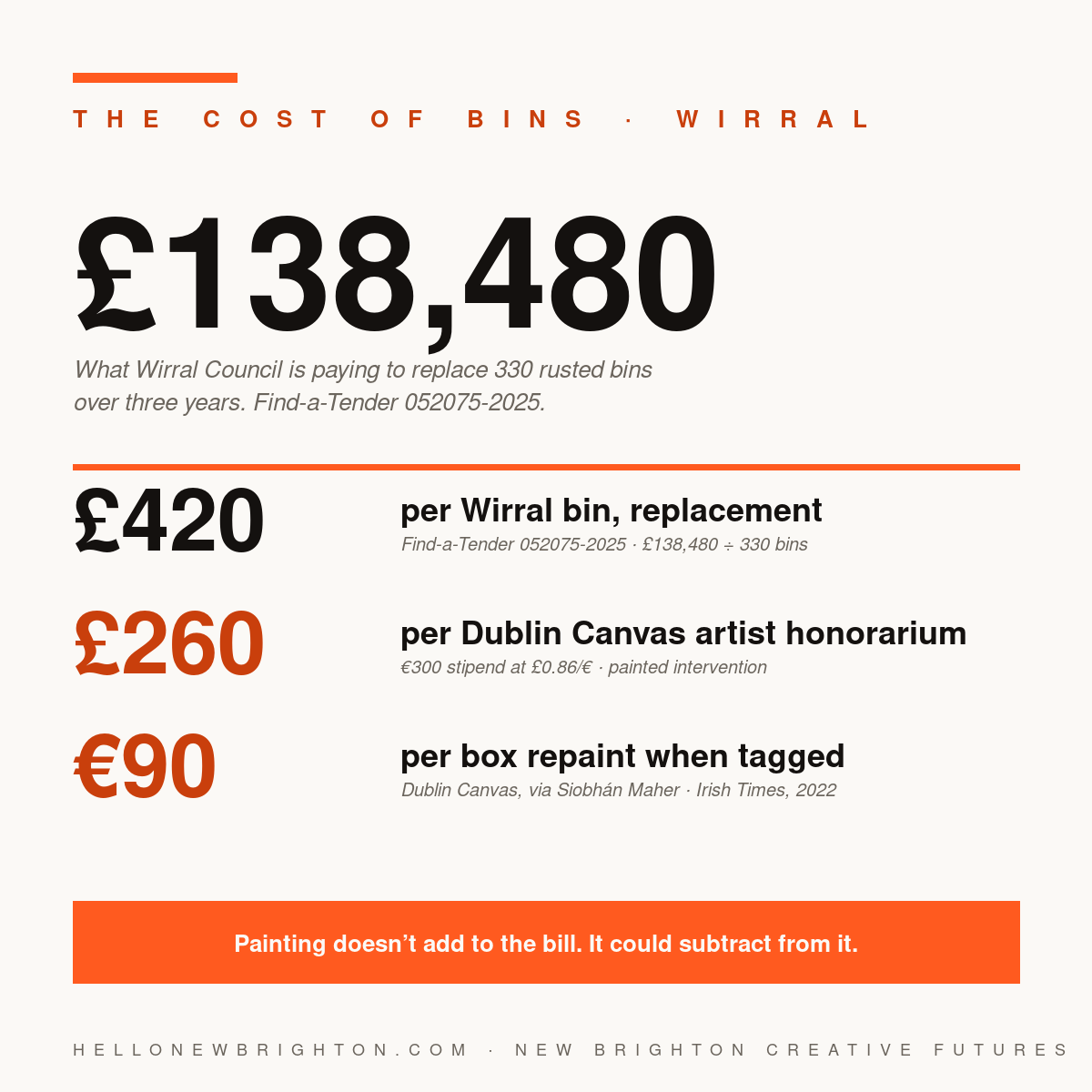
A commissioned artist repainting of a functional utility box, built on the Dublin Canvas benchmark plus [UK trade coating rates](https://puresealservices.co.uk/the-true-cost-of-graffiti-removal-a-uk-pricing-guide/), comes out at somewhere between £460 and £1,270 all-in per box. Roughly: an artist honorarium of £250–£500, materials at £30–£80, anti-graffiti coating at £130–£540 for a 1.5–3 square metre surface, and project management at £50–£150.
The comparison is not "shall we spend money on art we could spend on bins." The comparison is: for the price of replacing one dilapidated cast-iron bin, you could commission the painting of at least one, and in most cases two, functional utility boxes; for the price of replacing one Grade II heritage lamp column, forty; for the price of Wirral's already-tendered £138,480 three-year bin programme, you could paint every traffic-signal box in Birkenhead town centre and have change left over for evaluation.
That is not an argument for skipping the bin replacements. It is an argument for stopping the pretence that decay is neutral.
How councils actually do it — the mechanism
The mechanism matters, because the argument any council officer will fairly make in reply to a piece like this is: fine, but where in our machinery does it sit?
The Dublin template starts inside the Council's own innovation unit (Beta Projects, 2013), moves through the Culture and Public Domain functions once the pilot proves out, and settles as a joint-authority programme with staff officers on the selection panel. The Belfast template started with a committee paper — a September 2018 direction to its City Growth and Regeneration Committee, formalised in a March 2019 report — and £8,000 of existing Council budget matched by BID contributions from Cathedral Quarter and Belfast One. Bristol has taken a different route: a formally-tendered public-art delivery contract with Upfest, published on Find-a-Tender in 2025. The Sheffield template — for other public art — is a Percent for Art policy in place since the mid-1980s, developer-funded via the planning system, requiring no annual budget line at all.
All of these are available in outline to Wirral. The committee that owns street furniture on Wirral is the Environment, Climate Emergency and Transport Committee, which decided in June 2025 to retender the borough's waste and street-cleansing service on an eight-plus-eight-year contract running from August 2027. The committee that owns the cultural programme is Tourism, Communities, Culture and Leisure. The committee that owns the town centres is Economy, Regeneration and Housing, which adopted the Birkenhead and St Werburgh's masterplans in March 2025 with a £2 million UK Shared Prosperity Funding top-up. Any of the three can host a pilot; ideally the first pilot lives across all three, because the case for painted street furniture sits at the intersection of environment, culture and regeneration and belongs to none of them alone.
The natural policy hook already exists in Wirral. The Local Heritage List — 139 nominations by September 2025, draft consultation coming, adoption target 2026 — explicitly names street furniture (milestones, boundary stones, post boxes, lamp posts, statues, railings) as eligible for local listing. It is the first Wirral policy line in decades to treat street furniture as an asset with civic value rather than a maintenance liability. A commissioning strand sits naturally alongside a listing strand: some furniture is worth conserving; some is worth commissioning; some is worth both.
The Wirral turn
Everything above is here to make one point about Wirral in particular.
Our borough's street furniture is genuinely in poor shape. Anyone who walks a Wirral high street knows this without being told. The Council's own regeneration papers acknowledge it. The bin programme is a good, needed programme, and £138,480 for 330 bins over three years is not a scandal — it is a fair number for the job in front of it. But the job in front of it is only the replacement of the bins we already have. It does not address the utility cabinets, the bollards, the lamp columns, the surface of the boxes, the mood of the streets between them. It does not treat the small stuff as an asset. It treats it as an inventory.
There is another path, and it is not a radical one. It has been walked, at municipal scale, by Dublin since 2015; by Belfast since 2019; by Newcastle, Hull, Cardiff, Edinburgh, Glasgow, Aylesbury, Limerick, Bristol; by dozens of British and Irish councils quietly, competently, cheaply. And it starts, in almost every case, with a pilot.
We would like to propose one for Wirral.
Ten utility boxes and ten bins, in New Brighton — repainted through an open call to Wirral-connected artists, at Dublin Canvas rates, with a six-month evaluation framework agreed up front against baseline data (tagging incidence, cleansing call-outs, footfall, resident satisfaction).
New Brighton Creative Futures CIC — best known here as the steward of the OpenAIR Gallery in New Brighton's Victoria Quarter, but with the appetite and the infrastructure to deliver a small-scale programme of this shape — would like to be considered as one possible delivery partner, alongside any others the Council might invite to tender. Total programme cost, on the benchmark figures above, sits well inside a five-figure envelope. Total exposure to the Council of a well-designed pilot: less than a single set of five heritage-column refurbishments.
The point is not that this would be free. The point is that its cost sits in the same order of magnitude as its comparators — and buys a signal that a grey unit does not.
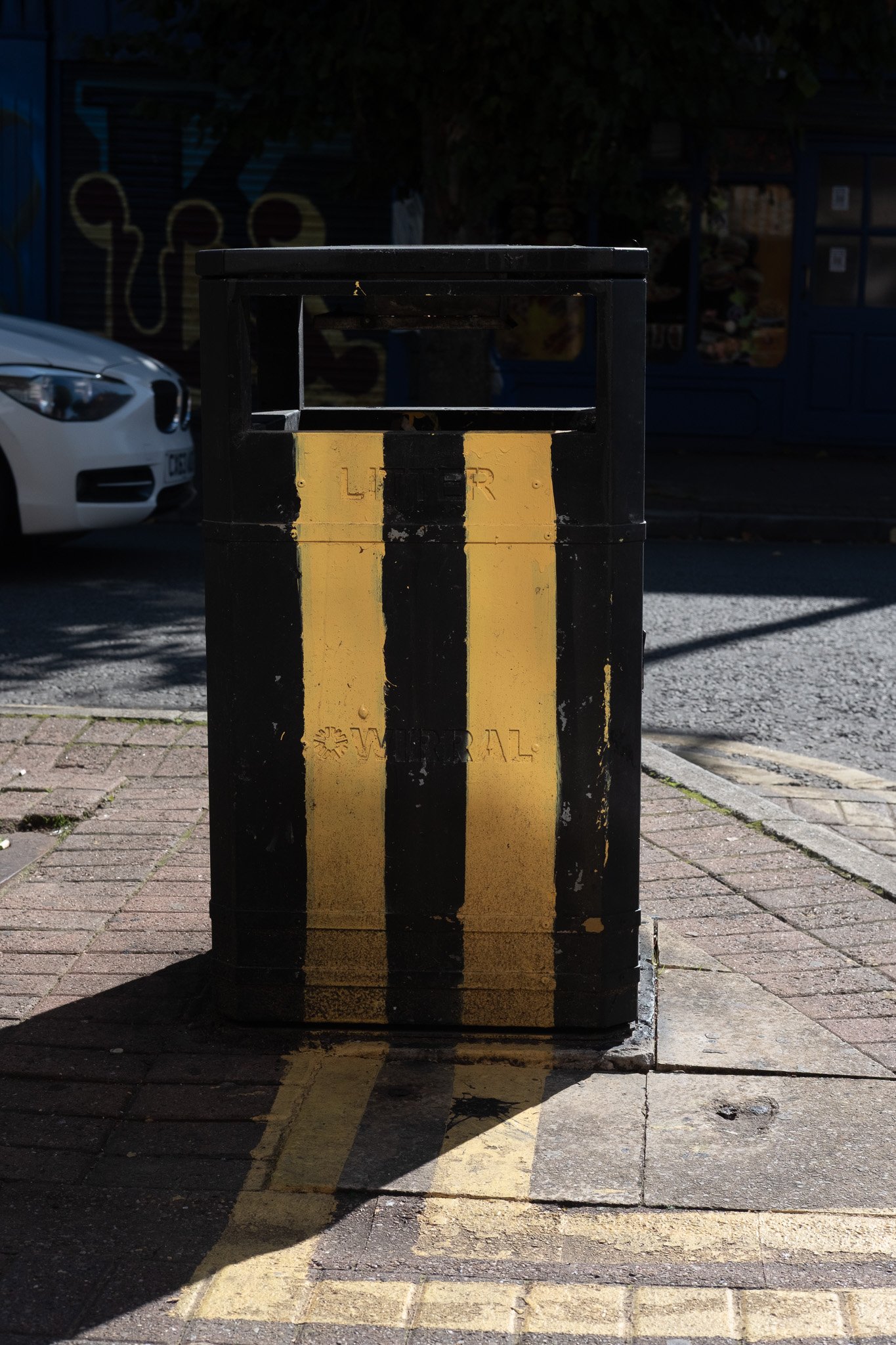
You can’t park there, mate! Victoria Quarter, New Brighton.
We should be honest, in closing, that this article has a context. Over the past eight years, local artists have on occasion made interventions on street furniture in New Brighton, and the Council has enforced against them.
But the same Council has, in its Birkenhead Masterplan, in its Local Heritage List project, in its Culture and Leisure committee, in its Regeneration and Place directorate, a set of levers with which the other conversation could be had. Enforcement is one lens. Commissioning is another. Dublin's councils, faced with essentially the same choice a decade ago, chose commissioning, and their traffic-signal boxes are now a small national point of pride. Belfast's councillors, faced with the same choice, wrote a committee paper and found £8,000. Newcastle, Hull, Cardiff, Edinburgh, Glasgow did the same.
None of them stopped enforcing against unauthorised work. All of them added a route by which authorised work could happen.
We would very much like to see Wirral consider adding that route.
Ten bins, ten boxes, one ward, an artist call-out and an evaluation framework. It is not a manifesto. It is a proposition. And if it works — measured properly, against a baseline, over six months — it becomes a template for the next town centre, and the one after that.
It is a small thing, in a big borough.
But it is the small thing our borough looks at every day.
Rory Wilmer is a Director of New Brighton Creative Futures CIC (Company No. 16547042), custodian and commissioner of the OpenAIR Gallery, New Brighton. NBCF is happy to be contacted by Wirral Council, or any other party who might find this article useful, at info@hellonewbrighton.com
See it for yourself — the works discussed
Every named programme in the piece, one link away from the actual work.
Dublin Canvas (Dublin City / Dún Laoghaire / Fingal / South Dublin — traffic-signal boxes since 2015; over 900 painted). Programme site · Artist gallery · Instagram · Irish Times feature with photographs, Nov 2023
Belfast Canvas (Belfast City Council + Belfast One / Cathedral Quarter BIDs — junction boxes since 2019; 130+ boxes across five phases). BCC Art in Belfast page · Extramural Activity photo archive of every phase · Daisy Chain Inc delivery-partner project page
Creative Central NCL (Newcastle City Council + North East Mayoral Strategic Authority — Newcastle city-centre utility boxes, 2024–26). Programme site · Cultured. North East feature with photos of Aysha Tengiz, GRAEME and Emma Bennett’s work · Aysha Tengiz portfolio
Hull City Council — Beverley Road signal-box trial 2020 (Emberton / Caprani / Azzopardi, ten sites). Council press release with photographs · Follow-up 2021
Cardiff — City Art Project (Sean Thomas, Cardiff Council caretaking officer; 100+ walls, shutters and cabinets across the city over five years). The Cardiffian, March 2026, with photographs of Sean Thomas, Lisa Derrick’s Grangetown embankment box, and the Whitchurch High School underpass fish scheme · Lisa Derrick’s Instagram
Edinburgh — Trams to Newhaven utility-box murals (City of Edinburgh Council, 18 boxes on Leith Walk and Constitution Street, 2020). Council press release · Dedicated artist gallery · Edinburgh News coverage
Glasgow — SWG3 / Yardworks “Outside The Box” (Glasgow City Council Community In Place Fund + Creative Scotland, G.R.I.D. Programme; Partick / Yorkhill / Govan). Yardworks · Long-form explainer (Glasgow Splash) · Yardworks Festival 2025 gallery
Aylesbury Town Council — Painted Utility Cabinets (since 2023; 20+ cabinets). Council programme page — a scrollable gallery of every painted cabinet
Limerick — Draw Out utility boxes (Draw Out, founded by Catherine O’Halloran 2012; 8 boxes with named artists on named streets). I Love Limerick feature with all eight works · Draw Out · Limerick Council programme announcement
Bristol — Upfest (Council-tendered public-art delivery contract, Centre Promenade, 2025). Find-a-Tender notice 047257-2025 · Upfest Gallery
Sources and bibliography
Every claim in the piece is supported by one of the sources below.
Wirral — the local anchor
Wirral Council, Birkenhead Town Centre Masterplan and St Werburgh’s Masterplan, adopted by the Economy, Regeneration and Housing Committee, 12 March 2025. https://wirral.gov.uk/planning-and-building/local-plans-and-planning-policy/wirrals-new-local-plan/new-local-plan-2
Wirral View, March 2025: Unpacking the latest developments in Wirral’s regeneration. https://wirralview.com/regeneration/march-2025-unpacking-latest-developments-wirrals-regeneration
UK Find-a-Tender notice 052075-2025 — Wirral MBC on-street litter bins replacement programme (£115,400 ex VAT / £138,480 inc VAT, 20 October 2025 – 19 October 2028; ~330 bins; “aesthetic features, durability and value for money”). https://www.find-tender.service.gov.uk/Notice/052075-2025
UK Find-a-Tender notice 032346-2025 — Wirral MBC recycling, refuse and street-cleansing contract, 1 August 2027 – 31 July 2035 (option to 2043). https://www.find-tender.service.gov.uk/Notice/032346-2025
Wirral Council, Environment, Climate Emergency and Transport Committee — committee details. https://democracy.wirral.gov.uk/mgCommitteeDetails.aspx?ID=911
Wirral Council, Economy, Regeneration and Housing Committee, 10 July 2025 reports pack. https://wirral.moderngov.co.uk/documents/g12046/Public%20reports%20pack%2010th-Jul-2025%2018.00%20Economy%20Regeneration%20Housing%20Committee.pdf?T=10
Wirral View, New waste strategy to be considered by committee (naming “Rethinking Waste: Reduce, Reuse, Recycle, Recover 2025-2030”). https://wirralview.com/environment/new-waste-strategy-be-considered-committee
Wirral Council, Litter bins service page. https://www.wirral.gov.uk/environmental-problems/street-care-and-cleaning/litter-bins
Local Heritage List for Wirral (Historic England / Wirral partnership). https://local-heritage-list.org.uk/wirral
Wirral Council, Local listing of heritage assets in Wirral. https://www.wirral.gov.uk/planning-and-building/built-conservation/local-listing-heritage-assets-wirral
Wirral View, Wirral’s Local List grows to 139 landmarks, with deadline now extended. https://wirralview.com/regeneration/wirrals-local-list-grows-139-landmarks-deadline-now-extended
Birkenhead News, Wirral Council’s £2m clean-up spend under scrutiny. https://www.birkenhead.news/wirral-councils-2m-clean-up-spend-under-scrutiny/
Wirral View, Taking the long-term view — waste collections and street cleansing. https://wirralview.com/environment/taking-long-term-view-waste-collections-and-street-cleansing
Local Government Association, Corporate Peer Challenge, Wirral MBC, November 2024. https://www.local.gov.uk/our-support/council-assurance-and-peer-challenge/peer-challenges-we-offer/corporate-peer-86
Dublin Canvas
Dublin Canvas, official programme site: About and Paint a Box 2026. https://www.dublincanvas.com/about · https://www.dublincanvas.com/paint-2026 · https://www.dublincanvas.com/ [imagery: full artist gallery at /artist-profiles-main; Instagram at @dublincanvas]
Eolas Magazine, David Murtagh: A Blank Canvas, March 2018 — profile confirming the Brisbane 2006 origin, Diageo redundancy in 2014, and the 2008 Temple Bar vinyl-wrap pilot. https://www.eolasmagazine.ie/david-murtagh-a-blank-canvas/
Conor Capplis, Dublin Canvas: On street corners around the city, art quietly thrives, The Irish Times, 5 November 2023. https://www.irishtimes.com/culture/art/2023/11/05/dublin-canvas-on-street-corners-around-dublin-art-quietly-thrives/ [imagery: four photographs; also carries the 853-boxes, two-thirds women / one in four non-Irish, funding split figures]
Gemma Tipton, How to paint a traffic utility box on an Irish street corner, The Irish Times, 6 September 2022 — source of the Siobhán Maher “€90 / weekly touch-up” quote and the “better than what’s there to paint over it” line. https://www.irishtimes.com/culture/art/2022/09/06/how-to-paint-a-traffic-utility-box-on-an-irish-street-corner/
Dublin.ie (Dublin Local Authorities own platform), Dublin Canvas long-form interview with David Murtagh. https://dublin.ie/live/stories/dublin-canvas/
Dublin Canvas open dataset (locations, image links, CC-BY 4.0). https://data.gov.ie/dataset/dublin-canvas-public-art [imagery: full location dataset with image URLs]
Belfast Canvas & other Belfast programmes
Belfast City Council, City Growth and Regeneration Committee, Belfast Canvas Pilot Proposal, minutes covering the September 2018 direction and the March 2019 pilot report. https://minutes.belfastcity.gov.uk/mgAi.aspx?ID=48673
Belfast City Council, Art in Belfast programme page. https://www.belfastcity.gov.uk/things-to-do/tourism-and-culture/culture/art-in-belfast
Daisy Chain Inc, Belfast Canvas project page (Phase V delivery). https://www.daisychaininc.co/projects/belfast-canvas [imagery]
Extramural Activity, Belfast Canvas — painted utility boxes photo archive. https://extramuralactivity.com/belfast-canvas-painted-utility-boxes/ [imagery — best single visual archive of every phase]
Other UK council programmes
Sam Wonfor, Newcastle’s latest artworks are hiding in plain sight, Cultured. North East, 27 August 2026 — source for Creative Central NCL utility-box cohort, artist names (Aysha Tengiz, GRAEME, Emma Bennett), locations, and funding attribution. https://www.culturednortheast.co.uk/p/newcastles-latest-artworks-are-hiding [imagery]
Creative Central NCL programme site. https://creativecentralncl.co.uk/
Aysha Tengiz portfolio. https://ayshatengiz.com/ [imagery]
Hull City Council press release, Artwork to adorn Hull’s most vandalised spots, 7 July 2020 — source for the Beverley Road signal-box trial, named artists Mike Emberton, Lydia Caprani and Sean Azzopardi, and the Cllr Daren Hale quote. https://news.hull.gov.uk/07/07/2020/artwork-to-adorn-hulls-most-vandalised-spots/ [imagery]
Hull City Council press release, Hull artists’ innovative designs to tackle vandalism recognised on world stage, 14 June 2021 — follow-up. https://news.hull.gov.uk/14/06/2021/hull-artists-innovative-designs-to-tackle-vandalism-recognised-on-world-stage
Ellen Cranstone, “Art belongs everywhere”: meet the people turning vandalism into works of beauty, The Cardiffian (Cardiff University Journalism School), 20 March 2026 — Sean Thomas, City Art Project, Lisa Derrick, Whitchurch High School Tŷ Calon underpass. https://journalism-school.cardiff.ac.uk/thecardiffian/2026/03/20/art-belongs-everywhere-meet-the-people-turning-vandalism-into-works-of-beauty/ [imagery]
Lisa Derrick, Instagram portfolio. https://www.instagram.com/lisajderrick/ [imagery]
City of Edinburgh Council, Street art enlivens Leith Walk and Constitution Street, 23 October 2020 — Trams to Newhaven Support for Business programme; Cllr Karen Doran; Vue Art Ltd and Tactical Media delivery. https://www.edinburgh.gov.uk/tramstonewhaven/news/article/69/street-art-enlivens-leith-walk-and-constitution-street [imagery — dedicated gallery at /leith-walk-constitution-street-murals/1]
The Glasgow Splash, Urban Canvas: how SWG3’s Yardworks has taken over the west end — long-form explainer sourcing the “Outside The Box” strand, GCC Community In Place Fund + Creative Scotland funding, G.R.I.D. Programme framing. https://theglasgowsplash.substack.com/p/urban-canvas-how-swg3s-yardworks
SWG3 Yardworks. https://swg3.tv/explore/yardworks/ [imagery]
Aylesbury Town Council, Painted Utility Cabinets programme page — every cabinet, artist, street and statement. https://www.aylesburytowncouncil.gov.uk/council-services/painted-utility-cabinets/ [imagery]
I Love Limerick, Limerick utility boxes 2 — Draw Out utility-box strand; all eight named artists on their streets. https://www.ilovelimerick.ie/limerick-utility-boxes-2/ [imagery]
Draw Out. https://drawout.ie/
Limerick City and County Council, Draw Out — Urban Exhibitionist returns to the streets of Limerick. https://www.limerick.ie/council/newsroom/news/draw-out-urban-exhibitionist-returns-streets-limerick
UK Find-a-Tender notice 047257-2025 — Bristol City Council award to Upfest Ltd for Centre Promenade public art, £35,000 ex VAT, 7 August – 30 November 2025. https://www.find-tender.service.gov.uk/Notice/047257-2025
Public Art Online, Sheffield — Percent for Art strategy (150+ public art commissions since 1985). https://publicartonline.org.uk/resources/practicaladvice/policiesguidance/strategies/sheffield.php.html
Behavioural economics and environmental psychology
James Q. Wilson & George L. Kelling, Broken Windows: The Police and Neighborhood Safety, The Atlantic Monthly 249(3), March 1982, pp. 29–38. https://media4.manhattan-institute.org/pdf/_atlantic_monthly-broken_windows.pdf
Kees Keizer, Siegwart Lindenberg & Linda Steg, The Spreading of Disorder, Science 322(5908): 1681–1685 (12 December 2008). DOI 10.1126/science.1161405. https://www.science.org/doi/10.1126/science.1161405
Robert J. Sampson & Stephen W. Raudenbush, Systematic Social Observation of Public Spaces: A New Look at Disorder in Urban Neighborhoods, American Journal of Sociology 105(3): 603–651 (November 1999). DOI 10.1086/210356. https://www.journals.uchicago.edu/doi/10.1086/210356
Bernard E. Harcourt, Illusion of Order: The False Promise of Broken Windows Policing, Harvard University Press, 2001. https://www.hup.harvard.edu/catalog.php?isbn=9780674015906
Anthony A. Braga, Brandon C. Welsh & Cory Schnell, Can Policing Disorder Reduce Crime? A Systematic Review and Meta-Analysis, Journal of Research in Crime and Delinquency 52(4): 567–588 (2015). DOI 10.1177/0022427815576576. https://journals.sagepub.com/doi/10.1177/0022427815576576
Charles C. Branas, Eugenia South, Michelle C. Kondo, et al., Citywide cluster randomized trial to restore blighted vacant land and its effects on violence, crime, and fear, PNAS 115(12): 2946–2951 (2018). https://www.pnas.org/doi/10.1073/pnas.1718503115
Daniel Nettle, Gillian V. Pepper, Ruth Jobling & Kari Britt Schroeder, Being there: a brief visit to a neighbourhood induces the social attitudes of that neighbourhood, PeerJ 2: e236 (14 January 2014). https://peerj.com/articles/236/
Economics of street furniture
Wybone Ltd — outdoor litter bin product categories. https://wybone.co.uk/product-category/litter-bins/outdoor-litter-bins/
Glasdon UK — Futuro litter bin. https://uk.glasdon.com/futuro-tm-litter-bin
Broxap — Heritage cast-iron 58L, Square cast-iron 115L, cast-iron category. https://www.broxap.com/heritage.html · https://www.broxap.com/square-standard.html · https://www.broxap.com/litter-bins/cast-iron-litter-bins.html
Wiltshire Council, Costs of highway works. https://www.wiltshire.gov.uk/article/1281/Costs-of-highway-works
• Surrey County Council, Highway Works Cost Schedule. https://mycouncil.surreycc.gov.uk/documents/s51054/Annex%202%20Highway%20Works%20Cost%20Schedule.pdf
Brighton & Hove City Council, Restoring our seafront lighting to its former glory, 2025 — £4m programme, 80+ Grade II listed lanterns. https://www.brighton-hove.gov.uk/news/2025/restoring-our-seafront-lighting-its-former-glory
Institute for Fiscal Studies, How have English councils’ funding and spending changed? https://ifs.org.uk/publications/how-have-english-councils-funding-and-spending-changed-2010-2024
House of Commons Housing, Communities and Local Government Committee, Local government finance and the 2019 Spending Review — 49.1% real-terms fall in government funding 2010–11 to 2017–18, 28.6% real-terms fall in spending power. https://publications.parliament.uk/pa/cm201719/cmselect/cmcomloc/2036/203605.htm
Institute for Government, Performance Tracker 2023 — Neighbourhood Services. https://www.instituteforgovernment.org.uk/publication/performance-tracker-2023/neighbourhood-services
Pure Seal Services, UK anti-graffiti coating trade rates. https://puresealservices.co.uk/the-true-cost-of-graffiti-removal-a-uk-pricing-guide/
CommissionIt, UK mural and graffiti-artist commission rates. https://www.commissionit.co.uk/product-category/art-commissions-furniture-jewellery/commercial_art_commissions/graffiti_murals/
If a claim in the piece above is not covered by one of these sources, that is a bug — please tell us and we will correct it.
