![[NB] Creative Futures CIC](http://images.squarespace-cdn.com/content/v1/68c276df7928f778938222f2/98488c41-8030-41a8-b1b4-ee4c899d7119/NBCF+BRAND+MASTER+copy-16.png?format=1500w)
The man the starlings wait for
Kenny Dunn has been keeping New Brighton clean for over ten years. The starlings know him by now.
Nine o’clock on a Tuesday morning at the end of August. The sky is low over the promenade. A sea breeze is spitting a fine cold rain — the first proper shift of the year, the end of a long, hot summer sliding into something else. Out on the estuary, half a dozen sailboats drift on the flat grey water, dwarfed by the container ship moored in the docks beyond them and by the tankers moving slowly through Liverpool Bay towards the sea.
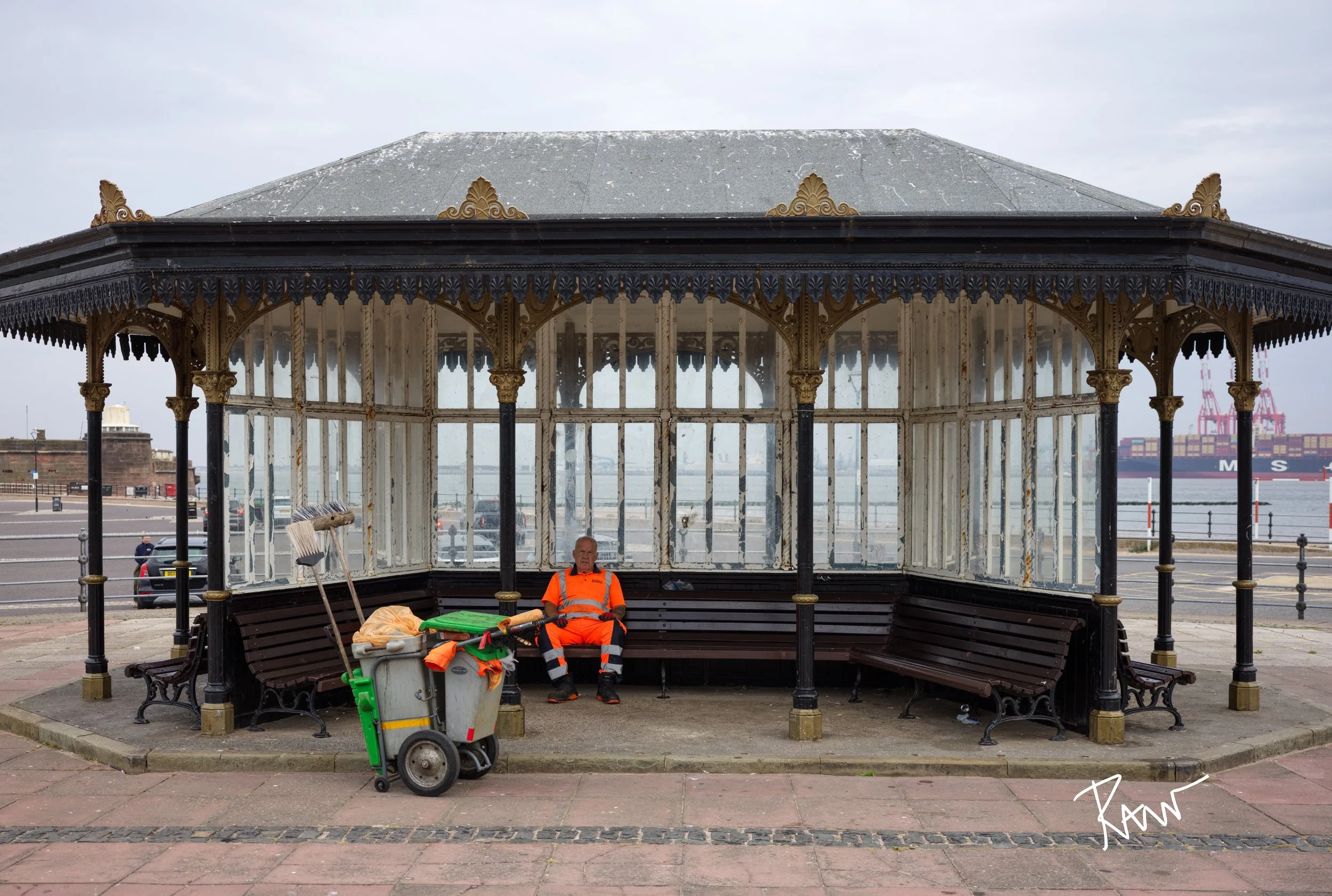
Nine o’clock on a Tuesday morning. The Fort in the distance, a container ship in the docks, Kenny taking a moment. Photo: Rory Wilmer, NBCF CIC.
Kenny Dunn is already out. Orange hi-vis, orange trousers, methodical pace, somewhere between the Fort and the Marine Lake. He is a Biffa street cleaner — has been for over ten years — and this is his round. The Palace, the Marine Lake, the promenade railings, the shelters, the alleys around Victoria Road. He is easy to spot — his hi-vis reads like a beacon at fifty yards — and the town knows him by sight. A lot of it knows him by name.
Behind him, tucked into his cart, are the same orange bags as his shirt. He carries the town’s rubbish in a colour that matches the man carrying it.
Every so often, when he stops, the starlings arrive.
They don’t cluster and squabble the way the seagulls do. They walk. They walk along the pavement in a loose, methodical formation, keeping his pace, keeping his line. When he stops to sweep or to bend into a bin, they stop too. They gather at his feet — perched neatly on the paving, tight little bodies, heads cocked upward — and they wait. They have learned, over months and years, that at some point Kenny will reach into his cart and bring out a handful of the treats he keeps there for them.
They know the man. They know the cart. They know it will come.
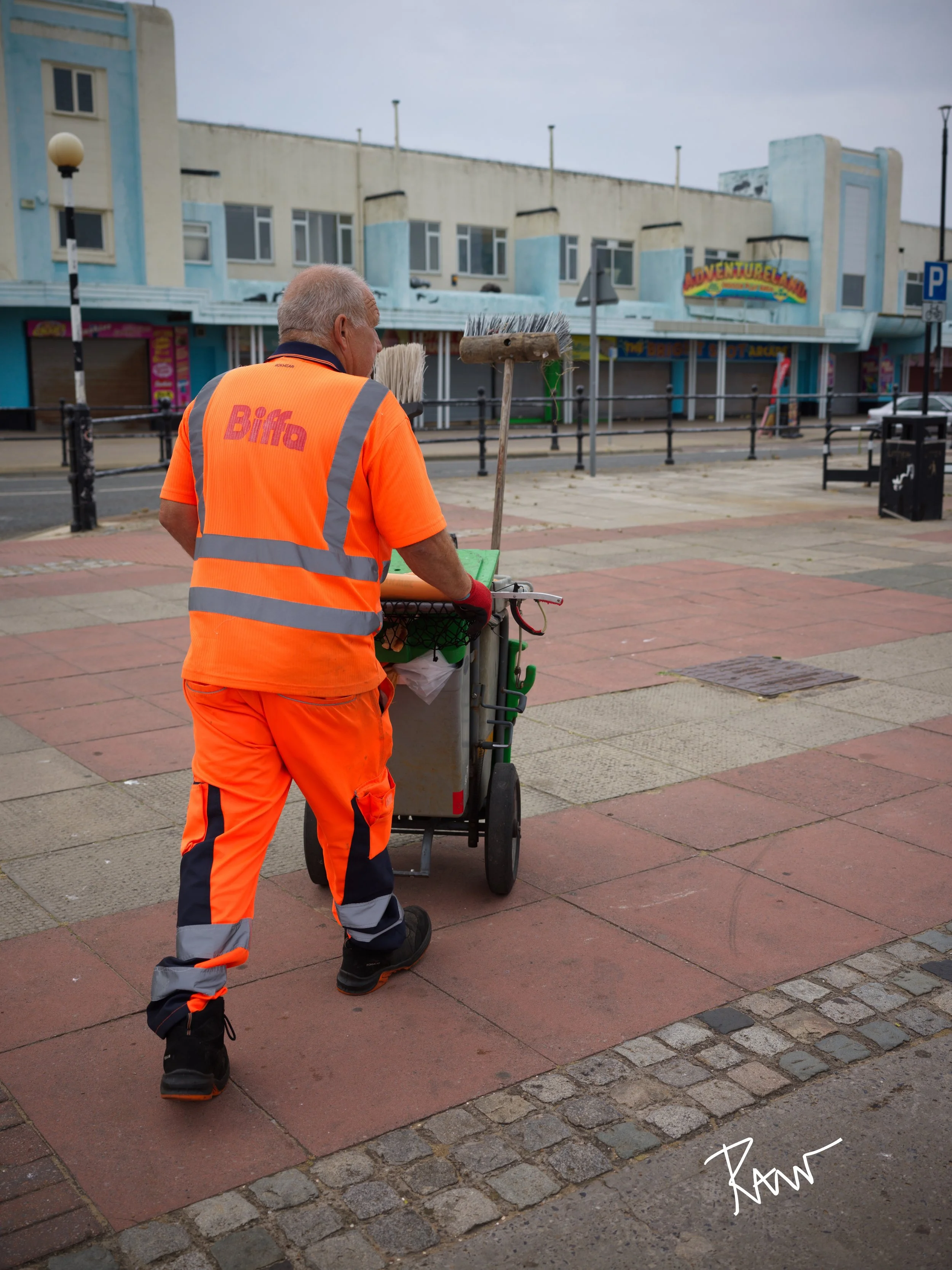
Photo: Rory Wilmer, NBCF CIC.
The job keeps him fit. Ten years of walking these streets means Kenny knows every alleyway, every bench, every bin lock that’s broken. The variety of things people leave for him to remove is, in his telling, a small ongoing anthropology of the town.
Full households of rubbish get pushed into street bins overnight. A complete set of gym weights, once — he had to lift them out one at a time. Lorry batteries. A chair, pushed in by one leg with the rest sticking up out of the top. “They thought, well, they’ve deposited it and that’s good enough,” he says, with the flat, unsurprised patience of someone who has seen it before.
Twice, he has fished out urns of human ashes. One plastic, one stainless steel. He mentions the stainless steel one with something close to regret — “Lovely one as well. It was a shame to throw it away, really.” — and moves on, because he has bins to empty.
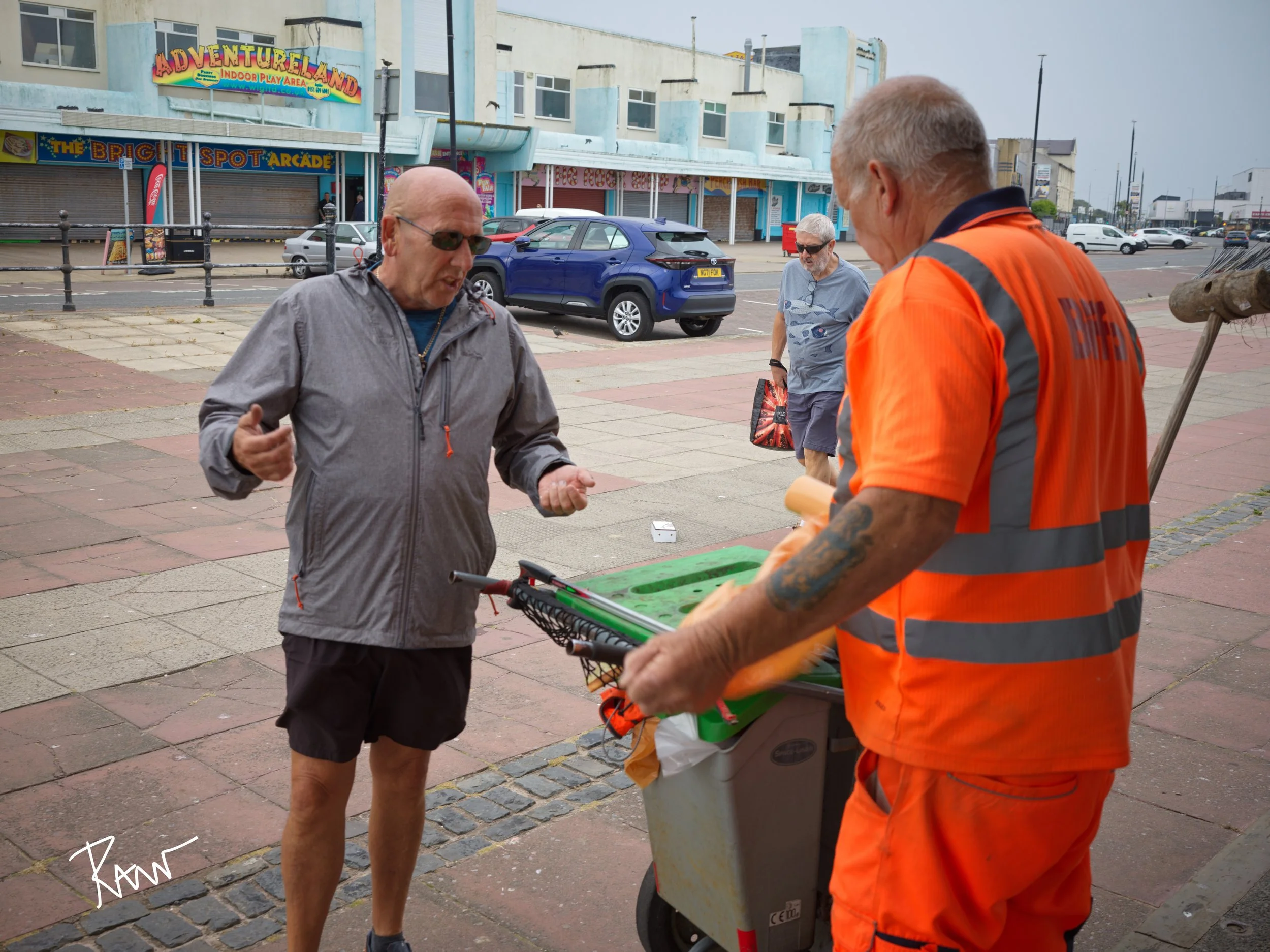
A man stops to ask Kenny for a bin bag to cover his mum’s lawnmower. Photo: Rory Wilmer, NBCF CIC.
The job is public in a way most aren’t. He is stopped constantly. Someone asks him for a bin bag; needs it to cover his mum’s lawnmower, apparently. Someone else wants to know where the town centre is. Someone else just wants to say hello. In the time we spent with him for this piece, half of New Brighton walked past to nod, wave, ask something, or exchange a word. He knows the ones who work here. He knows the regulars who walk here. He recognises the coach parties before they recognise him.
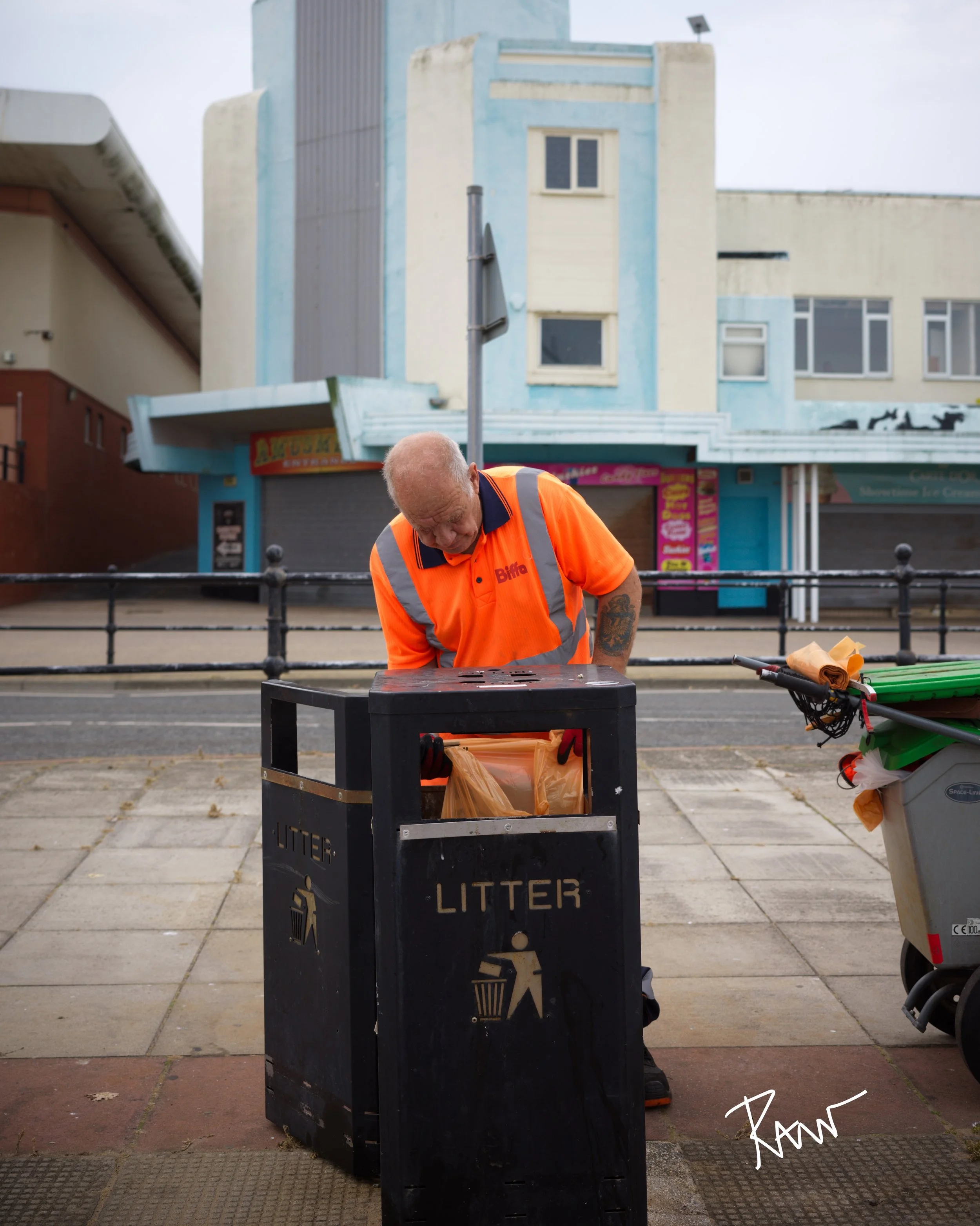
On the round — the Palace arcades behind, the sea a few paces at his back. Photo: Rory Wilmer, NBCF CIC.
Kenny grew up coming down here.
When we joke that he looks younger than he ought to — a decade of the shift, in all weathers, all those miles walked, and he still doesn’t quite look his age — he tells us the trick. He was born on the 29th of February. Leap year.
“Yeah — I’ll be celebrating my 18th birthday.”
His eighteenth leap-year birthday will be the 29th of February, 2028. He will be seventy-two on the day. He is, in ordinary reckoning, seventy now. Which places him, as a boy, in the sixties — a Wirral boy in the era when a bank holiday meant the family piled into the car and drove down to the front, and the front still had all its assets.
“We used to come down every bank holiday, with my dad, me mum. This place was amazing.”
The fair was up on the tower grounds. The tower itself — a great iron thing, one of the tallest structures in Britain when it went up in 1900, taller than Blackpool’s — had been dismantled between the wars, when the money to keep it painted and safe ran out; but the pleasure grounds around its base were still busy, still humming with rides and stalls and the noise of children who knew they had a whole day of it ahead. At the foot of the grounds stood the Tower Ballroom — one of the largest in the country, big enough to swallow ten thousand people on a Saturday night — and through the sixties the beat bands played in it, Merseybeat and the touring acts of the day, so that a Wirral family could spend the daylight hours on the sand and the evening in a room where the whole coast came to dance.
He remembers the ride up. He remembers the noise. He doesn’t need to describe it in more detail because his face does that.
And then there were the pools.
Not one, and not side by side — two separate lidos, on opposite sides of the same town, each doing its own job.
The Derby Pool was up at Harrison Drive, on the far side of the golf links, opened in 1932 and built with the ratepayers of Wallasey in mind. Locals used it. It was the workaday pool — plainer, unshowy, the one you walked to.
The New Brighton Bathing Pool was down on the promenade. It opened in 1934, declared open by Lord Leverhulme in front of a crowd of twelve thousand, and it was described — accurately — as the largest and finest aquatic stadium in the world. An enormous Art Deco lido with cantilevered concrete diving boards, tiered seating for twelve thousand spectators, underwater lights for evening swims, music piped over speakers by day. One hundred thousand people went through the turnstiles in its first week. Three hundred and fifty thousand paid to get in during the first four weeks alone. It was, briefly, a wonder of the world — and it was also, for a boy from the Wirral, an ordinary place. It was the Saturday of a child’s summer.
“We spent like six weeks of our holidays there.”
Six weeks. The entire summer of a boyhood, unpacked outdoors, over and over, year after year. Deckchairs on the terraces. Ice creams from the kiosk. The smell of chlorine and sunscreen. Children swimming until their fingers wrinkled, then sitting on the warm concrete until they dried, then going back in. His mum, his dad, the fair, the pool, the ships going by in the distance, the sun setting over the estuary in a colour he probably couldn’t name at ten but could still describe now.
Then, one by one, the town lost them.
The Tower Ballroom went first. It burned down in the early hours of the 5th of April 1969 — the fourth fire the tower complex had suffered, and this time the final one. Twenty-five fire pumps, four turntable ladders, walls collapsing before the brigade could save it. Kenny was thirteen. The site was later redeveloped as a park.
The Derby Pool went next. Battered by storms through the seventies, patched and reopened and patched again, it was eventually closed for good when the council decided the repair bill was more than the pool was worth. The remaining buildings were cleared in March 1984.
The New Brighton Bathing Pool held out longest. It lasted until the night of the 26th of February 1990, when a hurricane came in off the Irish Sea with winds over a hundred miles an hour and hammered the coast for two straight days. The pool, in the council’s own words afterwards, had been “battered virtually to destruction”. The repair bill was more than four million pounds. The Merseyside Development Corporation bulldozed what was left in the summer of 1990. The site sat empty for twenty years. When it was finally redeveloped — as Marine Point, in 2011 — there was no new pool. There was a cinema, a hotel, a Morrisons, a casino (now closed), chain restaurants, franchised coffee shops and a car park.
“Unfortunately they’ve gone now as well,” he says — and the sentence just sits there. It is not a complaint. It is a matter-of-fact accounting of what a town has and hasn’t. Kenny doesn’t trade in nostalgia — you can hear him refusing to — but you can also hear what it costs him to keep his voice level when he lists the things that used to be here.
You can read it as three unrelated accidents — a fire, a storm, a bigger storm. You can also read it as one long decision made three times over, in three different decades, by three different councils and corporations: that every time the town lost something, it cost less to demolish than to rebuild. New Brighton was not shuttered. It was managed down.
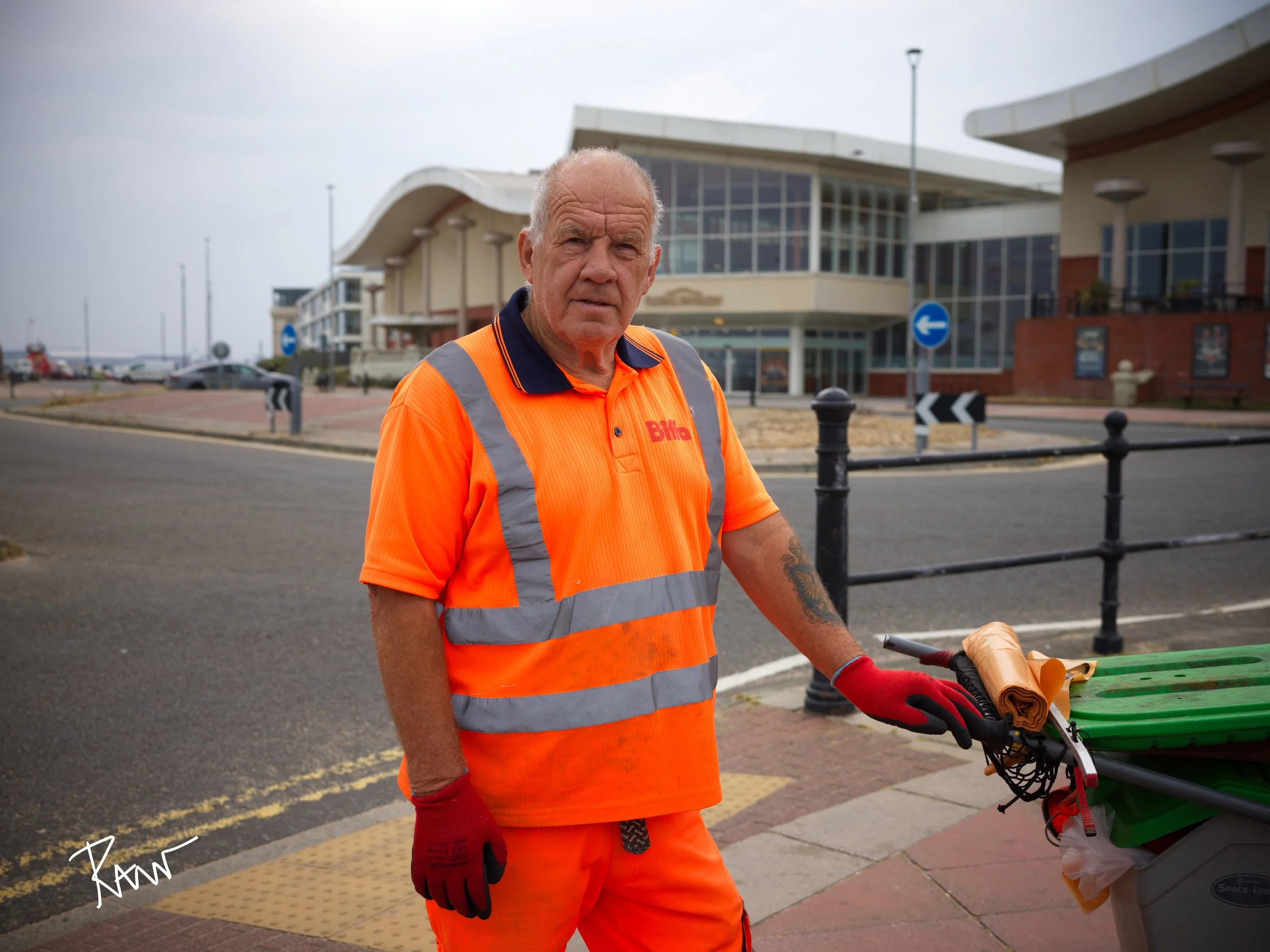
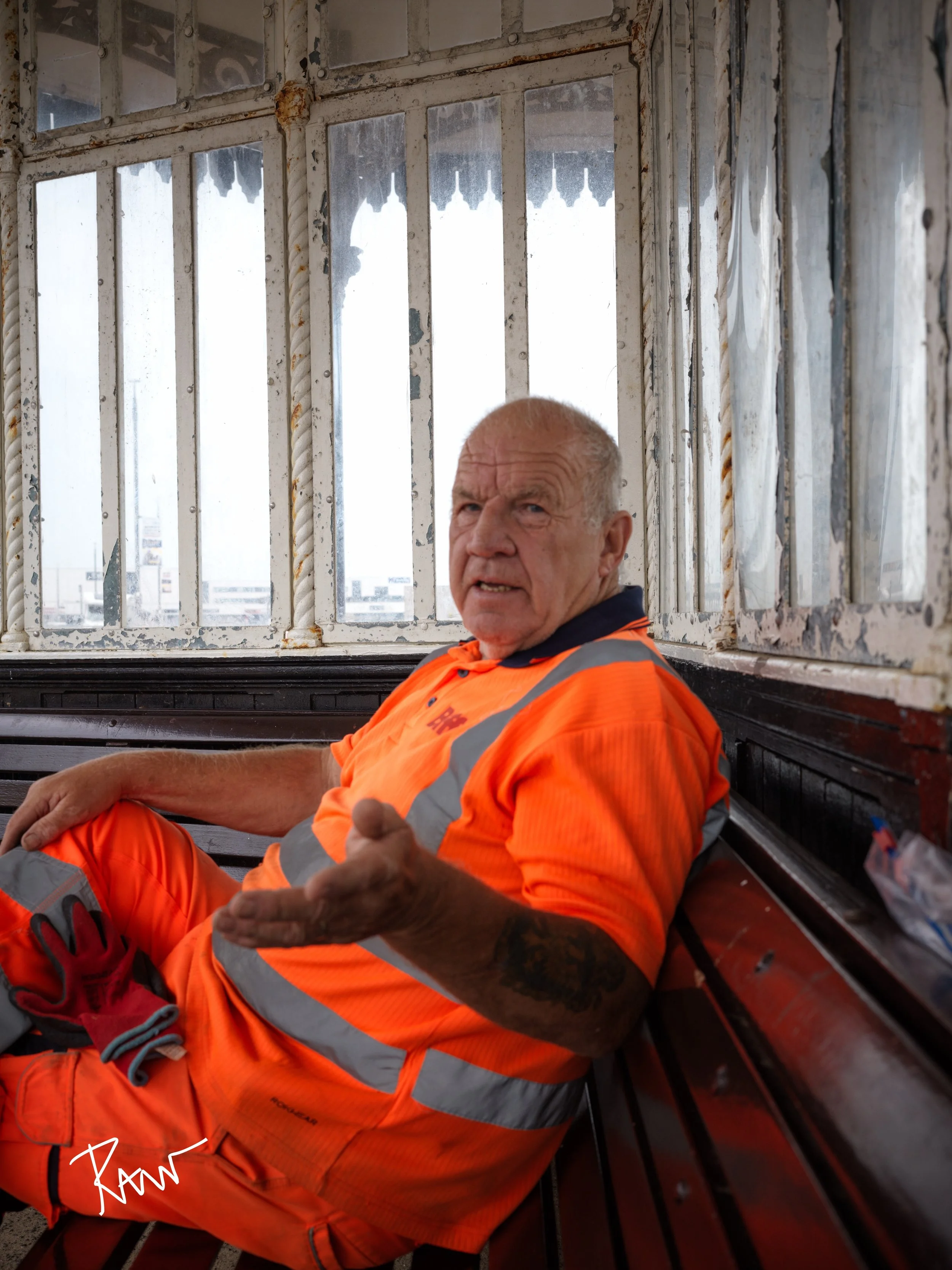
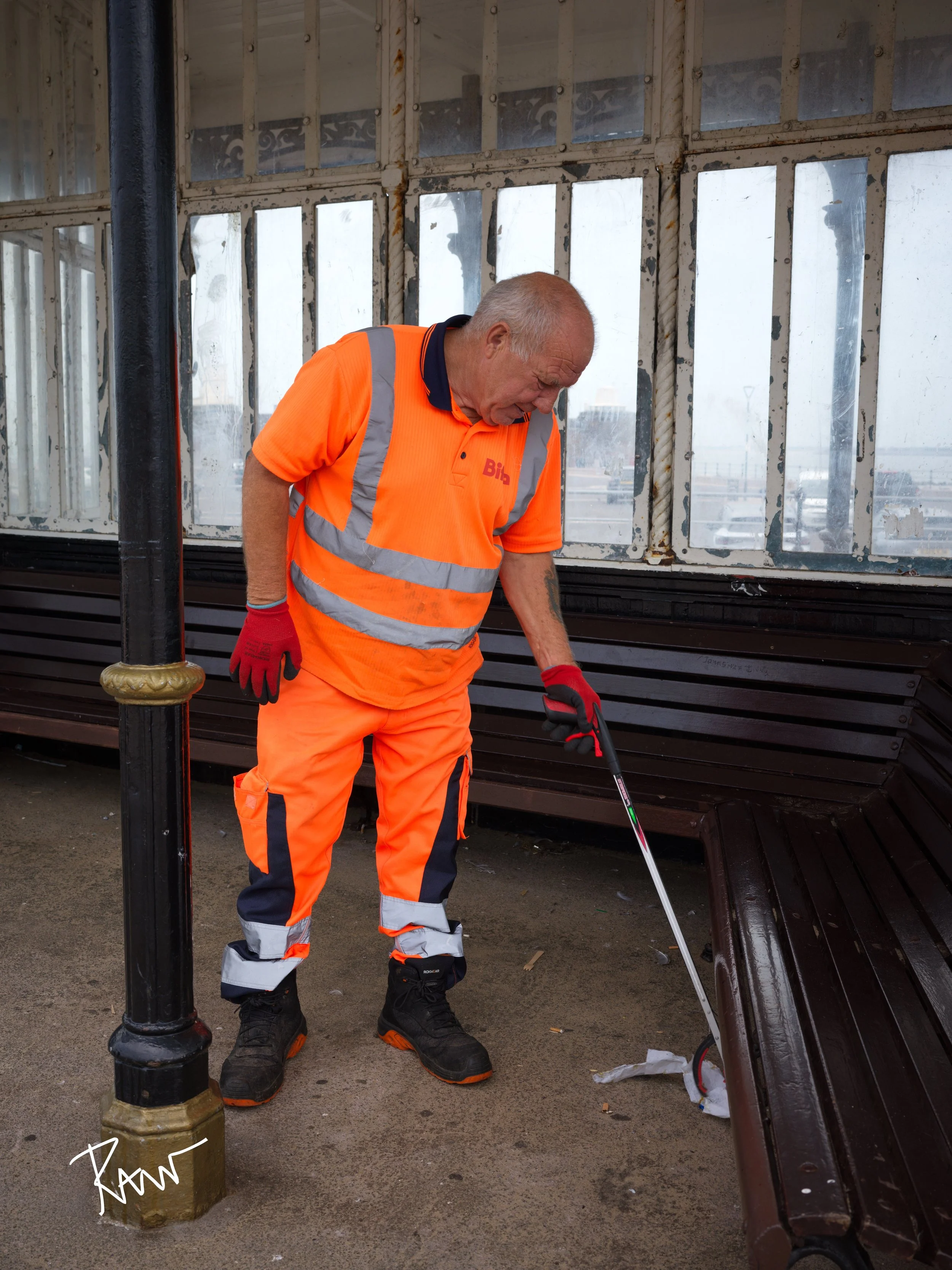
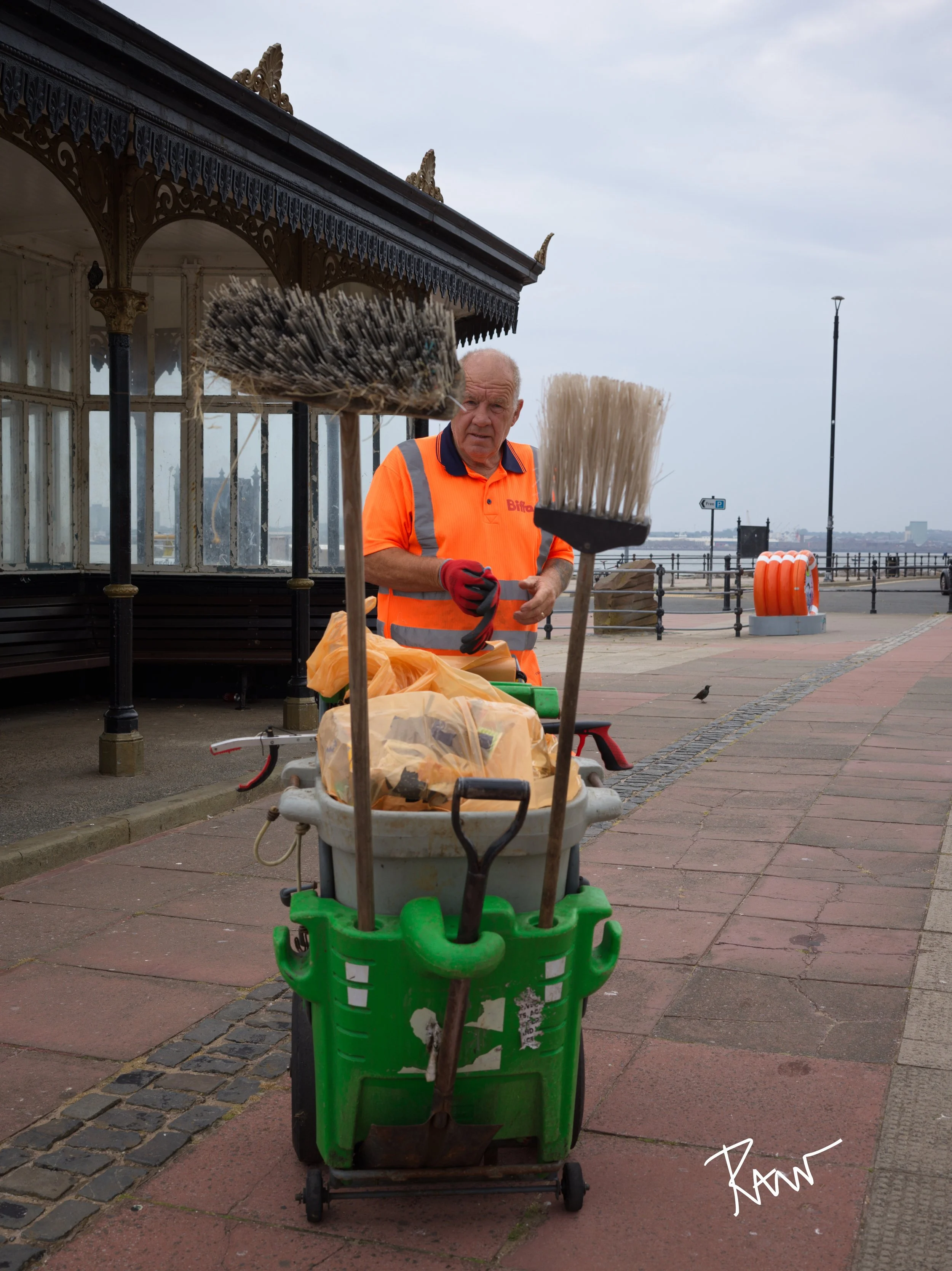
The photographer Martin Parr came here in the mid-eighties and stayed for two summers. The photographic work that came out of those visits — The Last Resort, published in 1986 — provoked a national argument at the time. Critics accused him of photographing a working-class holiday town at its most vulnerable: sunburnt, cramped, litter-strewn, chip papers on the sand, babies asleep in prams next to overflowing bins. Others recognised it for what it was — an honest visual record of a place still being loved by the people who could afford to come, in an era when the national press had already moved on. Parr didn’t photograph Kenny’s boyhood; Kenny was already grown when the shutter clicked. What Parr photographed was the last flowering of the culture Kenny grew up inside of. The same beaches. The same arcades. The same families with the same tin-foil sandwiches. Look at those photographs now and you are looking at something that was months from being demolished and didn’t yet know it.
There is a particular quiet cruelty to what happened next. Everything the town gave up in those years, the country now wants back. Cold-water swimming, before Covid a fringe pursuit, is a mass movement. Heatwaves have made outdoor pools the most desirable municipal asset a coastal town can own. Wild-swimming groups meet on beaches up and down this stretch of coast in the half-light of the early morning, and drive to Saltdean and Hilsea and Portishead to pay for a session in someone else’s lido, because their own was pulled down twenty, thirty, forty years ago. The community that would use these things today most is the community that no longer has them.
The ships, at least, are still coming and going. Container ships. Tankers. The little sailboats out on the flat water. He watched them from this same coast when he was ten. He watches them from this same coast now. Whatever else has changed, that hasn’t.
— — —
He watches the town most days, and forms views. When the coach parties arrive — and they still arrive — they ask him for directions. Where’s the town centre? Kenny points them at Victoria Road, because Victoria Road is what’s left to point at.
“There’s only Victoria Road left that I can point them to; there’s nothing else really.”
He thinks the area around the Fort could be used more. There is history under the fairground, he says, that should be publicised and turned into an attraction. He is not, again, a man who trades in nostalgia; these are things he’s said hundreds of times to strangers who asked, and every one of those answers is a real one.
But the one part of the town he thinks has genuinely got better, he credits by name.
“It’s gone a lot better, especially down Victoria Road, where Danny spent all that money and brought the place back to life.”
Danny is Daniel Davies — founder and director of Rockpoint Leisure, the company that started buying up derelict buildings in the Victoria Quarter in 2018 and turning gable ends into an open-air gallery. Kenny walks that quarter every week. He can see the difference from the street. He is not the kind of person who gives easy credit; he gives this one by name, and unprompted.
There are pubs he rates. Two, mostly. Perch Rock, for one — he enjoys the Perch Rock. The James Atherton isn’t bad either. There are others he pops into now and then — you get to know a town, walking it — but those are the two.
You picture him after a shift: orange stripped off, in one of them, having a quiet pint. That’s the man he is, offstage.
The seagulls, he does not credit.
“The seagulls are forever ripping my bags. Wherever I put my bags to be picked up, the seagulls will come down and rip them all up, empty everything out of it. So I’ve got to start again. They are — to say it quite lightly — they are a nuisance.”
The starlings are a different matter.
“The starlings I don’t mind at all. They’re lovely little birds.”
The treats are in his cart. Not in a car parked somewhere else — in the cart he pushes, so they’re near him wherever he stops. When he stops, they gather. When he moves, they follow. They walk beside him like they’re on the round with him. They look up at him. They wait.
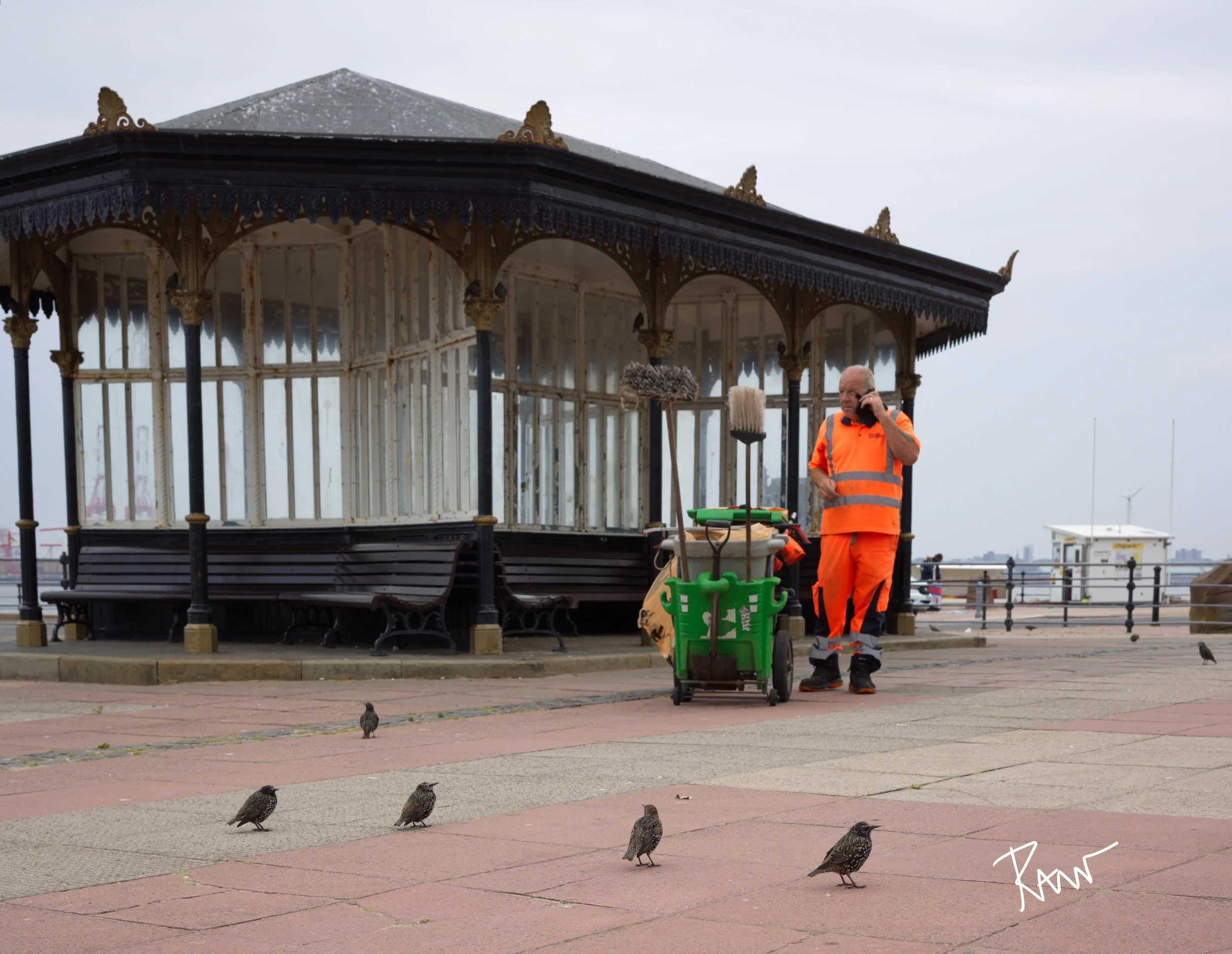
The starlings, waiting. Photo: Rory Wilmer, NBCF CIC.
If you had to pick one image of what Kenny Dunn’s job actually is, this is the one that would tell you. A man in orange, on foot, ten years into a walking beat of a coastal town, pausing to empty a bin — and half a dozen small birds gathered at his feet, heads tilted, patient, sure that he will remember them.
He does.
The mural came about because Danny rang him.
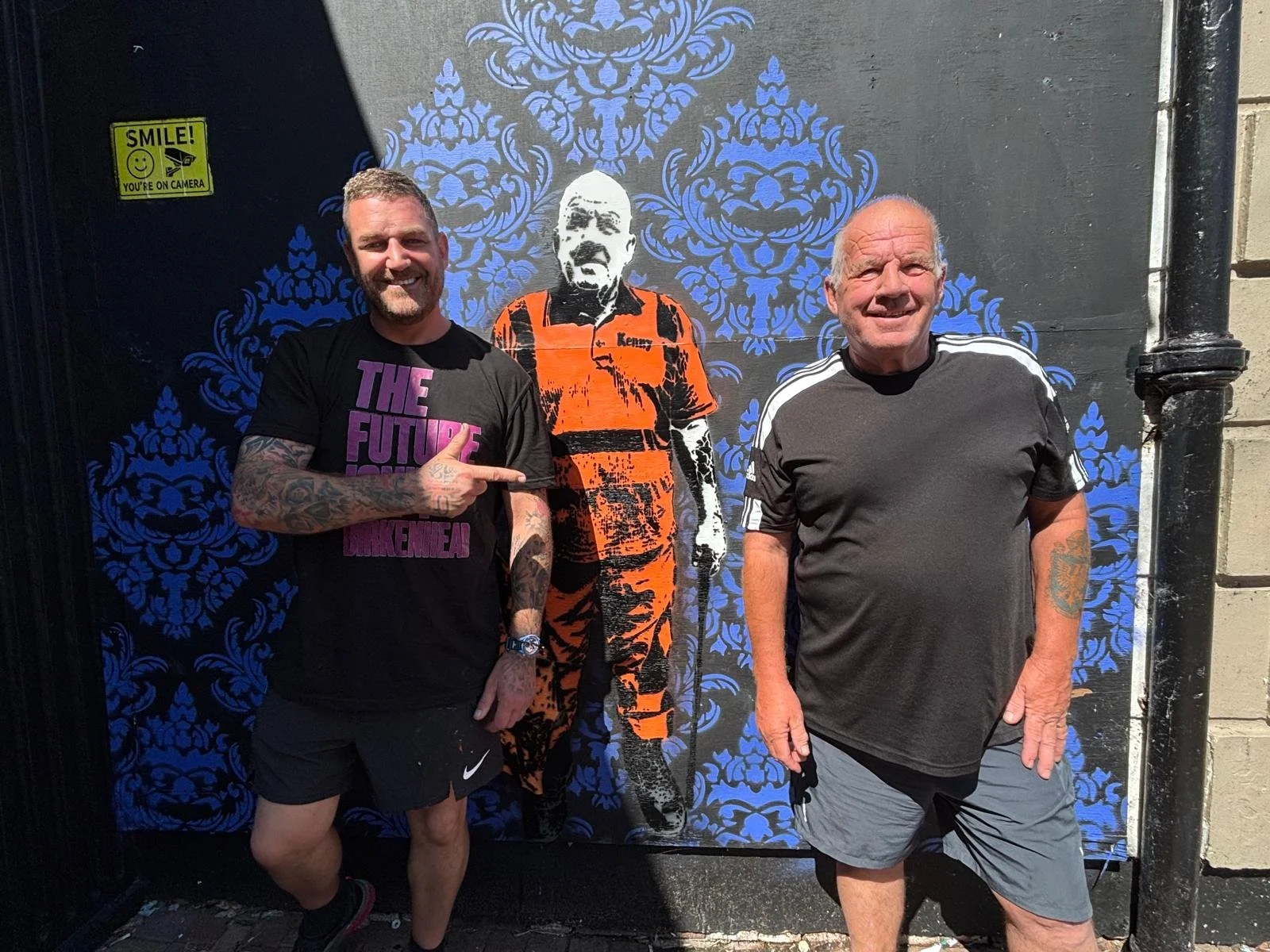
Dan Davies (left) and Kenny in front of the finished piece. Photo: Rory Wilmer, NBCF CIC.
Dan Davies had put Kenny’s name forward for the first piece in a new series — Unsung Heroes — that the London-based artist Dotmasters was starting on the OpenAIR Gallery in the Victoria Quarter. Dotmasters travelled up from London to paint it. Danny called Kenny personally to tell him it was going up. Told him to come down and watch.
Kenny went. So did his family. So did a lot of other people.
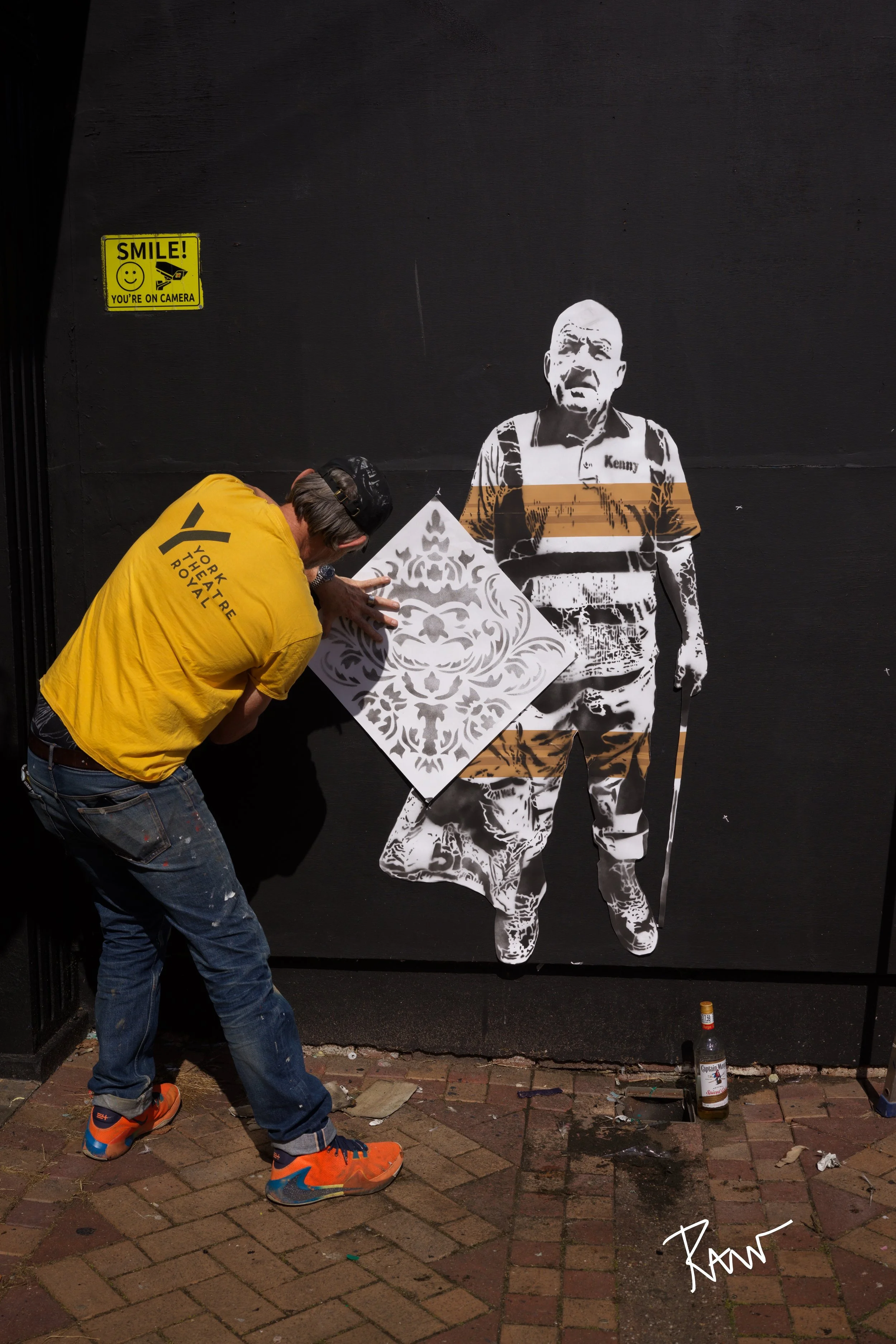
Dotmasters at work in the Victoria Quarter — laying the damask down beside the half-painted figure. Photo: Rory Wilmer, NBCF CIC.
By the time the paint was being laid down, half of New Brighton had wandered along to watch — the usual pirates, misfits and eclectic types who make up this town, and the poets, writers, photographers and artists who are somehow always there when something is happening. It stopped being a mural being painted and became a small warm gathering, unadvertised, held together by the man on the wall.
There was also a truck driver. His wagon was stuck at Birkenhead ferry terminal, waiting for its trailer to come in on the Dublin ferry, and he had a couple of nights to kill on the wrong side of the water. He’d walked down to New Brighton for a beer, and by the time the mural was going up he was one of the crowd — a stranger delayed by the same estuary the ships thread through, standing on the pavement watching an artwork being painted for a man he’d never met.
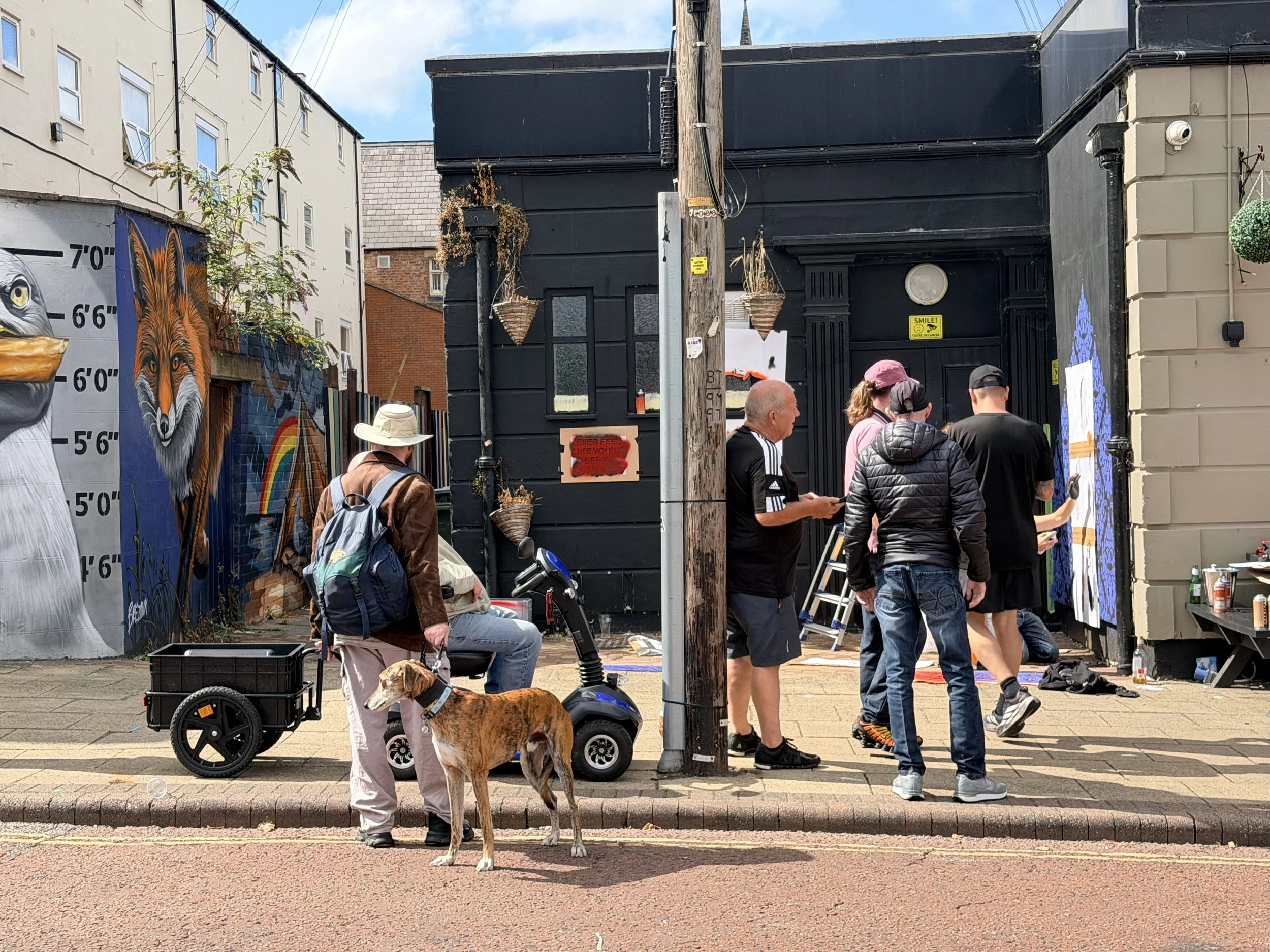
The crowd that gathered to watch — pirates, poets, family, strangers, a dog. Photo: Rory Wilmer, NBCF CIC.
Kenny stood there and watched the whole thing being made.
“That’s fantastic. I feel very humbled by it. It was amazing watching that getting done — the way [Dotmasters] put it all together. I just like to thank everybody who’s been a part of it. It really made me think.”
The finished piece stands in the Victoria Quarter now. A stencilled portrait of Kenny in his orange hi-vis, holding an orange bin bag, against a deep-blue damask pattern on a black wall. Signed Dotmaster. Any morning of the week you can walk past it and see it looking back at you.
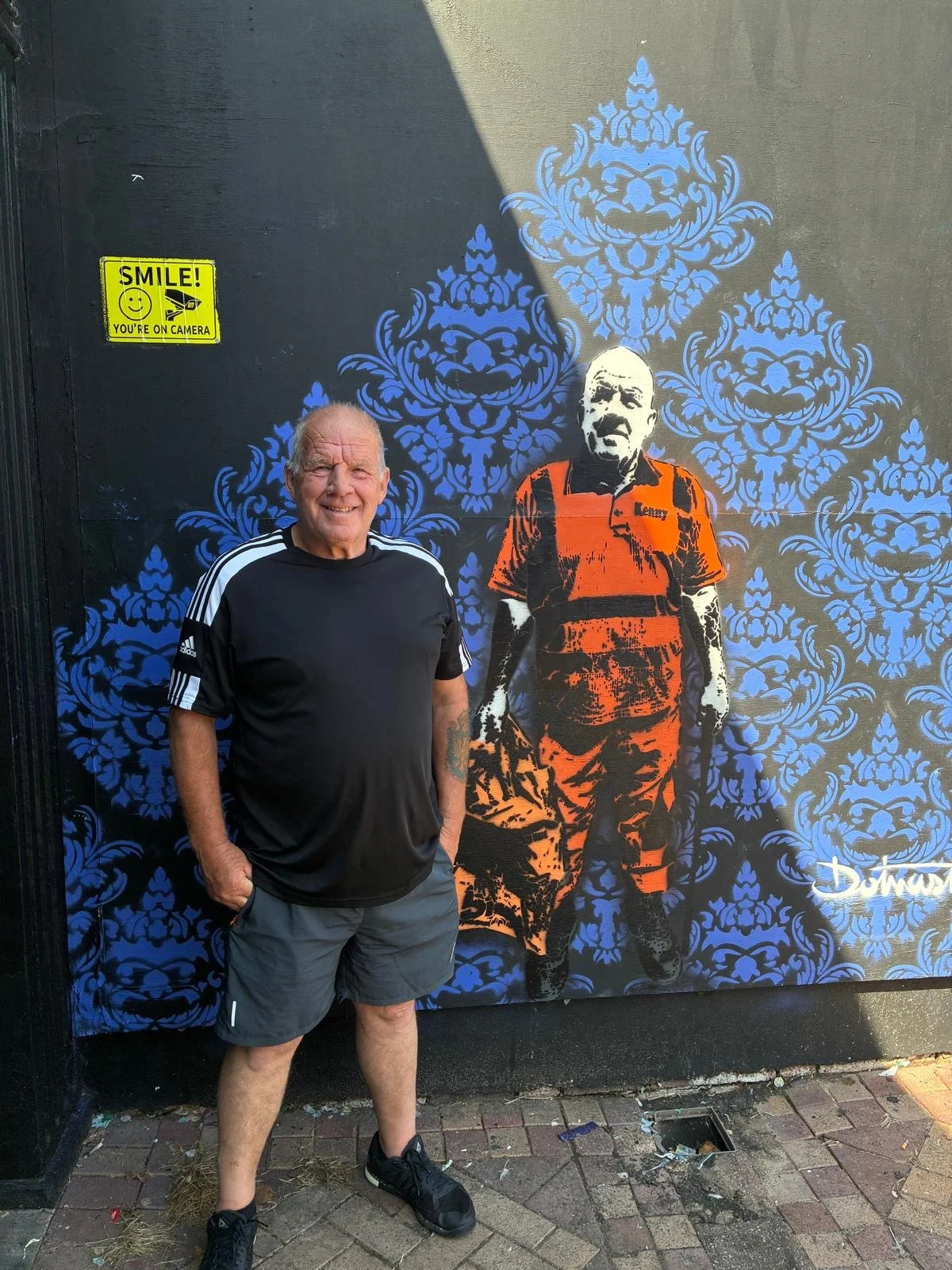
Photo: Rory Wilmer, NBCF CIC.
— — —
Any morning of the week, if you’re early enough, you can also walk past the man himself — a few streets over, on his round.
The starlings will be there too. On the ground at his feet, waiting, sure that he will reach into the cart soon and remember them.
He always does.
