![[NB] Creative Futures CIC](http://images.squarespace-cdn.com/content/v1/68c276df7928f778938222f2/98488c41-8030-41a8-b1b4-ee4c899d7119/NBCF+BRAND+MASTER+copy-16.png?format=1500w)
Written out of the plan
Wirral is drawing up the document that will shape this borough until 2045. It doesn’t mention New Brighton once. Here’s what we’ve told them — and how you can tell them too.
There’s a wall I walk past most days where the paint has started to go. Not dramatically. Just a corner lifting, the way a poster lifts when the damp gets behind it, and a fine dust of colour on the pavement underneath that you’d only notice if you were looking for it. I look for it. It’s an occupational hazard.
Salt air and UV don’t care what a wall is worth. They work on it every day, patiently, for free.
I’ve been thinking about that wall a lot this month, because of a document. Not a glamorous one. Twenty-three pages, a lot of grey boxes, twelve numbered questions. Wirral Council has begun writing a new Local Plan — the document that decides, for the next twenty years, what gets built where, what gets protected, and what developers are required to contribute towards.
We’ve just sent them a fourteen-page response. And I want to tell you why, because this is the least visible and most important thing we’ve done all year.
Here’s the plain-English version of what a Local Plan is.
Every planning decision in this borough gets tested against it. Every application, every appeal, every argument about a site. It is not a wish list or a strategy document that sits in a drawer — it’s the thing a planning inspector holds up and says does this comply. If something is in the Local Plan, it has weight. If it isn’t, it has to be argued for from scratch, every single time, by whoever happens to have the energy that week.
For nearly ten years, the thing with the energy has been us. A CIC, a handful of stubborn independents, and people painting in the rain in February.
That is not a plan. That’s a personality.
So I went through Wirral’s adopted Local Plan properly — all three hundred and seventy-one pages of it — looking for the policy that protects what we’ve built here. I want to be precise about what I found, because precision is the only thing that carries any weight in this process.
There isn’t one.
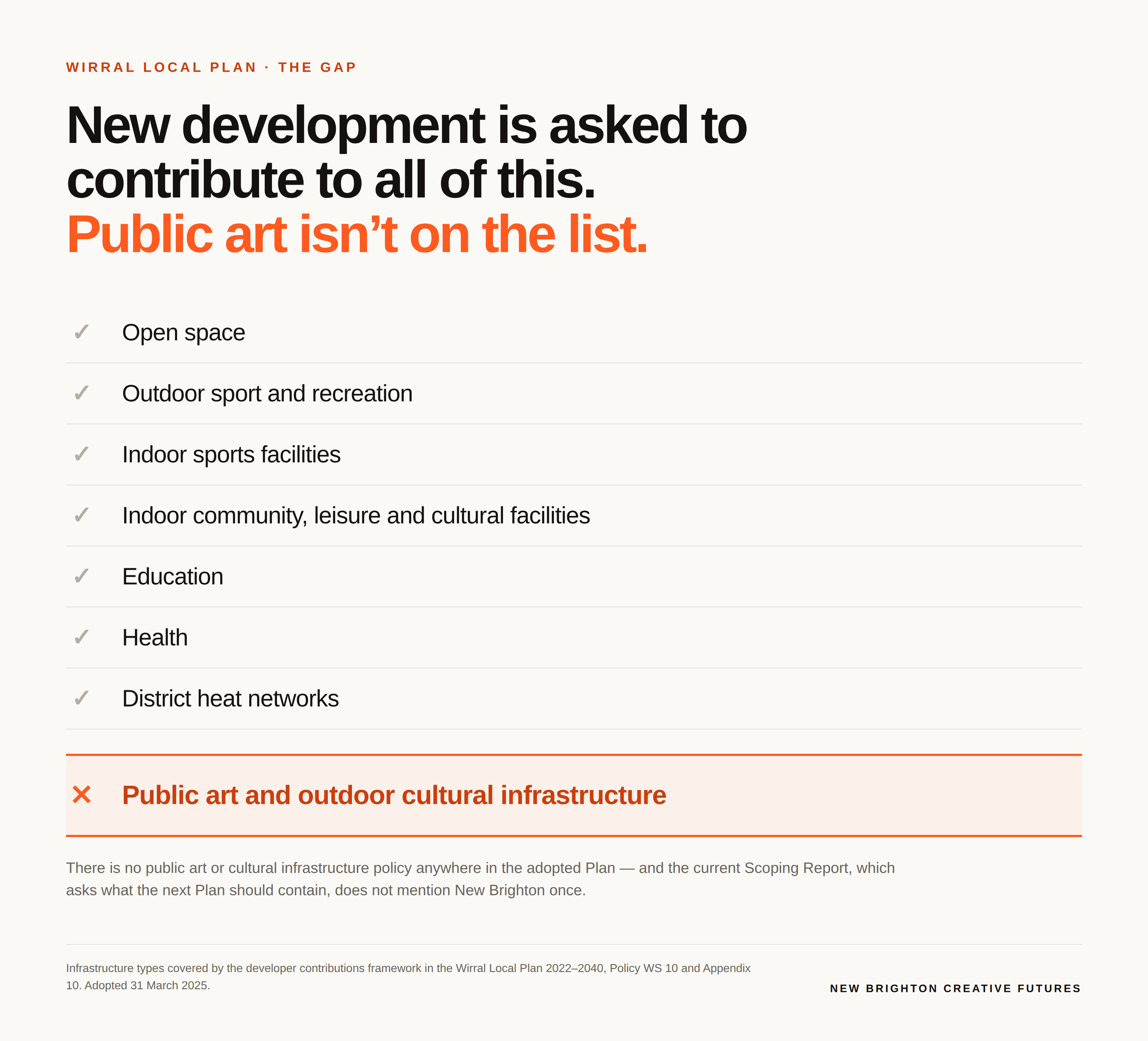
There’s no public art policy. No cultural infrastructure policy. No mechanism by which a new development contributes anything at all towards the thing that brought the visitors that made the development viable. The plan’s own Vision — its opening statement of what Wirral is going to be — promises a borough “recognised as a destination for exciting cultural experiences” with “a burgeoning local creative scene”. I agree with every word. I’d have written it myself. But a Vision isn’t policy, and nothing in the three hundred and seventy-one pages that follows gives that sentence any teeth.
There is one near-miss, and it’s almost funny. Policy WS 10.5 does cover cultural facilities — indoor ones. Theatres, halls, leisure centres. All good things, all worth having. But the form of culture this town actually runs on is outdoors, free, on the side of a building, and it falls straight through the gap.
And the New Brighton regeneration policy — the one written specifically for this town, the town whose comeback was built on paint — mentions cultural uses on development sites, which is welcome. It says nothing whatsoever about public art.
Then there’s this stage. The scoping consultation. The bit where they ask what the plan should contain before they write it.
New Brighton isn’t mentioned in it. Not once. Culture appears almost entirely as heritage — Port Sunlight, Hamilton Square, Birkenhead Park, conservation areas. Every one of those deserves protecting and I’d defend them all. But heritage policy protects what previous generations made. It has nothing to say about whether this generation is allowed to make anything.
Now the part I keep coming back to, because it’s the bit that turns a grumble into an argument.
Back in 2019 — before the CIC existed, before most of the murals — a House of Lords select committee looked at the future of English seaside towns and gave New Brighton a section of its own. I’ve written about that report before. What I hadn’t read closely enough until this month was paragraph 21.
It’s a list. The ingredients the committee recorded as necessary to what was happening here. And there, in a parliamentary report, is “the introduction of street and building art” — sitting alongside, of all things, “local authority support”.
Read that as what it is. Street art wasn’t listed as a nice outcome of regeneration. It was listed as one of the mechanisms. A tool. Infrastructure.
And then, at paragraph 22, the committee agreed with the evidence it had heard: what a place like this needs is “planning, zoning and having a long-term plan. It needs a 10 or 15-year plan, not a sticking plaster.”
Seven years on, Wirral is writing exactly that plan.
And the document asking us what should go in it does not contain the words “New Brighton”.
I want to say something about the masterplan too, and I want to say it carefully, because I’d rather be useful than satisfying.
In July 2024 the council adopted the New Brighton Marine Promenade Masterplan. It’s a proper piece of work — BDP produced it, it’s thoughtful about the Floral Pavilion and Marine Point, and it even notices us. It records that there’s been investment in “buildings and public artwork focused around Victoria Road — the ‘Victoria Quarter’”. It talks about murals on gables and facades.
It notices us, and then it asks nothing of anyone on our behalf. No requirement, no standard, no expectation. Awareness isn’t policy.
That wad years ago. I can find no published delivery programme for it and no funding package attached to it. It also never became a Supplementary Planning Document, which was the intention — and under the rules that changed this summer, it now can’t. So we have an adopted masterplan for our seafront that is, as far as I can tell from the outside, sitting still.
I’d genuinely like to be wrong about that, and if someone at the council tells me I am, I’ll correct this post the same day.
But if I’m right, then the Local Plan is now the only route left. Whatever momentum that masterplan needs, it has to come through this process — which is another reason we’re pushing so hard at a stage most people don’t even know is happening.
Here’s the honest part, because a piece like this is worthless without it.
Wirral Council has helped. UK Shared Prosperity Fund money went into the Captain Mike Lowe mural and into SNIK’s Entwined, and I’m not going to be churlish about that — it was real money, it paid real artists, and the walls are there. Thank you.
But that’s two commissions, funded project by project, through a pot that’s now ending, because an individual elected member was willing to champion it. That’s not a policy. It’s a favour. And favours don’t survive a restructure.
Meanwhile the value keeps going somewhere else entirely.
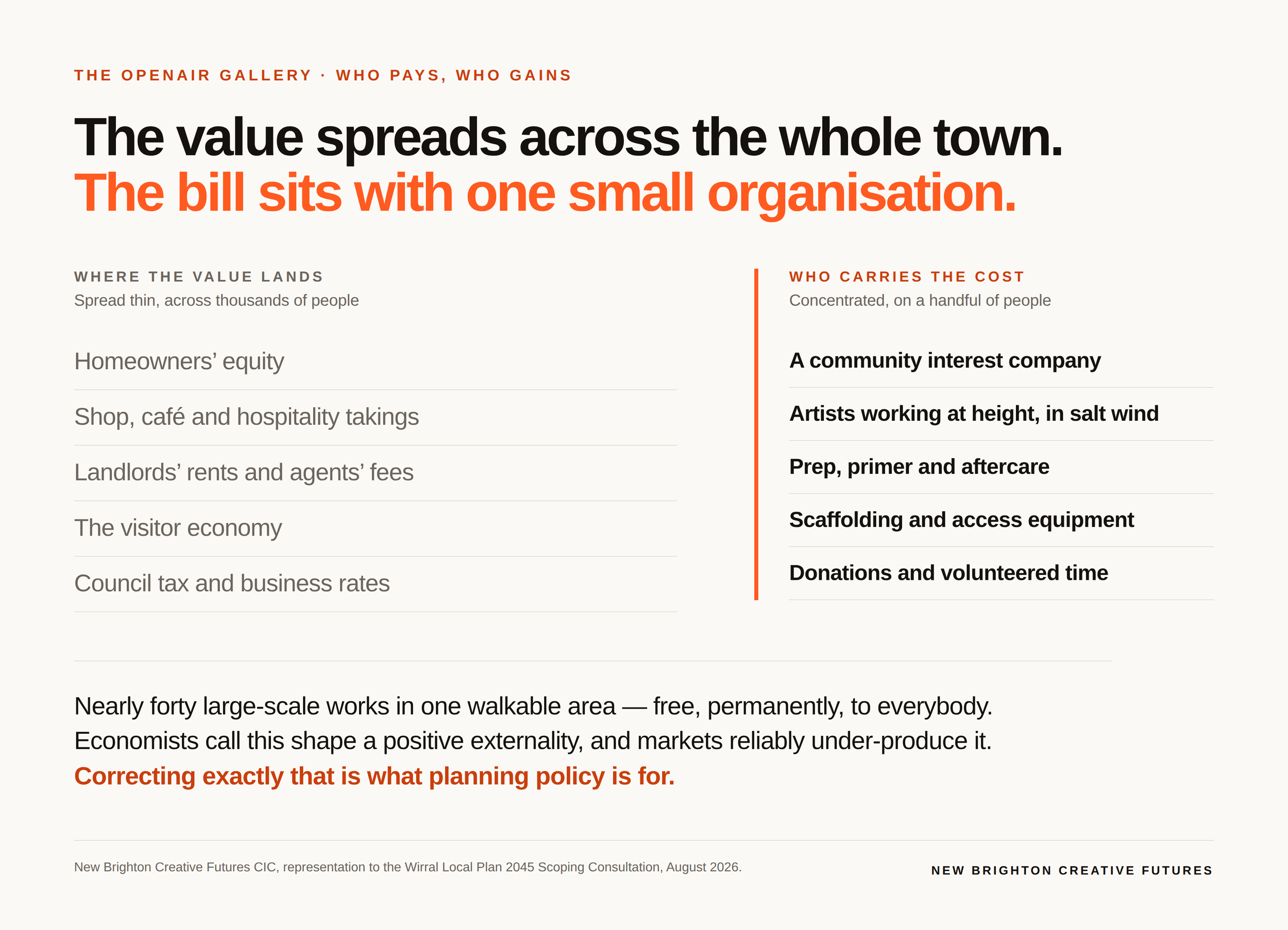
It goes into equity — yours, if you own here. Into shop takings. Into an agent’s fee. Into the council’s own council tax and business rates base. Nearly forty large-scale works in one walkable area, free at the point of use, permanently, to everybody. And the bill for prep, primer, aftercare, access equipment and skilled people working at height in a coastal wind sits with a community interest company.
Economists have a dry phrase for this shape. A positive externality. The benefit is real, large and spread thin across everybody; the cost is concentrated on whoever’s daft enough to carry it. And markets, reliably, under-produce anything built that way.
Which is exactly, precisely, what the planning system exists to correct. It’s why nobody thinks it’s outrageous that a developer contributes to a playground, or a GP surgery, or a stretch of pavement. We’re not asking for special treatment. We’re asking for a children’s play area’s worth of logic.
A cultural infrastructure policy in the new plan. Outdoor public art recognised as infrastructure, so it can attract a developer contribution like everything else on that list. The Victoria Quarter cluster named as an asset in the New Brighton policy, so it’s protected rather than assumed. One of the plan’s ten measurable outcomes to be a cultural one — because what doesn’t get measured doesn’t happen. Affordable creative and maker workspace tested in the evidence base. Culture separated out from heritage in the council’s own priority list, instead of bracketed in behind it. And a seat at the table for the next stage.
That last one is the one I actually care about.
Because here’s what we’re not asking for. We’re not asking to be handed anything. We’re not asking anyone to take a proposition on trust. We’ve spent the better part of a decade building the thing, and we know where the bodies are buried — how much a wall costs, why the primer matters more than the paint, how to get an artist of international standing to come to a seaside town in the rain, what to do when the scaffolding is up and the forecast turns, how to talk to a building owner who’s never said yes to anything in his life.
That’s not sentiment. That’s a skill set. It took ten years and a lot of mistakes to acquire and it exists in about six people’s heads, most of them within four hundred metres of Victoria Road.
Wirral is about to write a twenty-year plan for a borough whose most-written-about regeneration story is a cultural one. We’d like to be in the room when it’s written. That’s the whole ask.
And I’ll be plain about the other thing, because pretending otherwise helps nobody. New Brighton needs investment. The public realm needs it, the seafront needs it, and the collection needs maintaining — that wall I walk past isn’t going to reprime itself. We’ve been petitioning, lobbying, applying and asking for years now, and we’ll keep doing it, because that’s the job and because this town is worth it.
We’re patient. We’ve been patient a long time.
But paint isn’t.
Here’s where you come in, and it will take you four minutes.
The consultation is open to anybody. Not just organisations, not just people who know what a Local Plan is. It closes at 5pm on Friday 28 August 2026, and comments go to localplan@wirral.gov.uk — or through the council’s Placemaker portal if you’d rather.
You don’t need to answer all twelve questions. You don’t need to write fourteen pages; we did that so you don’t have to. An email of three sentences carries weight in this process, because officers count responses and themes, and a scoping consultation that receives fifty letters about culture is a very different document to one that receives one.
If you want a starting point, something like this is plenty:
I’d like the new Local Plan to include a policy on cultural infrastructure and public art. New Brighton’s regeneration has been driven by its open-air street art, which brings visitors, supports local businesses and has changed how the town is seen — but there is currently no policy protecting it or requiring new development to contribute towards it. Please also add culture and creativity as a distinct priority topic, separate from historic heritage.Put it in your own words. Say what the town looks like to you now compared to ten years ago. Say when you have moved here in. That’s the evidence they can’t get from a spreadsheet, and it’s the evidence only you can give them.
If you’d like to read what we sent, the full representation is [here], and we’ve published it in full because we’ve got nothing to hide and quite a lot to prove.
One last thing.
I don’t think anyone at the council is against us. I’ve never met an officer or a member who was. What I think happened is much more ordinary than that — culture got filed under nice to have, somewhere near the end of the document, in the bit that gets cut when the page count comes down.
That’s the whole problem in a sentence. Not hostility. Filing.
So this is us, politely, asking to be moved to a different drawer. We’ve got the evidence, we’ve got the track record, we’ve got a parliamentary committee’s word for it and a decade of walls to point at. What we haven’t got is a line in the plan.
Twenty years is a long time to be left out of a conversation about your own town.
Ask us in. We’ll bring the ladders.
Sources
• Wirral Council, Local Plan Scoping Report Consultation — open until 5pm, 28 August 2026
• Wirral Council, Wirral Local Plan 2022–2040, adopted 31 March 2025 — Vision; Policy WS 4.4; Policy WS 10.5; Policy RA 10
• Wirral Council, New Brighton Marine Promenade Masterplan (BDP), adopted 16 July 2024
• House of Lords Select Committee on Regenerating Seaside Towns and Communities, The future of seaside towns, HL Paper 320, 4 April 2019, paras 13–25
• Liverpool City Council, Draft Liverpool Local Plan 2025–2041, Policy QD8: Public Art
• Ministry of Housing, Communities & Local Government, National Planning Policy Framework, paras 96, 98, 131–135
• HM Government, Creative Industries Sector Plan, 23 June 2025
• Liverpool City Region Combined Authority, £25m Creative Places Growth Fund allocation
• New Brighton Creative Futures CIC, Representation to the Wirral Local Plan 2045 Scoping Consultation, August 2026
Feature photo of Rory Wilmer by Andrew Spence - Local Democracy Reporter
