![[NB] Creative Futures CIC](http://images.squarespace-cdn.com/content/v1/68c276df7928f778938222f2/98488c41-8030-41a8-b1b4-ee4c899d7119/NBCF+BRAND+MASTER+copy-16.png?format=1500w)
What a wall is worth
On house prices, street art, and the quiet economics of a seaside town that decided to back itself.
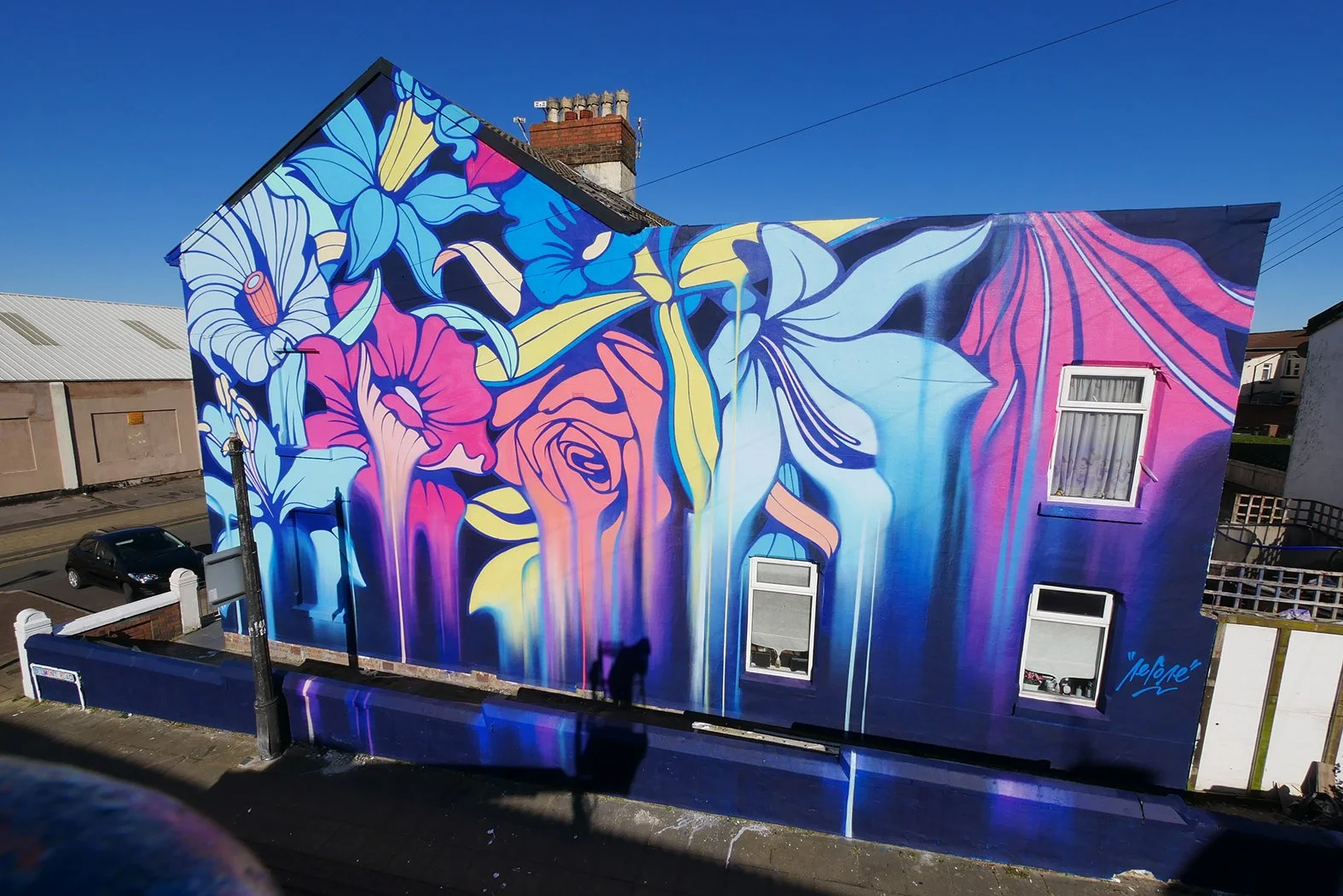
Nerone’s Belladonna Mural in New Brighton
There's a stretch of Victoria Road where, not so long ago, you could stand in the middle of a weekday afternoon and hear your own footsteps. Shutters down. Paper in the windows. That particular silence a street makes when it has stopped expecting anyone.
Daniel Davies described it to a licensing hearing, and he didn't dress it up: seven years ago, “fifty percent of the businesses were closed, the square footage was nearer 75%.” Then, in the same breath — the road was now fully occupied.
I want to talk about what happened in between. Not because it's a nice story, although it is. Because there's a number attached to it now, and the number is turning up on people's mortgage statements.
Over the last twelve months, the average sold price in CH45 was £248,894 — up 10% on the year before, and 16% above the old 2022 peak of £213,730. Widen the lens and it holds. Wirral house prices rose 6.5% in the year to May 2026, against 5.8% across the North West and 2.7% for the UK as a whole. We’re not tracking the national market. We’re outrunning it.
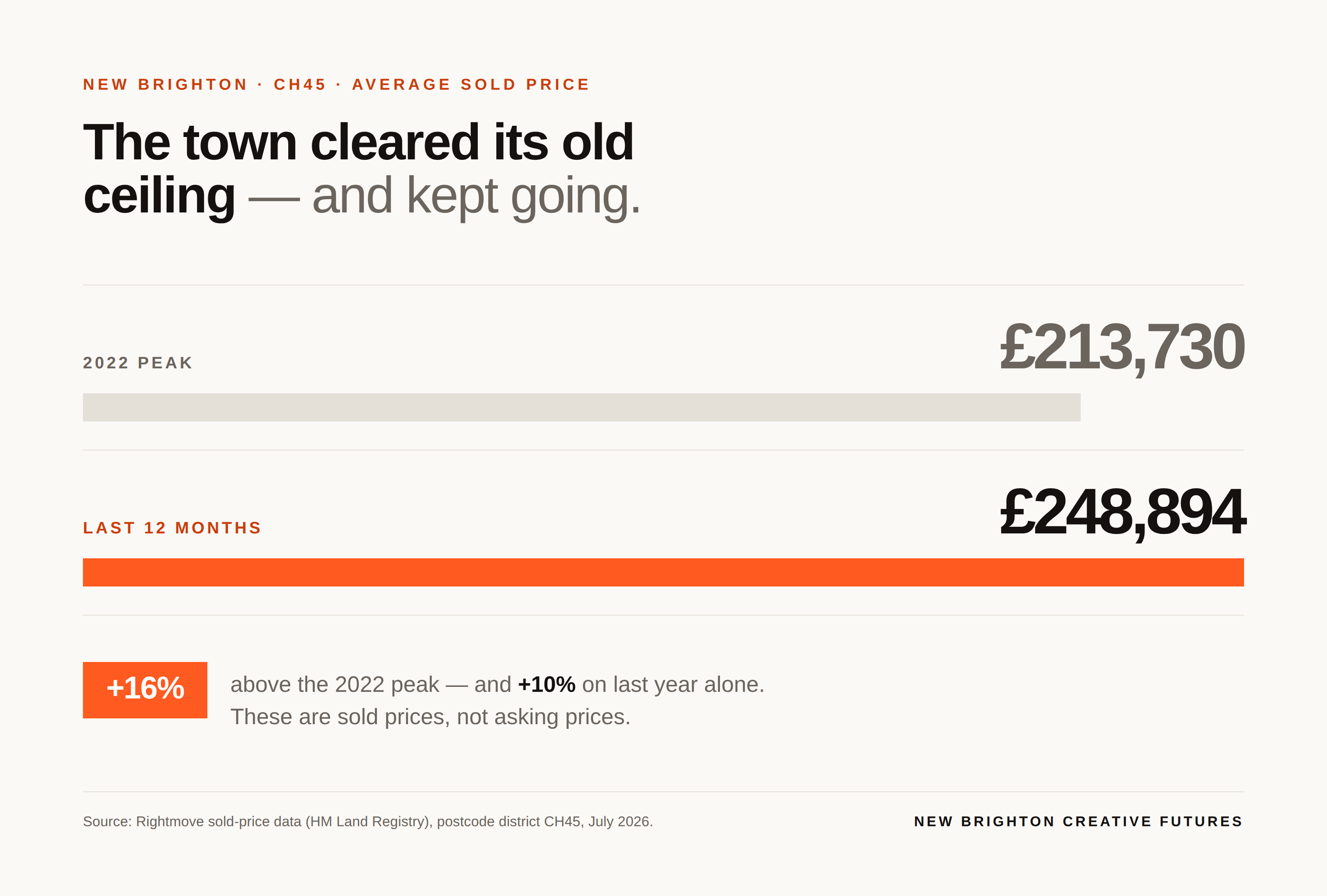
CH45 average sold price. Source: Rightmove / HM Land Registry.
Now the honest part, because a piece like this is worthless without it. This is not all street art. That would be a lovely thing to claim and it would not be true.
Lockdown rearranged what people wanted from where they live. Sea, sky, a bit of space, somewhere to walk that isn’t a corridor. Coastal towns up and down the country caught that wave and so did we. Add the affordability gap — The Sunday Times put a four-bed Victorian semi here at around £250,000 — plus a twenty-seven-minute train into Liverpool, and you’ve a decent case for New Brighton before a single wall gets painted.
Though I’d note, in passing, that the pandemic was no gift to us. It shut the venues, grounded the artists and cancelled the events for the best part of two years. Oakland Gallery opened in October 2020 with work by forty artists and was closed again within weeks. The wave that lifted coastal prices arrived precisely when we could do least about it — and the trail kept working anyway, because an outdoor gallery is the one cultural venue a lockdown can’t shut.
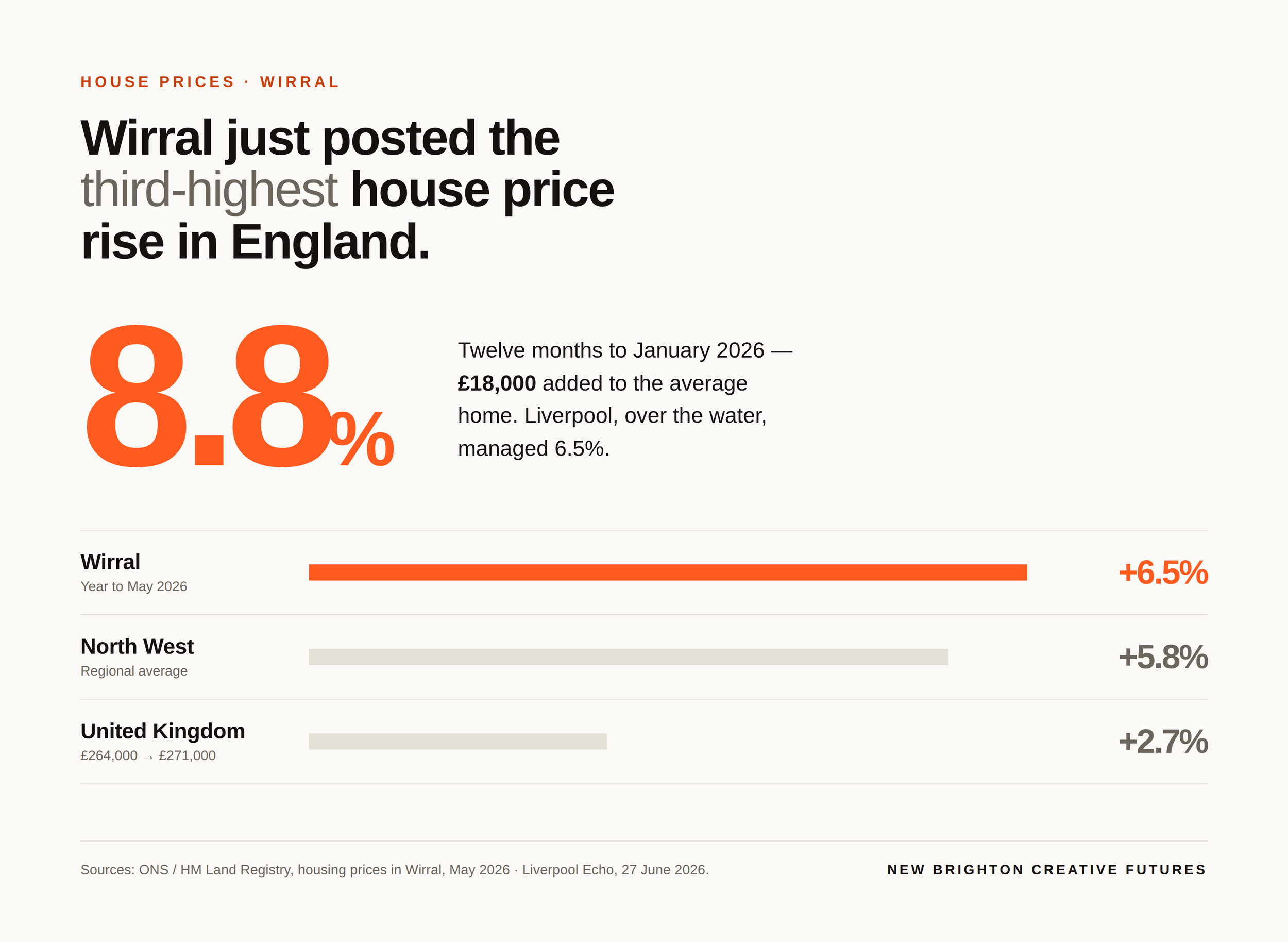
Annual house price growth. Sources: ONS / HM Land Registry; Liverpool Echo.
So the honest question was never did the murals move the market. It’s this: every seaside town in England got the pandemic. Why did The Sunday Times write about ours?
Last summer they named New Brighton one of the twenty best UK seaside places to live, fourth in England, and called it “the opposite of a fading resort” — pointing to “a refreshed streetscape, community clean-ups and lots of cool new independent businesses” as “the most visible signs of the long-term planning and investment that are turning New Brighton into a lively rival to fancier Wirral neighbours such as Heswall, Hoylake and West Kirby.”
Read that again. Fancier neighbours. And here’s the strange part — at almost exactly the same moment, a Which? survey had us down among Britain’s worst seaside towns. Same beach. Same weather. Same train line. What changed was what we chose to put on our walls — and who we handed the brush to.
And it wasn’t only newspapers that noticed. Back in 2019 a House of Lords select committee on the future of seaside towns gave New Brighton a section of its own — “New Brighton – a regeneration model?” — and called the project’s characteristics “worthy of amplification”. Daniel gave evidence to it. While plenty of people locally still thought this was a punt, Parliament was writing the town up as something other coasts might copy.
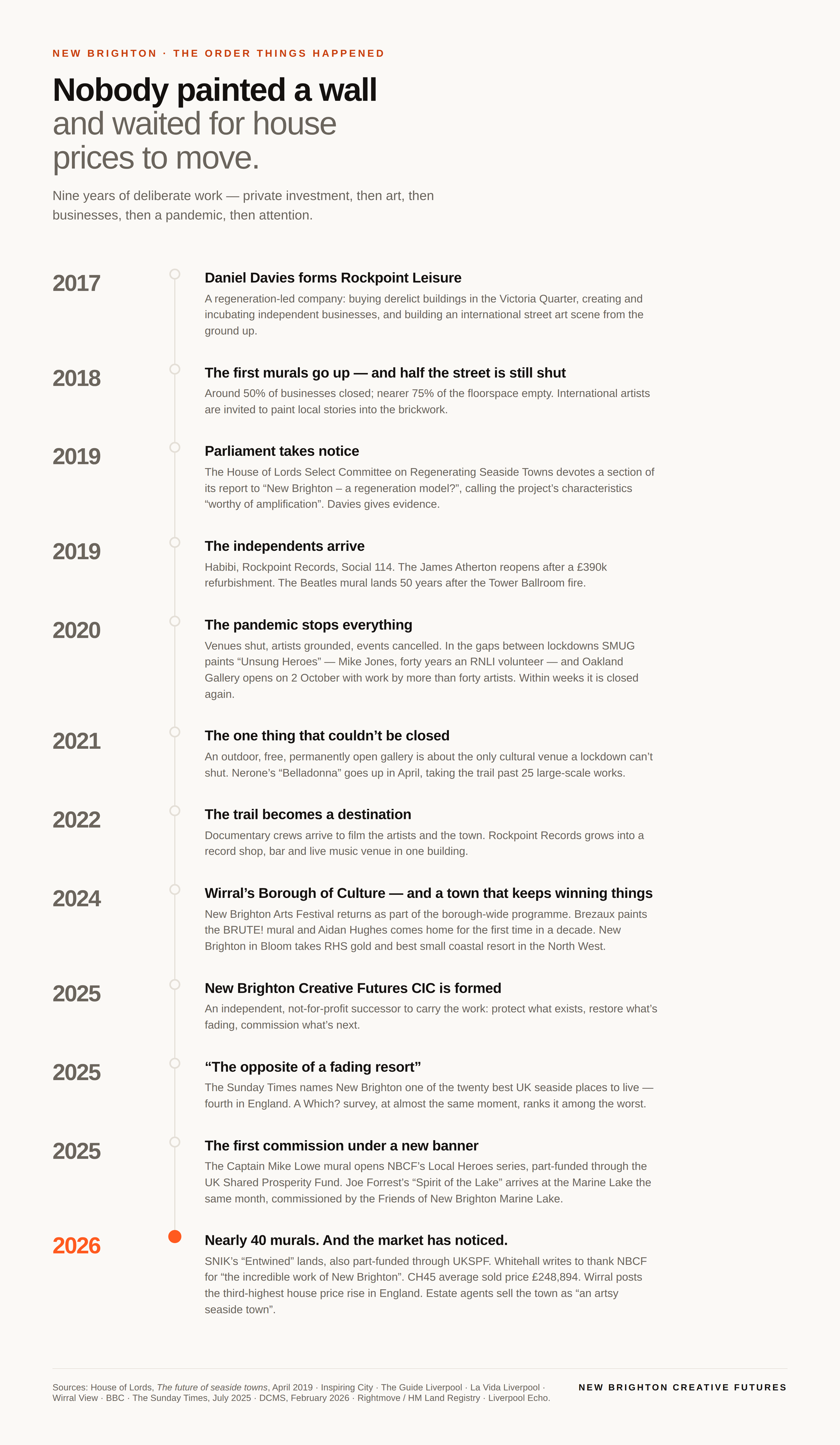
Eight years in Victoria Quarter New Brighton.
There’s a proper evidence base under all this, and it isn’t sentimental. Cebr’s analysis for Arts Council England found that for every £1 of value the arts and culture industry creates, a further £1.17 is generated across the wider economy — £2.17 in total. Every £1 of turnover drags £1.23 more along behind it. Every full-time job in the arts supports another 1.46 elsewhere. And in the year measured, the sector paid £3.4 billion in tax against the roughly £440 million it received in Arts Council funding.
You’ll hear bigger numbers at conferences — “four pounds back for every pound in” gets a lot of airtime. I’d rather quote the figure that survives scrutiny.
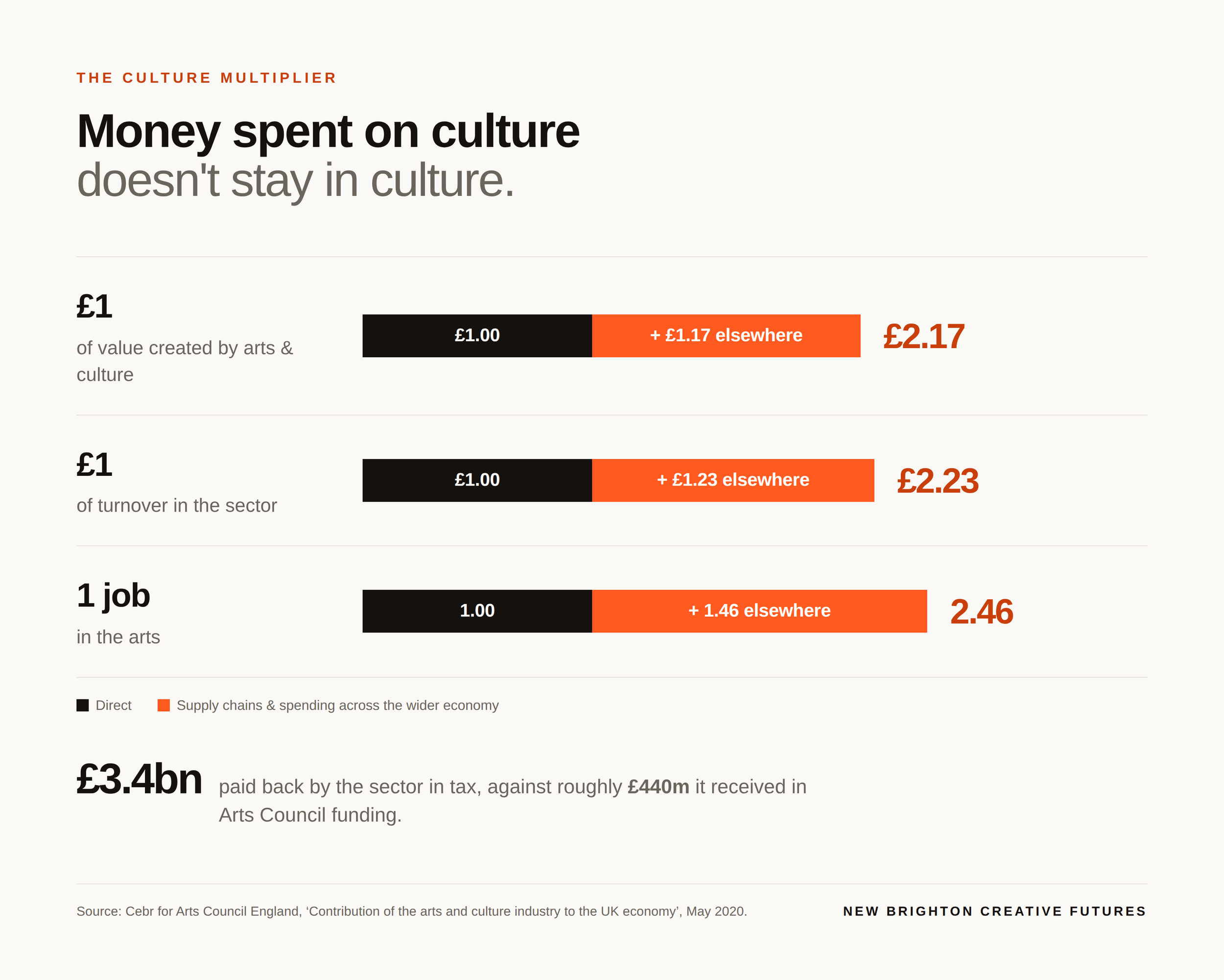
Source: Cebr for Arts Council England, May 2020.
The property link is better documented than most people assume, too. When English Heritage asked the LSE to measure what character does to a housing market, Ahlfeldt, Holman and Wendland found homes inside conservation areas carried a premium of around 8.5–9.5% even after controlling for everything else about the property — the raw gap was over 23%. That is the measurable price of a streetscape people believe in. Academic work on street art specifically, from Naples to Philadelphia, traces the same mechanism straight through the property market. Art changes how a place is read. How a place is read changes what people will pay to live in it.
Which brings me to the part that made me laugh out loud. Our estate agents have started selling the story back to us.
Last month the Echo ran a piece on first-time buyers leaving Liverpool for the Wirral, and topped it with a photograph of our murals — New Brighton, the caption explained, being somewhere new homeowners want to be because of the links to Liverpool, the affordability, and the fact that it’s an “artsy seaside town”. Inside, Adam Slinger, a director at Peterson & McCoy on Atherton Street, was asked what he’s actually selling here. His answer: “It’s quite an artsy seaside town, it’s bidding to be Town of Culture. We get lots of families coming over.” The same piece has Wirral posting the third-highest house price rise in England between January 2025 and 2026 — 8.8%, or £18,000 on the average home, against Liverpool’s 6.5%.
So there it is. A man selling houses on the strength of a culture bid, under a photograph of work paid for by people who will never see a penny of the commission. He’s right to, by the way. I’ll just leave that there. Nudge.
Here’s the thing I most want you to take away, and it’s the bit that gets missed every time.
You do not need a mural on your gable end for a mural to be working for you.
The value doesn't sit on the painted wall. It radiates out from it. Down the terrace, round the corner, three streets back from the front, to a house whose owner has never once thought about SNIK or Nerone or Fanakapan and never needs to. When someone drives over from Manchester for the trail, buys lunch, walks past a for-sale board and thinks actually… — that's your street too. Nearly forty large-scale works sit inside one walkable area here, among the densest clusters in the UK. That density is the asset. No single wall does this. All of them together do.
And that's the awkward economics of an Open Air gallery. It's free, permanently, to everybody. It's also exposed to salt air and UV that eat paint for a living — so it needs prep, primer, aftercare, access equipment, and artists paid properly for skilled work at height in a coastal wind. The returns are privatised: they land in your equity, in a shop's takings, in an agent's fee. The costs sit with a CIC, a handful of stubborn independents, and people painting in the rain in February.
Which is where I should tell you how the Town of Culture bid went, since our estate agent was selling it in June and the shortlist landed in July. We didn't make it. Nearly four hundred towns went in; fifteen came out. Birkenhead did — and good luck to them, sincerely, because the Wirral wins either way.
Read that as a failure if you like. I'd point instead at the letter the Department for Culture, Media and Sport sent me in February, which described the grassroots energy here as "fuelling such innovative and thriving cluster activity", said the department "shares your excitement about the untapped potential across towns like yours", and closed by thanking us for "highlighting the incredible work of New Brighton."
A town of culture isn't a title in the government's gift. It's something a place either is or isn't. We are one — with the accolade or without it — and either way the walls still need maintaining and the next artist still needs paying.
So — if your house is worth more than it was in 2019, and statistically it is, then part of that is the sea. Part of it is interest rates. Part of it is a whole country deciding, all at once, that it wanted a coastline.
And part of it is a wall you drive past every day and stopped noticing years ago.
You don't owe us anything for that. But if you've ever wondered what supporting street art actually buys you — it's the thing you already own, worth more. Come and find us at Rockpoint Records. Or take a wall. We'll get it painted, and the town will do the rest.
Sources
Rightmove, House prices in CH45 (HM Land Registry sold-price data)
ONS / HM Land Registry, Housing prices in Wirral, May 2026
The Sunday Times' 20 best UK seaside places to live 2025, reported by Time Out, 12 July 2025
Which? seaside town survey 2025, as reported by LiverpoolWorld
Cebr for Arts Council England, Contribution of the arts and culture industry to the UK economy, May 2020
Ahlfeldt, Holman & Wendland for English Heritage, An assessment of the effects of conservation areas on value, LSE, 2012
Forte, F. & De Paola, P., "How Can Street Art Have Economic Value?", Sustainability 11(3), 2019
Birkenhead News, Street art helps reshape New Brighton's identity and Company that helped revive seaside town in row with HMRC
Birkenhead News, New Brighton bids to become UK's first Town of Culture
Peterson & McCoy Estates, Estate Agents New Brighton
House of Lords Select Committee on Regenerating Seaside Towns and Communities, The future of seaside towns, 4 April 2019, paras 13–25
DCMS, Shortlist for UK Town of Culture revealed, 9 July 2026
Department for Culture, Media & Sport, Ministerial Support Team, letter to New Brighton Creative Futures, 11 February 2026 (ref TO2026/00626/CR)
Katie Parr, First time buyers headed to Wirral over Liverpool despite rising costs, Liverpool Echo, 27 June 2026
